
Research Signal – Source date 2026-03-20
The study asks whether a difficult day is associated with changes in how clearly someone thinks in the moment. A different question is whether repeated stressful days are related to cognitive change measured months later. A registry-described observational study in Seoul is designed to examine both timescales in older adults, while also asking whether social connection and inflammatory biology may help explain the pattern.
The study, titled “Global Collaborative Research on Establishing a Korean Cognitive Aging Cohort,” focuses on community-dwelling older adults and is part of an international effort to establish a Korean cohort comparable with the U.S. Einstein Aging Study. The supplied publication date is March 20, 2026, but the provided material does not establish the exact wording of the registry record on that date. Its value at this stage lies in the questions and measurement plan, not in a demonstrated relationship between stress and cognitive decline.
A stressful day is not the same as lasting cognitive change
Researchers often face a timing problem when studying aging. A yearly assessment may show that a person’s cognitive performance has changed, but it cannot capture the ordinary fluctuations that occur between visits. A single daily report, meanwhile, can describe a person’s mood or thinking at a particular moment without showing whether that moment has any connection to a longer-term trajectory.
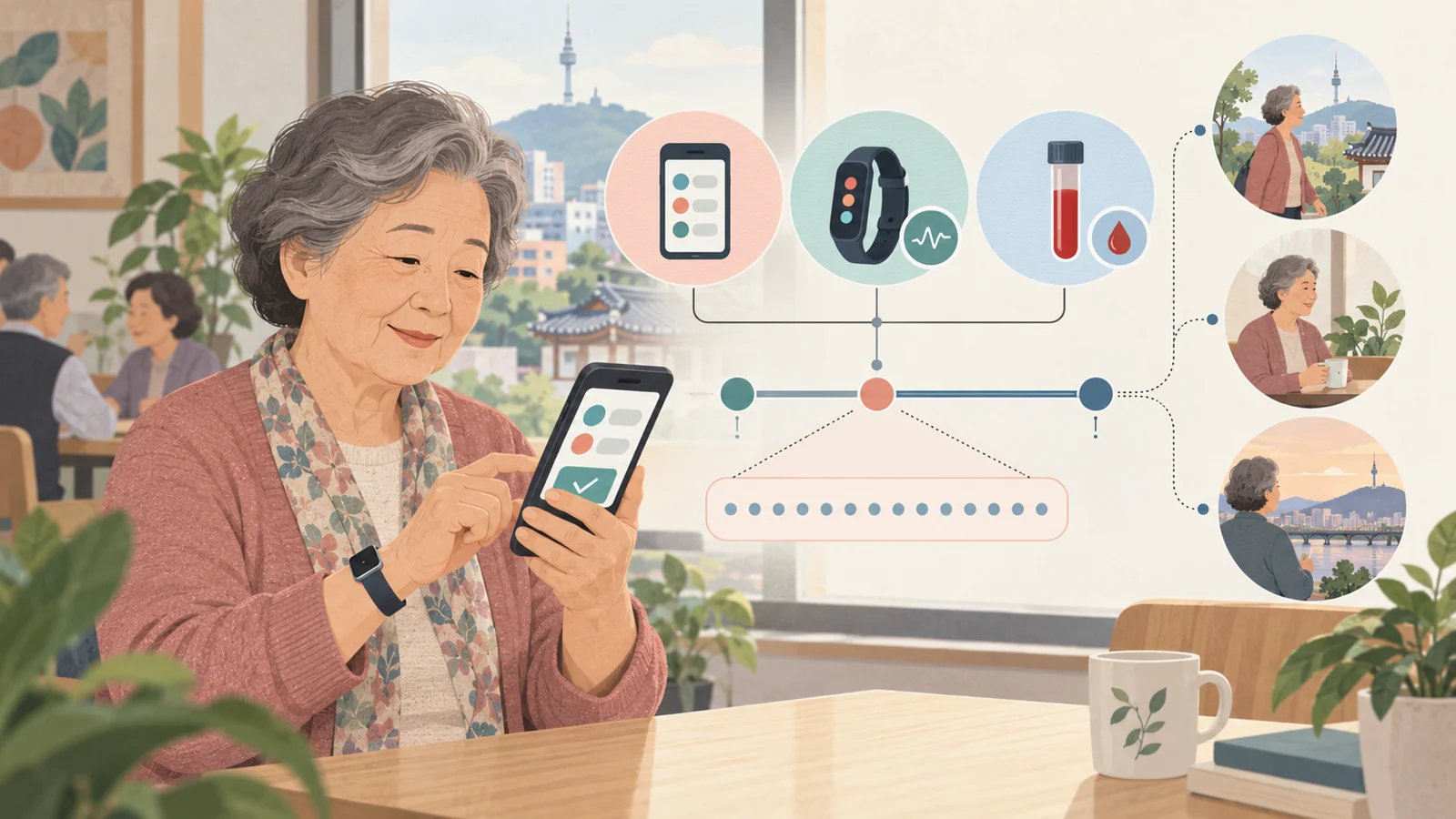
This cohort is designed to place those observations alongside one another. Participants will complete baseline assessments, then report repeatedly during a two-week intensive period. Follow-up assessments are planned at six months and one year. The investigators want to examine whether real-time psychological stress is related to short-term cognitive performance and whether patterns observed during the daily measurement period are also related to later cognitive function.
The design does not turn a stressful day into a forecast of dementia. It creates a way to ask a more specific question: do within-person changes in emotion, social interaction and thinking tend to appear together, and are they associated with differences seen at later assessments? That is a relationship the cohort is built to investigate, not a result it has already established.
The study follows people at two timescales
The participant experience combines ordinary questionnaires, brief repeated reports and clinical measurements. At baseline, participants will provide information about depression, cognitive function and personal characteristics. During the two-week period, a smartphone app will prompt brief surveys one to six times a day about emotions, cognitive performance and social interactions. The protocol also describes cognitive tasks based on the Einstein Aging Study approach.
Frequent prompts are intended to reduce the need to remember how a person felt several days earlier. They can also show whether the same person’s responses vary across the day. Voice-assisted surveys and smartphone training are described as ways to make this demanding schedule more workable, particularly for participants who may not already be comfortable with intensive phone-based research.
A Galaxy Watch will be used to collect measures related to sleep quality, heart rate or heart-rate variability and physical activity. These readings occupy a different layer from the participant’s own report. A person may describe feeling tense, socially isolated or mentally slowed, while the wearable records a pattern of sleep or activity that can be considered alongside that experience. None of these measurements, individually or together, is described here as a validated diagnostic or prediction tool.
The six-month and one-year visits serve a different purpose from the two-week burst. They provide later reference points for cognitive assessment and other measurements, allowing the investigators to examine whether short-term experiences are related to change over time. The protocol therefore links dense observation over days with more widely spaced assessments across a year.
What blood markers can add to the question
The researchers also plan blood sampling to study inflammatory markers, including CRP, IL-6, IL-10 and TNF-α. The samples are described as being processed and stored through a collaboration involving Korea University Anam Hospital, with analysis planned using the Einstein Aging Study protocol. Additional cortisol testing and ApoE genetic variation analyses are also described.
The purpose is not simply to add more data. The investigators want to examine whether inflammatory processes could help account for an observed relationship between emotional stress and cognitive function. In statistical terms, the proposed pathway is a possible mediating relationship: stress might be associated with inflammatory measurements, which might in turn be associated with cognitive outcomes.
That explanation remains conditional. The planned blood tests measure circulating biological markers; they are not direct measurements of inflammation inside the brain. Even if stress, biomarkers and cognition were found to vary together, an observational cohort would still need careful analysis to distinguish a possible pathway from other explanations. The study design can test whether the measurements fit the proposed relationships, but it cannot by itself show that stress causes dementia, that inflammation is the cause of a cognitive change, or that reducing stress would prevent decline.
Designed around older adults at higher social risk
Recruitment is described through the Seongbuk Senior Welfare Center in Seoul, with an emphasis on socially vulnerable older adults receiving social welfare support because of economic poverty and social isolation. This focus matters because social circumstances can affect both the experience of stress and the practical ability to participate in research that requires repeated phone responses, wearable use, blood sampling and return visits.
The protocol describes smartphone classes and training for the ecological momentary assessment schedule. That support may help participants learn the app and voice-assisted features before the intensive period begins. It also makes clear that the cohort is not intended to represent every older adult in Korea automatically. The recruitment setting and eligibility requirements shape whose experiences enter the study.
The registry material uses two different age descriptions. Its overview refers to community-dwelling adults aged 60 and older, while the detailed selection criteria list inclusion at age 65 or above. The supplied record does not resolve that discrepancy, so it is more accurate to acknowledge both descriptions than to present one threshold as definitive. The detailed criteria also exclude people diagnosed with dementia and people with sensory, cognitive or physical impairments that would prevent participation in the surveys and assessments.
These boundaries affect interpretation. Findings from a socially vulnerable group recruited through one Seoul welfare center could be especially useful for understanding those participants’ experiences, while still not establishing how the same relationships would appear across all Korean communities or among people unable to complete the protocol.
A Korean cohort built for comparison
The international collaboration is intended to make the Korean cohort comparable with the U.S. Einstein Aging Study. Comparable protocols can make it easier to examine whether social support, isolation and cultural context are associated with cognitive function and inflammatory measurements in similar ways across settings.
Comparability is a research capability, not proof that two populations are equivalent. The Korean investigators are seeking a shared structure for measurements and follow-up while studying older adults whose social and cultural environments differ from those in the U.S. cohort. That combination could help researchers ask which patterns appear across settings and which may depend on local circumstances.
The cross-national element also gives the social questions a more concrete role. Social support and isolation are not presented merely as background characteristics. The study plans to consider how annual levels of connection relate to cognition and biomarkers, and whether social or cultural factors modify those relationships. The results would still require attention to recruitment, eligibility, measurement differences and the limits of observational comparison.
What this could mean for community dementia prevention
A useful outcome from this kind of cohort would be a clearer account of how daily emotional strain and social circumstances relate to cognitive aging among vulnerable older adults in Korea. If reproducible, actionable relationships emerge—and if later work shows that services designed around those relationships improve outcomes—the findings could help communities shape dementia-prevention programs around people’s lived conditions, not only around clinical measurements.
That could mean better-informed support through senior welfare centers, more culturally tailored cognitive-rehabilitation or prevention programs, and services that recognize the links among isolation, emotional stress and health. The cohort itself would not deliver those benefits or prove that any particular intervention works. It could provide a foundation for deciding which community needs deserve closer attention and which approaches should eventually be tested.
Key Sources
- Primary source: Global Collaborative Research on Establishing a Korean Cognitive Aging Cohort
Government or Regulator · Clinical Trial · 2026-03-20
Keep exploring