
Research Signal – Source date 2026-02-12
Sarcopenia is the age-related loss of muscle strength, muscle quantity, and physical function. It can make walking, climbing stairs, recovering from a stumble, or carrying groceries harder, increasing the risk of falls, frailty, and loss of independence. A review published on February 12, 2026, brings together current thinking about why muscle ages in several different ways—and why a treatment that adds muscle tissue may still fall short of restoring useful movement.
The review reflects an important change in how sarcopenia is understood. Earlier definitions often centered on how much muscle a person had. Current diagnostic frameworks increasingly give greater weight to strength and physical performance, while still using measurements of muscle quantity to help confirm or characterize the condition. These are related measurements, but they are not interchangeable. A person may have more lean tissue without gaining the strength, coordination, or endurance needed for daily activity.
The practical question is therefore broader than how to build muscle. It is how to restore a muscle system that can receive instructions, produce energy, and transmit force effectively.
Muscle needs more than mass to produce useful movement
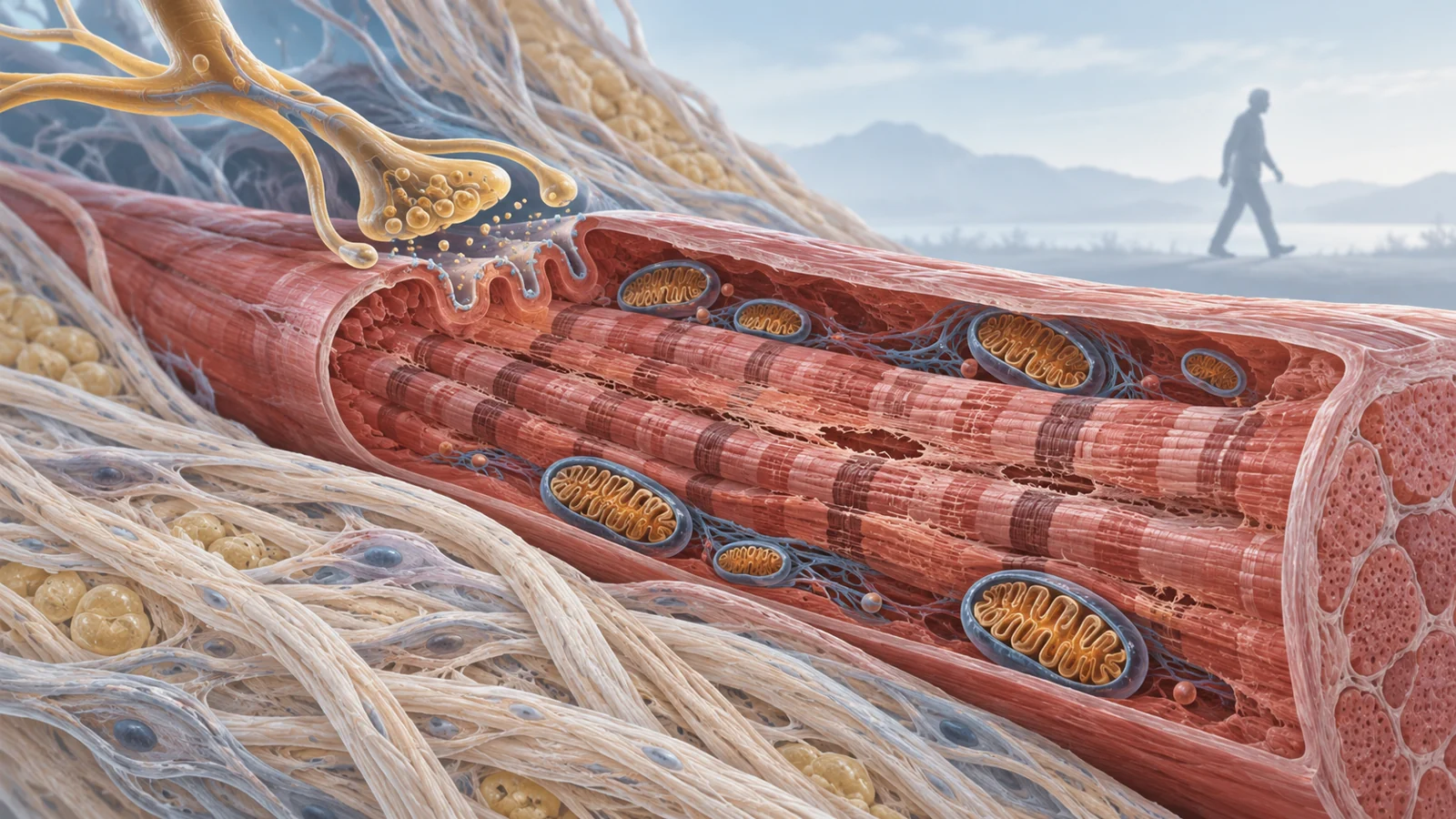
Every deliberate contraction depends on several connected parts working together. Nerves must activate muscle fibers through neuromuscular junctions, the specialized contact points where nerve signals reach muscle. The fibers need mitochondria that can convert fuel into usable energy. The surrounding tissue must also transmit the force generated by those fibers rather than dissipating it through structural changes.
Aging can disrupt each requirement through a different route. At the neuromuscular junction, nerve terminals may partially withdraw, acetylcholine receptors can become fragmented or less dense, and supporting Schwann cells can behave abnormally. The result is not simply fewer nerve cells. Even before a fiber is completely denervated, communication can become less reliable, reducing contractile efficiency and slowing the start of a contraction. The review connects this deterioration with reduced power and delayed activation. Physical activity, including resistance and motor-learning exercise, is described as a way to help preserve the junction by stimulating synaptic and neurotrophic signaling.
Energy production is another vulnerability. Aging muscle may contain fewer or less effective mitochondria, with reduced oxidative phosphorylation and more reactive oxygen species. Damaged mitochondria can persist when mitophagy—the process that removes them—becomes less effective. Lower respiratory capacity is associated in the reviewed evidence with fatigue, slower walking, and reduced strength. NAD+, a cofactor involved in metabolism and DNA repair, also declines in aging skeletal muscle. Restoring NAD+ levels is an active research direction, but the review describes early therapeutic findings as modest rather than as a settled solution.
The tissue around muscle fibers matters too. In older muscle, fibro-adipogenic progenitors can remain activated and contribute to excessive collagen deposition, fat infiltration, and fibrosis. A stiffer extracellular matrix can limit force transmission and restrict the movement and repair activity of muscle stem cells. Experimental anti-fibrotic approaches have shown promise in animals, but the review does not describe consistent functional benefits in human trials.
These mechanisms help explain why a larger muscle measurement is not the same thing as a better-functioning muscle. Size is one part of the system. Activation, energy supply, tissue architecture, and coordination determine whether that system can support movement.
The same molecule can mean different things in different settings
Muscle also communicates with the rest of the body. It releases myokines—signaling proteins and other factors that can act locally or travel to other organs. The review uses interleukin-6, or IL-6, to show why the meaning of a biological signal depends on its source, timing, and surrounding conditions.
During exercise, contracting muscle can release IL-6 temporarily. In that setting, the signal helps mobilize energy and is associated with adaptive, anti-inflammatory effects. Persistently high IL-6 at rest has a different significance. It may come from aging tissues, immune cells, or adipose tissue and can contribute to catabolic processes that promote muscle loss. The review describes a possible imbalance in sarcopenia: resting IL-6 may be elevated while the short-lived exercise response is blunted, suggesting both chronic inflammatory pressure and reduced muscle adaptability.
This context-dependent behavior is more useful than treating IL-6 as simply good or bad. A measurement taken at one moment may not reveal whether a signal reflects a beneficial response to activity or a sustained background state associated with tissue stress. It also shows why a therapy aimed at one pathway may have different effects in different people, depending on which biological processes are driving their decline.
Treatment research is testing several routes to recovery
Resistance training and adequate nutrition remain the foundation described by the review. They address strength, function, and the raw materials needed for tissue maintenance, although adherence and individual response vary. At the time of publication, no drug had formal regulatory approval specifically for sarcopenia.
Drug development has nevertheless explored several mechanisms. Myostatin and activin pathway inhibitors, including bimagrumab, can increase lean mass. The review notes that gains in lean tissue have not reliably translated into comparable improvements in functional endpoints. This is a central therapeutic lesson: an intervention can change a body-composition measure without repairing the nerve connection, mitochondrial capacity, or force-transmitting tissue needed for movement.
Other approaches aim at different parts of the problem. Selective androgen receptor modulators have shown anabolic effects in studies discussed by the review, while growth-hormone and ghrelin-related therapies have produced mixed results and raised metabolic or cardiovascular concerns. NAD+ precursors have been investigated because of the age-related decline in mitochondrial cofactors. Compounds such as creatine and β-hydroxy-β-methylbutyrate are discussed as nutritional strategies that may be useful particularly alongside resistance exercise. These approaches belong to different evidence contexts and should not be treated as interchangeable treatments.
Senescence-targeting research asks a different question. Aging muscle accumulates cells that have stopped dividing but continue releasing inflammatory, fibrotic, and tissue-degrading factors, a collection known as the senescence-associated secretory phenotype. In mouse models of accelerated aging, clearing senescent cells improved muscle function and regenerative capacity. Those findings support the idea that senescent cells can contribute causally to muscle decline in those models. They do not establish that senolytic treatment benefits older adults with sarcopenia, nor do they establish its safety for them.
The contrast between these strategies is informative. Increasing lean mass targets one visible feature of muscle, while senescence-targeting experiments attempt to alter a damaging cellular environment. Neither comparison supplies a simple ranking, and neither removes the need to measure whether people can actually move better, remain independent, and tolerate treatment over time.
Molecular profiles may reveal different kinds of sarcopenia
The review describes a growing effort to look beyond one measurement or one molecule. Transcriptomic, proteomic, metabolomic, and clinical data can be combined to examine how genes, proteins, metabolites, and physical function change together. Muscle proteomics has identified patterns involving mitochondrial enzymes, contractile proteins, extracellular-matrix components, and stress responses. Blood-based studies have also produced candidate markers, including proteins associated with weakness and frailty.
The attraction is clear. Sarcopenia may not have one biological cause. For some people, neuromuscular decline may be prominent; for others, metabolic dysfunction, inflammation, fibrosis, or combinations of these processes may matter more. Multi-omics analysis could eventually help distinguish such patterns and identify molecular subgroups with different risks or treatment responses.
But preliminary subgroup identification is not the same as validated treatment selection. A marker can correlate with weakness without causing it. A cluster of patients can look biologically distinct without showing that a specific therapy works better for that cluster. The review presents precision medicine as a direction for research, not as a clinical system already ready to choose treatment from an individual’s molecular profile.
Comparisons are also complicated by how sarcopenia is measured. Studies may use different definitions of weakness, muscle quantity, and physical performance. Imaging methods and the body region analyzed can change the resulting estimate, while biomarker studies may use different populations and reference standards. The review emphasizes that most candidate circulating markers still require stronger validation before they could serve as reliable clinical surrogates.
For future trials, this means that a larger muscle measurement should not be allowed to stand in automatically for better mobility. Functional outcomes, patient differences, and the durability and safety of any benefit will need to remain visible alongside molecular and imaging data.
What targeted care could mean for everyday mobility
The long-term promise of this research is care that treats muscle decline as a set of interacting problems rather than a single shortage of tissue. An older adult might receive exercise and nutrition support while clinicians use validated measures to determine whether neuromuscular communication, energy production, inflammation, fibrosis, or another driver deserves particular attention. Targeted therapies could then be judged by whether they help people walk, rise from a chair, recover from exertion, and preserve independence—not only by whether they increase lean mass.
That capability remains conditional. Molecular profiles must become clinically useful, and treatments matched to relevant biological drivers must demonstrate durable functional benefit with acceptable safety. If those requirements are met, the payoff would be practical rather than cosmetic: a more precise way to help older adults preserve mobility and resilience as muscle ages.
Key Sources
- Primary source: Sarcopenia and Muscle Aging: Updated Insights into Molecular Mechanisms and Translational Therapeutics.
DOI or Journal Page · Review or Meta-Analysis · 2026-02-12
Keep exploring