
Research Signal – Source date 2025-12-17
Late-day agitation, wandering, and confusion can be especially difficult for people with dementia and the people caring for them. This pattern, often called sundowning, can appear alongside disrupted sleep. A registered study in southern Taiwan is testing whether the timing and composition of essential-oil scents might affect both symptoms.
The study is not yet a report of a successful treatment. It is a small interventional study with an estimated enrollment of 35 people living in long-term care facilities. Its registry entry was published on 17 December 2025. The current record lists an actual start date of 15 September 2025 and an active, not recruiting status. Its primary completion date of 2 January 2026 and completion date of 12 January 2026 are both identified as estimates.
Why the timing of symptoms matters
The study focuses on residents with diagnosed dementia who have observable sundowning or sleep disturbance. The practical question is unusually specific: could one scent routine support daytime alertness and evening relaxation, while another calming blend is used throughout the day?
Here, aromatherapy means diffusing essential-oil scents into the dementia care unit. Trained staff administer the sessions under standardized conditions, while usual medical and nursing care continues. The study therefore tests an addition to ongoing care, not a replacement for it.
Two scent schedules, one fixed order
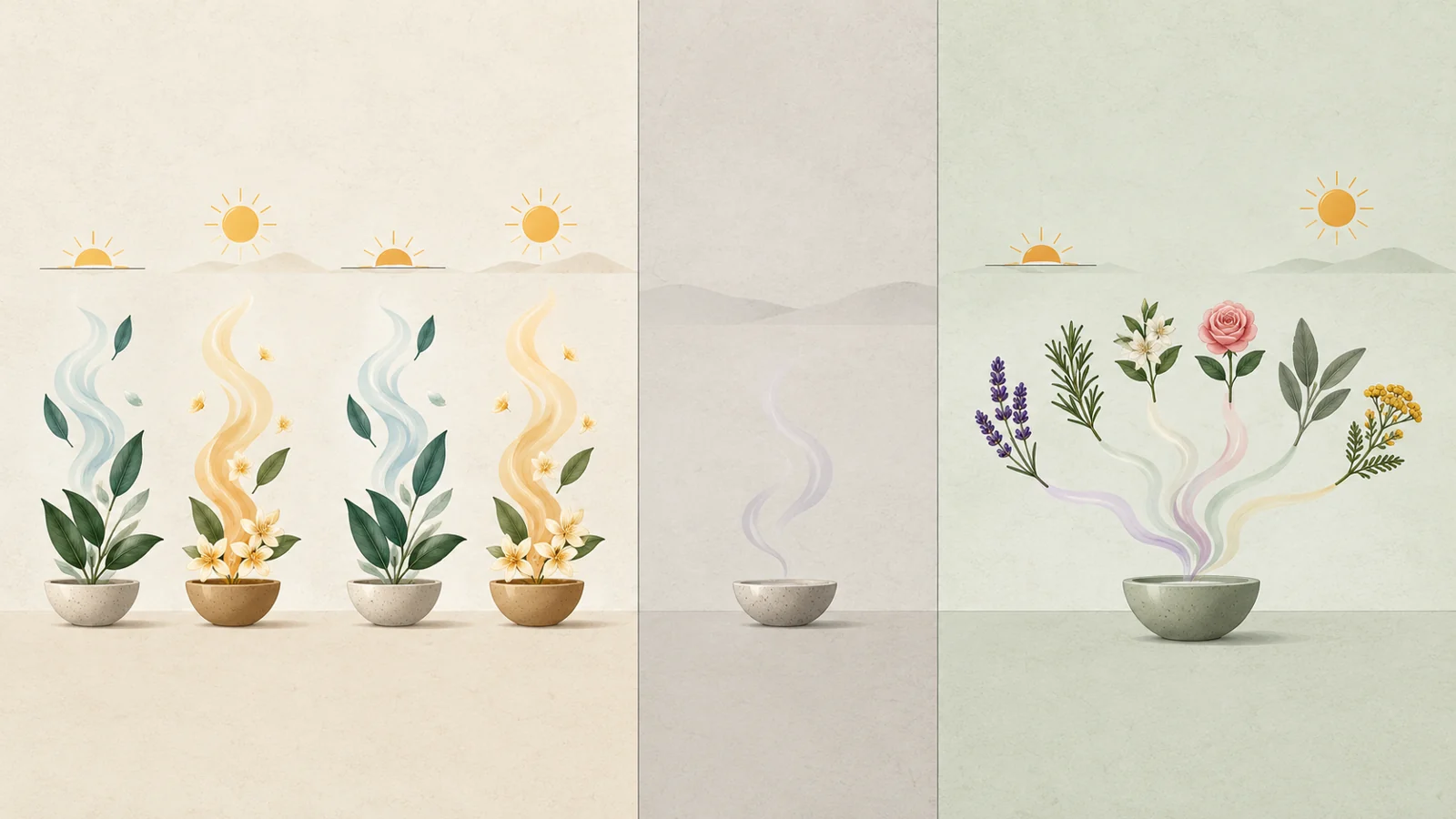
Formula A changes across the day. At about 09:00, staff diffuse a 2:1 blend of rosemary and lemon oils, described as intended to promote alertness and daytime activity. At about 14:00, they switch to a 2:1 blend of lavender and sweet orange, intended to reduce agitation and support relaxation later in the day.
Formula B uses the same blend at both sessions. It combines sweet orange, spike lavender, true lavender, vetiver, bergamot, and Roman chamomile. The registry describes this mixture as a calming formula intended to provide broader relaxing and stabilizing effects across the day. The oils are listed as organic, but that description is not evidence that the intervention is safe or effective for every resident.
The registered sequence lasts six weeks in total. Participants receive Formula A for two weeks, followed by a two-week washout, then Formula B for two weeks. Diffusion is scheduled twice daily, five days per week, during each treatment phase.
The registry narrative calls the design a repeated crossover because each participant is compared with their own earlier measurements. The listed study arm, however, is a single A-then-B sequence. Formula and study period therefore move together: Formula A always comes first, and Formula B always comes later. A difference between the phases could reflect the formulas, changes over time, or effects that linger after the first phase. The washout is intended to separate the periods, but the record does not establish that it removes every lingering effect.
That matters because a comparison between two aromatherapy regimens is not the same as a comparison between aromatherapy and care without aromatherapy. Even if the two phases produce different scores, the result would need to be interpreted as a difference between these two scheduled regimens, not direct proof that essential oils improve dementia symptoms overall.
What the researchers will measure
The primary outcome is agitation and sundowning behavior, measured with the Chinese Cohen-Mansfield Agitation Inventory. The inventory uses 29 items rated on a frequency scale from 1, meaning never, to 7, meaning several times an hour. A higher total indicates more severe or frequent agitation. Assessments are planned at baseline and at the end of each two-week intervention phase.
Sleep quality is the secondary outcome. The Chinese Pittsburgh Sleep Quality Index produces a global score from 0 to 21 from seven sleep-related components. Higher scores indicate poorer sleep. In this study, the score is also collected at baseline and after each treatment phase.
These measures can show whether rated agitation or questionnaire-based sleep quality changes during the study. They do not by themselves measure altered dementia progression, sleep physiology, medication use, or caregiver burden. The registry says the results will be analyzed with a linear mixed model that examines within-person changes while considering period and sequence effects. That planned analysis does not remove the interpretive challenge created by the fixed order of the listed arm.
The supplied registry snapshot contains no posted outcome findings. It therefore supports an account of the study’s design and intended measurements, not an estimate of which blend works better, how large any effect might be, or how often adverse events occur. Tolerability remains an open question in this record; the presence of organic ingredients and the investigators’ expected benefits cannot establish it.
What this could mean for everyday dementia care
A useful result would make it possible to consider a staff-delivered scent routine as a practical addition to dementia care, especially during the hours when agitation and confusion become harder to manage. Residents might experience less distress in the evening and easier sleep, while families and professional caregivers could face fewer demands around those symptoms.
That possibility depends on several conditions: symptom improvement would need to be reproducible, tolerability would need to be acceptable, and the schedule would need to work in real care facilities. Extending the approach to homes or community services would be a further step requiring evidence beyond this long-term-care setting.
Key Sources
- Primary source: Aromatherapy Formulas for Sundowning and Sleep Quality in Patients With Dementia.
Government or Regulator · Clinical Trial · 2025-12-17
Keep exploring