
Research Signal – Source date 2025-12-16
Senescent cells are cells that have stopped dividing, often after damage, stress or other biological insults. They do not simply become inert. Many continue releasing a mixture of inflammatory signals, growth factors and enzymes known as the senescence-associated secretory phenotype, or SASP. As senescent cells accumulate, those signals can alter neighboring cells, damage tissue structure and sustain chronic inflammation.
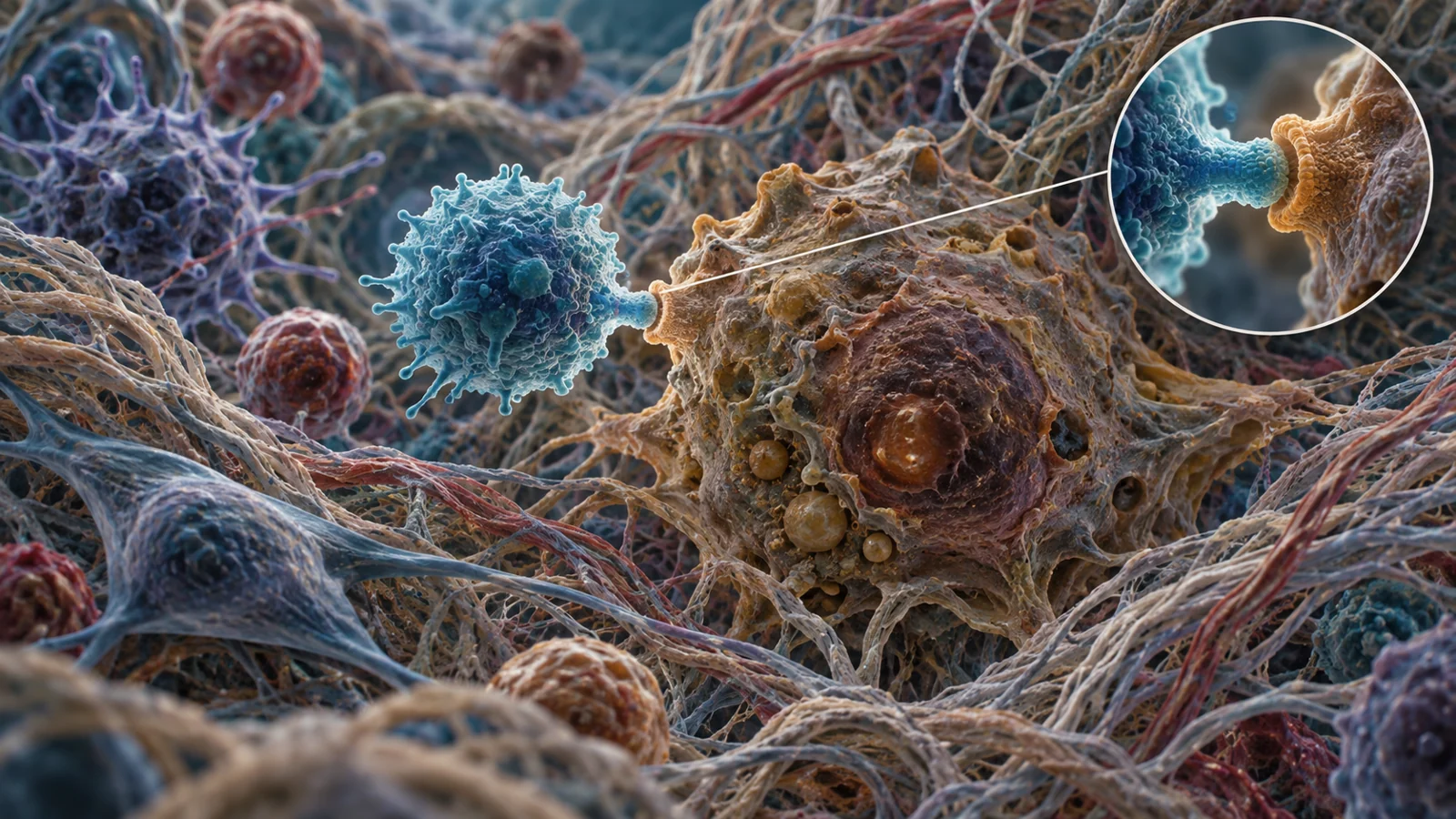
A review published on December 16, 2025, examines whether engineered immune cells could help remove some of these cells. CAR T cells are T cells fitted with synthetic receptors that recognize chosen surface targets. The approach was developed for cancer treatment, but researchers are now testing whether it can be redirected toward senescent cells in preclinical models of fibrosis, metabolic disease and aging.
The idea is striking because it turns a feature of aging into a possible recognition problem. The harder question is what happens after recognition. Senescent cells differ from one tissue to another, some may still support repair, and the T cells doing the clearing can lose effectiveness as they repeatedly encounter targets or move through damaged tissue. The review therefore points to two linked requirements: a target that identifies the right cells and a living treatment that can remain active in the right place.
When stopped cells keep changing the tissue
The consequences of senescence begin with the signals released by the arrested cell. The SASP includes cytokines and chemokines such as IL-6, IL-8, CCL2 and CCL5, along with matrix-remodeling enzymes and reactive oxygen and nitrogen species. These factors can influence inflammation, extracellular structure and nearby cells. Some of the released reactive molecules can also contribute to further DNA damage, helping senescence spread through a local tissue environment.
CAR T therapy offers a different way to intervene. Instead of relying on a drug that affects a pathway shared by many cells, researchers place a synthetic receptor on T cells so they can bind a selected surface feature. If the target is present on a senescent cell, the engineered T cell can become activated and kill it. That design makes the identity of the target central to both the promise and the risk.
The evidence summarized in the review remains preclinical. It combines cell-culture experiments, mouse models of disease and natural aging, observations in human tissues, and work in aged nonhuman primates. These settings can show that a strategy is biologically feasible, but they test different questions. A human tissue sample can reveal where a marker appears; it cannot show that treating a person with a CAR T product will improve an organ.
Two recognition strategies answer different questions
One approach focuses on the urokinase plasminogen activator receptor, or uPAR. In the studies discussed, researchers found uPAR on senescent cells in several experimental settings, including therapy-induced senescence in mouse lung adenocarcinoma, oncogene-induced senescence in mouse hepatocytes and culture-induced senescence in hepatic stellate cells. Anti-uPAR CAR T cells were then tested in vitro and in mice.
In mouse models of liver fibrosis induced by CCL4 or diet, the cells depleted senescent hepatic stellate cells. Other experiments used naturally aged mice and mice fed a high-fat diet. A single anti-uPAR CAR T infusion was associated with fewer SA-β-gal-positive cells, lower inflammatory cytokines and improvements in measures such as glucose tolerance and exercise capacity. Those outcomes belong to their respective mouse models; they are not a pooled treatment effect or evidence of benefit in people.
A second strategy uses NKG2D-based CAR T cells. Rather than binding uPAR, these cells are designed to recognize ligands for the natural killer group 2 member D receptor, which the reviewed work found on several types of senescent cells. The experiments included senescence induced by DNA damage, oncogenic or replicative stress, and increased P16INK4a activity in cell cultures. The approach also removed senescent cells in irradiated and aged mice and in aged nonhuman primates.
The NKG2D studies answer a broader question about whether a different senescence-associated surface pattern can be recognized across models. They do not establish that NKG2D is more effective or safer than uPAR. The two strategies were studied in different experimental systems, with different targets and outcomes. Keeping those contexts separate is essential when interpreting a field that is still testing what can be recognized, where the engineered cells can go and what changes follow clearance.
The hardest target is a harmful state
Senescence is not a single, uniform identity. Cells can enter the state through different routes, and their surface proteins can vary by tissue, trigger and stage. The review highlights transcriptomic and proteomic work that identified 38 surface proteins expressed on senescent cells across 13 tissues as possible targets. A list of candidates is useful for discovery, but it also shows why a universal marker is difficult to establish.
A marker can also appear on cells that are not the intended target. In liver disease associated with metabolic dysfunction, uPAR is found not only on activated senescent hepatic stellate cells but also on activated hepatic stellate cells in other states, immunosuppressive TREM2-positive macrophages and polymorphonuclear myeloid-derived suppressor cells. The review discusses CD206, encoded by MRC1, as a more restricted candidate in senescent stellate cells in human and mouse liver models. That proposal identifies a direction for target development; it is not evidence that a successful CAR T treatment using CD206 already exists.
The biological role of senescence adds another constraint. Removing a senescent cell is not automatically beneficial. In a cited experiment, pharmacological or genetic elimination of senescent hepatic stellate cells impaired liver regeneration after part of the liver was removed in young mice. The result was not a senescence-directed CAR T adverse event. It illustrates a more basic boundary: some senescent cells can release signals that help coordinate repair, including signals involved in liver regeneration. A treatment that removes every cell carrying a broad marker could therefore interfere with a useful process while trying to reduce chronic damage.
The practical goal is more selective than “clear senescent cells.” It is to distinguish harmful accumulation in a particular tissue from a temporary or repair-associated state, then match that distinction to a receptor that does not unnecessarily engage other cell populations.
The treatment has to stay capable
Target selection is only half of the problem. CAR T cells are living treatments, so their performance depends on the condition of the cells before engineering and on what happens after infusion. Repeated antigen stimulation can push T cells toward exhaustion, accelerated differentiation and senescent traits. The surrounding tissue can add nutrient competition, suppressive cytokines, stromal barriers and chronic inflammatory signals.
Exhaustion and senescence are related but not identical. Exhaustion is a regulatory state shaped by prolonged antigen exposure, with inhibitory receptors and transcriptional programs that limit activity. Replicative senescence is associated with cumulative cellular stress and irreversible growth arrest. Both can reduce proliferation and effector function, but they arise through different processes and should not be treated as interchangeable labels.
Aging makes the starting material more complicated. The T-cell repertoire becomes less diverse, and age-associated changes can reduce plasticity and proliferative potential. A product made from older T cells may therefore begin with less capacity to expand or persist. The review emphasizes that characterizing the differentiation state and baseline fitness of T cells before genetic engineering is an important part of improving therapy across different diseases.
This creates a feedback problem. The treatment is intended to remove cells whose accumulation contributes to an unhealthy environment, yet the environment may be hostile to the T cells that must perform the removal. A receptor can be biologically well chosen and still fail to produce a useful treatment if the engineered cells cannot maintain their function long enough to reach and engage their targets.
Reaching the right tissue is part of the therapy
The target cell also has to be physically accessible. In the mouse experiments reviewed, uPAR-directed CAR T cells accumulated around senescent hepatocytes within days and showed an effector-memory profile with low exhaustion markers. That finding supports tissue entry in those models. It does not guarantee comparable distribution in older or fibrotic human organs.
Aged and fibrotic tissues can become mechanically difficult to traverse. Cross-linked collagen, glycosaminoglycans and advanced glycation end-products increase matrix stiffness and reduce interstitial porosity. These changes can create physical barriers for T cells moving through tissue. Chemical signals matter too. Factors such as TGF-β and CXCL12 may discourage effector-cell entry or suppress cytotoxic function after the cells arrive.
This is why a successful binding experiment is not enough. The engineered cells need to travel through the relevant tissue, find a meaningful fraction of the target population and remain functional during the encounter. Poor access could leave harmful senescent cells untouched even when the receptor recognizes them accurately. Conversely, forcing activity in a tissue with a broad or poorly distributed target could increase the chance of engaging cells that should be preserved.
Safety has a different evidentiary threshold
The reviewed animal studies provide encouraging safety observations in their own settings. The NKG2D-based work reported no adverse effects in aged nonhuman primates, and the summarized uPAR experiments reported no CAR T-associated cytokine release syndrome or severe toxicity in the mouse models. These findings support continued study, but they do not establish long-term safety in humans.
Cancer CAR T treatment supplies an important reason for caution. Strong immune activation can produce cytokine release syndrome, in which CAR T cells and other immune cells amplify inflammatory signals. The review notes that this systemic toxicity occurs in a substantial fraction of patients receiving conventional cancer CAR T therapy, but that cancer-treatment experience is not a transferable risk estimate for senescence-directed treatment. The target cells, tissues, product design and patient populations would differ.
Mouse models also cannot reproduce every human-specific safety problem. Some tissue antigens are not conserved between mice and people, and an intervention that appears selective in a mouse may encounter a different distribution of related markers in human organs. Human tissue observations can improve target selection, but they remain distinct from a clinical treatment result. Moving toward people would require evidence that the intended cells can be reached and cleared without unacceptable effects on repair, healthy cells or immune regulation.
What targeted cell clearance could mean for damaged organs
For people with diseases involving harmful senescent-cell accumulation, selective immune-cell treatment could eventually offer a way to reduce fibrosis-related damage and help preserve organ function. The animal findings make that possibility concrete: uPAR-directed cells were linked to senescent-cell clearance and improved metabolic or exercise measures in particular mouse models, while NKG2D-based cells removed senescent cells across cultured systems, mice and aged nonhuman primates.
A meaningful clinical benefit would depend on preserving useful repair-associated senescence, giving the engineered cells enough fitness and tissue access to act where they are needed, and demonstrating safety in human organs. It would also require manufacturing that can produce these living treatments at a practical scale. If those conditions are met, targeted clearance could become less about trying to reverse aging in the abstract and more about protecting the function of organs under sustained biological stress.
Key Sources
- Primary source: Above and beyond senescence and CAR T cell: advances and future perspectives.
DOI or Journal Page · Review or Meta-Analysis · 2025-12-16
Keep exploring