
Research Signal – Source date 2025-11-24
Aging research is increasingly asking whether some parts of aging can be influenced rather than simply accepted as inevitable decline. But “influenced” can mean several different things. It may refer to a change in a laboratory estimate based on biological markers, a change in the function of a tissue, or more years lived without disease or disability.
Those outcomes are related, but they are not interchangeable. A person’s chronological age is the number of years they have lived. Biological age is an estimate based on markers such as genetic, biochemical, or epigenetic changes. Healthspan describes the years spent living without major disease or disability. A lower biological-age estimate could be interesting without showing that someone will remain independent for longer.
A review published on November 24, 2025, titled “Aging reimagined: Bridging clinical modulation and scientific breakthroughs,” brings together research on these different possibilities. The authors describe their work as a narrative literature review based on PubMed and Medline searches through May 7, 2025, along with searches of reference lists. It combines mechanistic research, animal studies, human investigations, and lifestyle literature. It is not a new clinical experiment testing whether aging has been reversed.
Two ways researchers are trying to influence aging biology
Some of the review’s most concrete examples operate at very different biological levels.
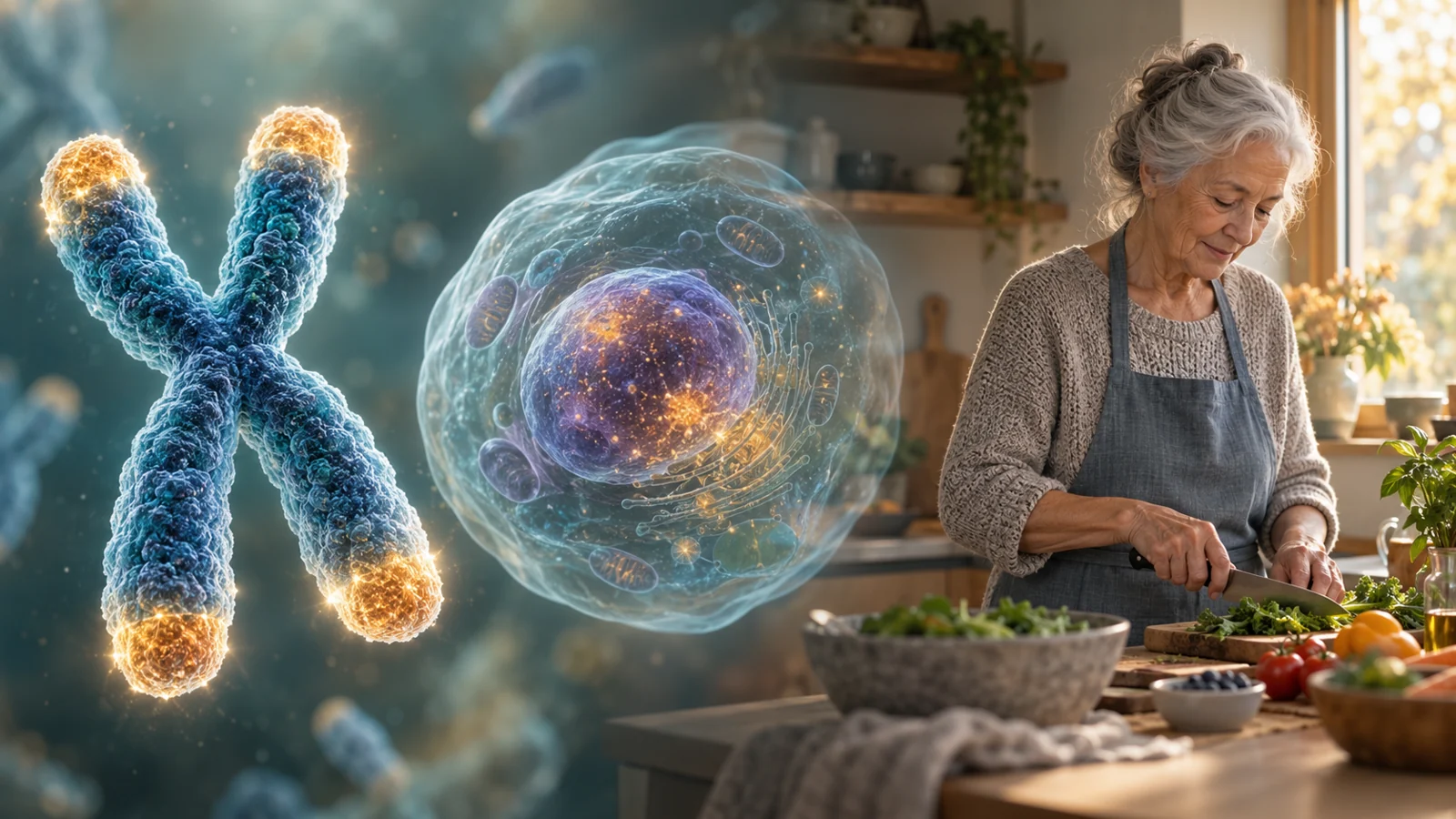
Telomeres are protective structures at the ends of chromosomes. Each time a cell divides, telomere repeats can become shorter, eventually limiting the cell’s ability to continue dividing. Telomerase is an enzyme that helps rebuild these protective ends. The review describes telomere biology as one route through which researchers have learned about cellular aging, and it discusses compounds intended to reactivate telomerase as a possible way to affect several aging-related processes.
That possibility has a serious complication. Telomerase activity is also connected to cancer biology, and the review notes that artificial activation could carry cancer-related risks. A mechanism that helps maintain chromosome ends is therefore not automatically a safe route to longer-lasting tissues.
Cellular reprogramming asks a different question. Research summarized by the review showed that mature, specialized cells can be converted into pluripotent stem cells, erasing aspects of their developmental identity and epigenetic age. In simpler terms, the cell’s operating program can be reset so that it resembles a much earlier state.
The review separates that full reprogramming work from partial reprogramming. Its table places partial cellular reprogramming in the preclinical animal-model category, with possible restoration of youthful gene expression but a risk of tumor formation. The distinction matters because evidence that a cell can be reset under laboratory or animal conditions does not establish that human tissues can be safely rejuvenated.
The review also discusses pathways involving autophagy, rapamycin, adenosine monophosphate-activated protein kinase, and forkhead box O transcription factors. These examples show how broad the field has become. Researchers are not pursuing one universal “aging switch”; they are studying several interacting processes involved in cellular maintenance, metabolism, inflammation, and tissue decline.
What the human evidence actually measured
The review’s prominent human example is the 2019 thymus regeneration, immunorestoration, and insulin mitigation study, known as TRIIM. The earlier study combined growth hormone, metformin, and dehydroepiandrosterone. As summarized in the review, it reported thymus-related changes and a reduction in biological age as estimated by epigenetic clocks.
Those findings are relevant to the question of whether some aging-related changes might be modifiable in people. They are not the same as evidence of longer life, fewer years with disability, or durable protection from chronic disease. An epigenetic-clock estimate is a measurement of biological markers. It is not a direct count of healthy years gained.
The study involved nine participants and had no control group. That makes it difficult to know how much of the reported change came from the intervention, how much might reflect other factors, and whether the findings would generalize to a broader population. Because several substances were used together, the design also cannot show which component caused which effect.
The review itself acknowledges an additional interpretive problem. It is a narrative synthesis rather than a systematic review, and the authors note that this approach can emphasize encouraging findings or leave some disputes less fully examined. In this case, readers are evaluating both the limitations of the small, uncontrolled study and the limitations of the review’s method of assembling the wider field.
The review describes the TRIIM-X extension as ongoing from its publication perspective. That reference indicates a continuing research effort, not a result that can be used here to settle the question. The central point is narrower: the study offers an early human example of changes in selected aging-related measurements, while leaving the relationship between those measurements and everyday function unresolved.
Inflammation, metabolism, and the conditions around aging
The review connects aging biology with processes that develop across years of ordinary life. Inflammaging means persistent, low-level inflammation that becomes more common with age. The review links it with senescent cells, impaired cellular recycling, mitochondrial dysfunction, and altered immune responses. It also connects this inflammatory state with conditions such as cardiovascular disease, dementia, and frailty.
Metaflammation describes a related process driven more directly by metabolic dysfunction. The review uses the term for inflammation associated with factors such as nutrient excess, processed-food-heavy diets, adipose-tissue dysfunction, and insulin resistance. Unlike inflammation that emerges gradually with age, this metabolic form may begin earlier and contribute to accelerated cellular senescence and epigenetic aging.
Sleep provides a useful example of why these relationships should not be reduced to a simple list of lifestyle tips. The review describes a two-way connection. Sleep quality and duration often change with age, influenced by illness, stress, and medication use. At the same time, poor sleep in older adults is associated with outcomes including cognitive decline, falls, and death.
This kind of relationship complicates interpretation. Sleep disturbance may be part of aging-related decline, a contributor to other problems, or both. The same applies to metabolic dysfunction and inflammation. They are not merely background details surrounding aging research; they are possible routes through which biological processes and lived health affect one another.
The tradeoffs behind promising interventions
The review’s discussion of rapamycin and metformin illustrates why a promising pathway cannot be judged by its intended mechanism alone.
Rapamycin and related mTOR inhibitors are discussed in connection with autophagy, the cell’s process for breaking down and recycling components, as well as reduced cellular senescence. The review also identifies possible costs, including insulin resistance, dyslipidemia, and infections. A treatment that changes cellular maintenance may therefore create metabolic or immune problems that matter greatly in real-world use.
Metformin is presented differently. The review connects it with activation of adenosine monophosphate-activated protein kinase, improved insulin sensitivity, and reduced oxidative stress. It also notes gastrointestinal side effects and, crucially, an unclear longevity effect in healthy humans. A drug can have a well-established metabolic role without having demonstrated that it extends healthy life in people who do not have the condition for which it is commonly used.
These examples are not a ranking of anti-aging products, and they do not support self-treatment. They show why translation from aging biology to clinical care requires more than a favorable molecular story. Long-term safety, interactions among effects, appropriate patient selection, and outcomes that matter to daily life all become important. So does access. If effective interventions remain available mainly to affluent patients, the scientific achievement could widen rather than narrow health disparities.
From biological measurements to public health
The review places these developments within a broader shift from reacting to disease toward preventing or delaying decline. Precision-medicine tools such as polygenic risk scores, multi-cancer early-detection tests, and epigenetic clocks are presented as part of that shift. They may help identify risk or track biological change, but the usefulness of a measurement depends on what decisions it improves and whether those decisions lead to better health.
The same caution applies to lifestyle research. Exercise, nutrition, stress management, and circadian alignment are described as accessible influences on health and longevity. Their importance in the review does not turn them into a guaranteed way to reset biological age, nor does it make them interchangeable with a drug or cellular intervention. Different approaches act on different processes and have different kinds of evidence behind them.
Aging research therefore has at least three translation problems to solve. First, researchers need to clarify which biological changes are being measured. Second, they need to determine whether those changes correspond to tissue function and meaningful clinical outcomes. Third, any intervention that proves useful must be evaluated over long periods and made available beyond people who can pay for specialized care.
The review argues that aging is dynamic and open to intervention, but its own limitations call for a measured reading of that claim. The field contains discoveries that make modification scientifically plausible, early human findings that are intriguing, and many unresolved questions about safety, causation, durability, and fairness.
What targeting aging could mean for independent living
The most important possible benefit would not be a younger number on a biological-age report. It would be older adults retaining physical and cognitive function for longer, spending fewer years dependent on care for chronic disease or disability. That could ease pressure on families and care systems while giving more people the opportunity to remain independent.
This remains a conditional future possibility, not an outcome demonstrated by the review. It would require interventions that produce durable gains in health and function, carry acceptable long-term risks, and reach people beyond affluent patients. The scientific question is whether aging-related biology can be influenced. The public-health question is whether that influence can become safe, meaningful, and broadly shared.
Key Sources
- Primary source: Aging reimagined: Bridging clinical modulation and scientific breakthroughs.
DOI or Journal Page · Review or Meta-Analysis · 2025-11-24
Keep exploring