
Research Signal – Source date 2025-08-05
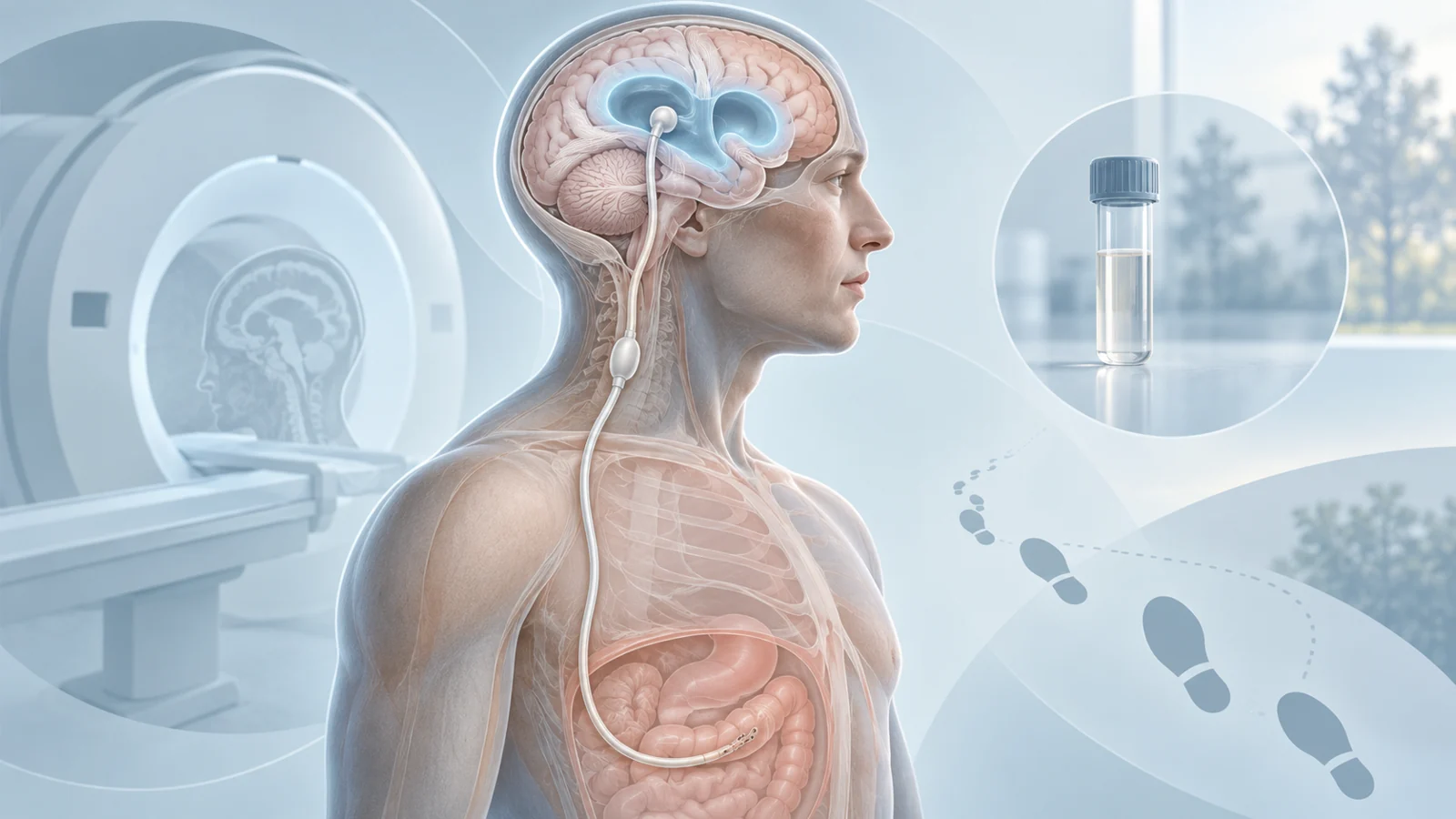
Normal pressure hydrocephalus, or NPH, involves excess cerebrospinal fluid in the brain’s fluid-filled spaces, called ventricles. A shunt can divert that fluid to the abdomen through a tube, and some patients improve substantially after the operation. Others improve less, or not in the same ways. A planned study is asking whether brain scans and biological signs of neurodegeneration could help explain those differences.
The ClinicalTrials.gov record has a publication date of 5 August 2025. The current supplied record lists the study’s actual start as 25 March 2025, describes it as recruiting and indicates that results have not been posted. An exact August 2025 revision was not available for verification, so the current descriptions and recruitment status cannot be attributed to that date. The study is therefore important here for its design and intended measurements, not for evidence that one test already predicts who will benefit.
What the registry is following
The project is a single-centre observational cohort study. Researchers plan to follow people with symptomatic NPH through their clinical assessment and, where clinically indicated, through shunt surgery. Some participants may instead reach a decision against surgery. The study will compare assessments collected around that real-world care pathway with information from people in comparison populations, including adults with chronic hydrocephalus without symptoms and people without hydrocephalus.
The groups are not randomized treatment arms. The decision to operate is part of clinical care, and the registered comparisons include differences between shunt-responsive and non-responsive participants. Following people who decide against surgery does not itself establish a planned comparison of surgery with no surgery. The observational design can reveal associations between imaging, biomarkers and later measurements. It cannot, by itself, establish why a particular person improves or prove that a biological feature causes a poor response.
The registry’s structured field gives an estimated enrollment of 100. Elsewhere, the narrative describes 50 symptomatic participants and separate comparison populations, while a group description gives a different count for the comparison group. The supplied fields do not provide a reconciled enrollment breakdown, so those figures should be treated as descriptions of the planned study structure rather than a settled accounting. The record gives an estimated primary completion in February 2028 and estimated overall completion in February 2029.
Two ways the study will investigate uneven recovery
The first question concerns white matter, the nerve-fibre pathways that connect different parts of the brain. Several of these pathways lie near the ventricles, where fluid changes may be relevant to NPH. The study plans diffusion-weighted MRI before and after shunting, with attention to pathways including the corpus callosum, internal capsule, corona radiata and anterior thalamic radiation.
Diffusion tensor imaging, or DTI, uses the movement of water through tissue to describe the organisation of these pathways. The registry lists measures such as fractional anisotropy, axial diffusivity and radial diffusivity. In everyday terms, the scans are intended to show whether the structure and directionality of water movement in selected white matter tracts change after surgery, and whether those changes differ between participants classified as shunt-responsive and non-responsive.
The second question looks for signs of neurodegeneration that might help account for limited improvement. Planned measurements include blood markers such as amyloid beta, GFAP, neurofilament light and p-tau217, alongside a cerebrospinal-fluid test for synuclein and optional brain or skin tissue sampling. The tissue procedures may occur during shunt surgery, but the record does not imply that every participant will undergo a biopsy.
Researchers plan to combine several of these measures into a composite degenerative index and compare it between response groups. The record describes a planned analysis; it does not establish that the index can diagnose neurodegeneration or predict an individual patient’s response before shunt surgery. A relationship between a biomarker pattern and postoperative performance would still need replication and further clinical validation before it could guide individual decisions.
How improvement will be counted
The registry defines shunt response as a 10% improvement in gait speed. That threshold is a grouping rule for the study’s comparisons. It is separate from the primary imaging outcome, which concerns changes in white matter diffusion measures before and after shunting.
Walking is a practical outcome in NPH, but it is only one part of the patient’s experience. The study also plans to track cognition, urinary symptoms and quality of life, using clinical assessments collected from enrollment through the period after surgery. A participant could meet the walking-speed threshold while still having substantial cognitive, urinary or daily-life difficulties. Conversely, meaningful change in another domain would not automatically alter the study’s gait-based response classification.
This separation matters because an observable difference on a scan and an improvement in walking do not answer exactly the same question. The study is designed to examine how these measurements relate to one another across a cohort. It is not designed, from the registry description alone, to show that a particular diffusion pattern is the reason someone walks better or that surgery reverses nerve damage.
What wearables and digital tests add
The study also asks whether everyday monitoring is practical for people with NPH. Participants may be offered an under-mattress sleep monitor and a wrist activity monitor. The planned purpose is to assess whether people will use these devices and whether measurements such as time in bed, sleep patterns, steps and daily movement relate to quality of life.
This is a feasibility and association question, not evidence that the devices improve recovery. The registry does not provide results demonstrating that participants will accept the monitors, that their readings accurately capture clinically meaningful change, or that the measurements can be used to select treatment.
A separate aim concerns self-administered digital cognitive assessments before and after surgery. These tests could offer another way to measure change around the procedure, but the study must first establish whether the assessments can detect useful differences in this population. Their planned inclusion does not show that digital scores will replace clinician-led evaluation or predict postoperative benefit.
What this could mean for shunt decisions
Patients and families could eventually have more individualized discussions about shunt surgery if reproducible relationships emerge between white matter imaging, neurodegenerative measurements and the pattern of recovery afterward. Clinicians might be better able to explain why walking could improve while cognitive or everyday difficulties remain, or why the likely benefit is harder to estimate for a particular patient.
That possibility depends on several steps still ahead. The study would need to complete its comparisons, show that the relationships are reliable, and test whether the measurements add useful information before surgery in other groups of patients. Explaining why postoperative outcomes differ would be an important scientific result, but it would not by itself create a clinically useful predictive tool.
Key Sources
- Primary source: White Matter Distortion and Dementia Biomarkers in Normal Pressure Hydrocephalus (NPH)
Government or Regulator · Clinical Trial · 2025-08-05
Keep exploring