
Research Signal – Source date 2025-06-01
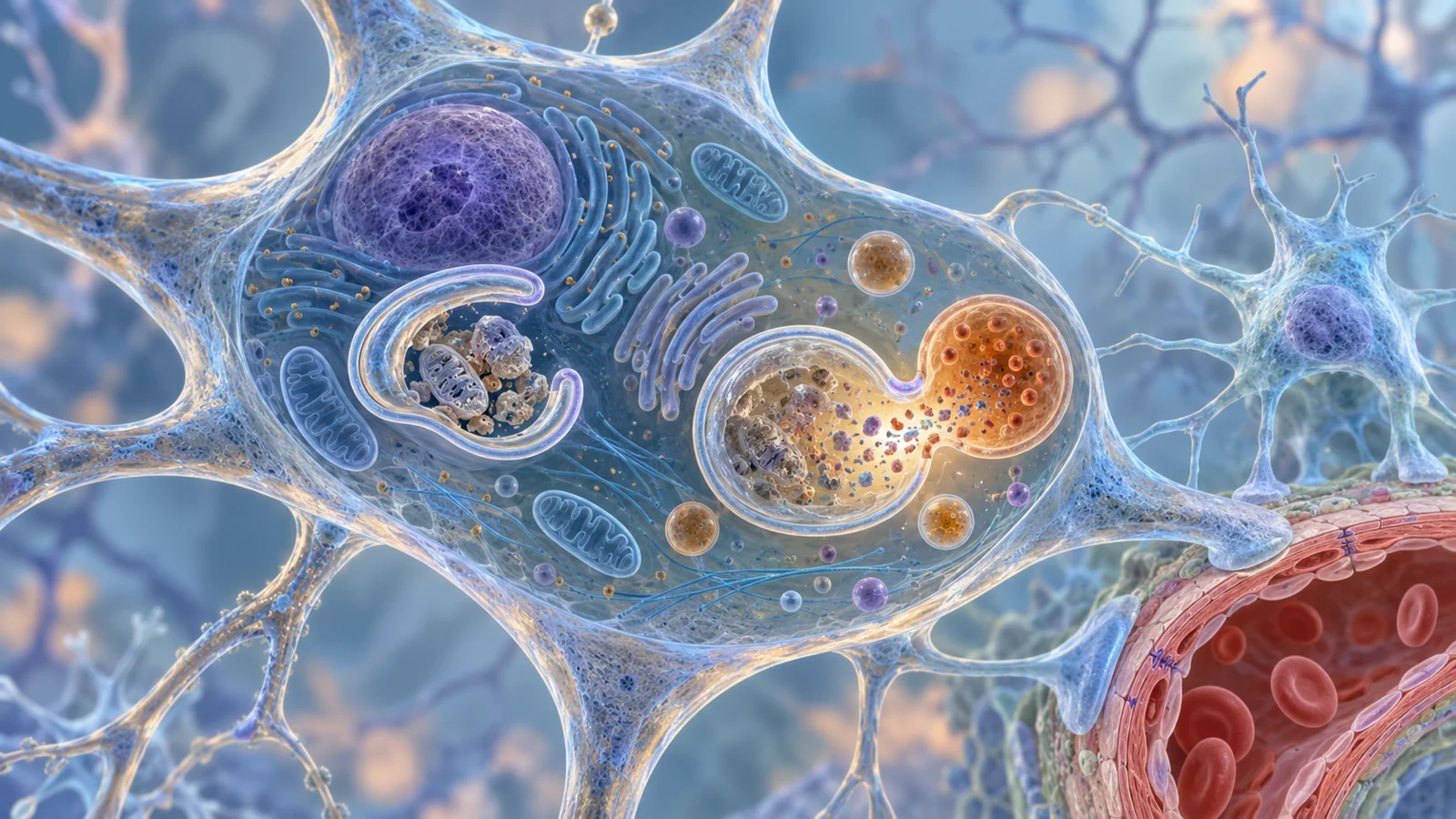
Could protecting memory require addressing the cells and small blood vessels that support neurons, as well as the neurons themselves? A review published on June 1, 2025, proposes a therapeutic rationale built around that question. It brings together evidence on autophagy, inflammation, cellular senescence, mitochondria, lysosomes, and the blood–brain barrier to explain why several drugs might be given complementary roles in protecting an aging brain.
The proposal is not a demonstrated treatment. It is a mechanistic argument assembled from different kinds of evidence, including cell experiments, animal models, observational findings, and selected clinical results. Its central idea is that improving one damaged cellular process may not be enough if another part of the same system cannot keep up.
Why starting cellular recycling is only half the job
Autophagy is often described as a cell’s recycling system. It helps gather and transport damaged or unwanted material so it can be broken down and reused or removed. Lysosomes are the compartments that perform much of that breakdown. For the process to protect a cell, material must move through the whole pathway, from initiation to delivery and degradation.
That makes the relationship between autophagy and lysosomal function important. Stimulating the early stages may increase the amount of material waiting to be processed. If the lysosomes cannot degrade that material efficiently, the result may be stress and accumulation rather than effective clearance.
The review uses rapamycin to make this dependency concrete. In some Alzheimer’s disease models, early rapamycin treatment reduced amyloid-beta plaques and phosphorylated tau while improving measures related to synaptic plasticity and cognition. The benefit was linked to stronger autophagy when lysosomal function remained capable of completing the process. In models with impaired lysosomal degradation, however, mTOR inhibition could produce autophagic stress and worsen the buildup of toxic proteins. Rapamycin also performed less well in later-stage settings and in models with limited lysosomal capacity, including 5xFAD mice.
The lesson is not that activating autophagy is inherently harmful or helpful. Its effect depends on the condition of the downstream machinery, the timing of intervention, and the cells receiving it. A therapy that increases delivery into a recycling pathway may need to support the pathway’s finishing step at the same time.
How the proposed drug roles fit together
The review assigns different jobs to three main components: metformin, benzimidazole derivatives, and acetylsalicylic acid, or aspirin. The authors present these roles as complementary reasons to investigate a combination, not as proof that the drugs produce a measured synergistic effect in people.
Metformin is discussed as an energy-sensing intervention. By activating AMP-activated protein kinase, or AMPK, it may promote autophagy initiation and support mitochondrial biogenesis. The review also connects metformin with SIRT1 and pathways involved in mitochondrial function and antioxidant defenses. In the proposed arrangement, metformin would help cells respond to energy stress and begin the recycling process.
Benzimidazole derivatives are given a different role. The review describes compounds such as FLBZ as promoting autophagy through mechanisms that do not depend on mTOR inhibition. In particular, it highlights lysosomal clustering and fusion through the JIP4–TRPML1 pathway. This matters because it addresses the movement and processing of material downstream of initiation. The authors suggest that this could help provide lysosomal readiness without relying entirely on the metabolic effects associated with chronic mTOR inhibition.
Aspirin is positioned as both an inflammation-modulating agent and an autophagy-related component. The review discusses effects involving Beclin-1 and LC3B, alongside suppression of COX-2 and NF-κB signaling. It also describes specialized pro-resolving mediator pathways that could support a less inflammatory environment. In senescent cells, reducing harmful secretory behavior is not the same as killing the cells. The review leaves aspirin’s role as a true senolytic in the central nervous system unconfirmed, while treating its possible senomorphic and anti-inflammatory effects as relevant to the proposal.
PDE5 inhibitors and rapamycin remain important parts of the review’s broader discussion. PDE5 inhibitors are presented as another route toward autophagy-related and neurovascular effects, while rapamycin illustrates the risks of increasing autophagy when lysosomal completion is impaired. They provide context for the combination rationale, but the central three-agent proposal should not be read as an established fixed regimen containing every compound discussed in the review.
What changes when evidence crosses systems
The supporting findings do not all describe the same intervention, tissue, disease stage, or outcome. That makes the evidence useful for testing the logic of the proposal, but insufficient for assembling a treatment result by addition.
Some of the benzimidazole evidence comes from retinal pigment epithelial cells rather than brain cells. In that setting, FLBZ was associated with changes including lower lipofuscin accumulation, reduced secretion of apolipoproteins linked to drusen formation, and less disruption of cellular junctions. These observations support interest in an mTOR-independent way to influence autophagy and cellular stress. They also show the distance that remains between a retinal-cell mechanism and protection against Alzheimer’s-related cognitive decline.
The review describes a different line of evidence for mirodenafil, a PDE5 inhibitor that can enter the brain. Experiments involving SH-SY5Y cells and APP-C105 transgenic mice linked mirodenafil with AMPK activation, autophagy markers, reduced amyloid-beta and phosphorylated tau, and better performance on behavioral tests. The proposed mechanisms included cGMP-related signaling, effects on a tau-associated kinase, and support for autophagy–lysosomal function. These findings are relevant to the broader PDE5 discussion, but they do not test the metformin–benzimidazole–aspirin combination.
Human observational evidence adds another layer. A meta-analysis of six observational studies involving 245,095 people reported a lower observed Alzheimer’s risk among PDE5 inhibitor users, including a pooled hazard ratio of 0.53. Yet the analysis also reported very high heterogeneity, and short-term tadalafil trials had neutral cognitive outcomes. An association seen in healthcare data can be influenced by differences between people who receive a drug and those who do not; it does not establish causal prevention or validate a separate combination proposal.
Aspirin supplies a useful counterpoint. The review reports that the large double-blind, placebo-controlled ASPREE trial, which followed almost 20,000 older adults for five years, did not find protection against cognitive decline or Alzheimer’s disease from low-dose aspirin. That result does not settle what aspirin might do as one part of a carefully designed multi-agent intervention, just as favorable findings for one component cannot establish that the full combination will work. The relevant question is whether coordinated action at several points produces sustained benefit in an appropriate population, at tolerable exposure, and with measurable cognitive protection.
The biological idea still has to survive real exposure
A coherent pathway diagram is only the beginning of a therapy. The compounds must reach the relevant tissues, affect the right cell types, and do so at exposures that do not create greater harm than the process they are meant to correct. The blood–brain barrier is therefore a practical obstacle. Not every compound crosses into the central nervous system efficiently, and a mechanism observed outside the brain cannot automatically be treated as a brain effect.
Cell-specific responses add another complication. The review notes that prolonged or high-dose AMPK activation could have different consequences in neurons and astrocytes. A response that supports autophagy and mitochondrial health in one cell type might suppress flux or trigger stress responses in another. The same intervention could therefore produce a different net effect depending on which cells are exposed, what stage of disease they are in, and how well their lysosomes are functioning.
Aspirin also illustrates why familiar drugs still require careful evaluation in a new therapeutic context. Low anti-inflammatory doses may be tolerated by many people, but aspirin can cause gastrointestinal irritation, bleeding, and impaired wound healing. Those risks become more important when it is combined with agents that alter cellular stress responses or when treatment is intended to continue over a long period.
The review proposes biomarker-guided precision medicine as one way to handle this complexity. Measures related to autophagy impairment, inflammation, and metabolic dysfunction could eventually help identify people whose biology is more likely to respond. That remains a research direction, not a clinically usable selection rule or dosing plan. The supplied evidence does not establish the sequence, dose, duration, or long-term safety profile needed to recommend such a combination.
What this approach could mean for preserving memory
The review’s potential significance lies in its attempt to treat brain aging as an interaction among several vulnerable systems. Rather than assuming that more recycling machinery is always better, it asks whether initiation, lysosomal completion, inflammatory control, mitochondrial support, and cellular senescence need to be addressed together. If a combination can coordinate those functions without worsening stress in particular brain cells, it could eventually offer a way to protect the conditions that allow neurons and their vascular support systems to keep working.
For people at risk of Alzheimer’s-related cognitive decline, the hoped-for consequence would be the preservation of memory for longer through protection of several interacting cellular functions. Reaching that outcome would require evidence that the proposed combination delivers sustained cognitive protection at tolerable exposures, beyond the mechanistic rationale and separate component findings assembled in this 2025 review.
Key Sources
- Primary source: Synergistic Autophagy-Related Mechanisms of Protection Against Brain Aging and AD: Cellular Pathways and Therapeutic Strategies.
DOI or Journal Page · Review or Meta-Analysis · 2025-06-01
Keep exploring