
Research Signal – Source date 2025-04-24
The current ClinicalTrials.gov record describes a trial asking whether a structured seated exercise program could support physical function for older adults with dementia. The program combined Vitality Acupunch, or VA, movements with devices worn on both hands to track movement accuracy. Its practical question was broader than whether participants could move more precisely: could a regular activity in an adult-daycare setting help preserve abilities that matter in daily life?
The current record now lists an actual study start on April 24, 2025, actual primary completion on December 18, 2025, and actual overall completion on the same date. It also lists 142 participants as the actual enrollment. Those later lifecycle details belong to the current record and should not be projected backward as though they were known when the April 2025 registration was first made. The supplied registry record has no posted results, so the design can be explained without claiming that the program worked.
A seated routine with a built-in measurement question
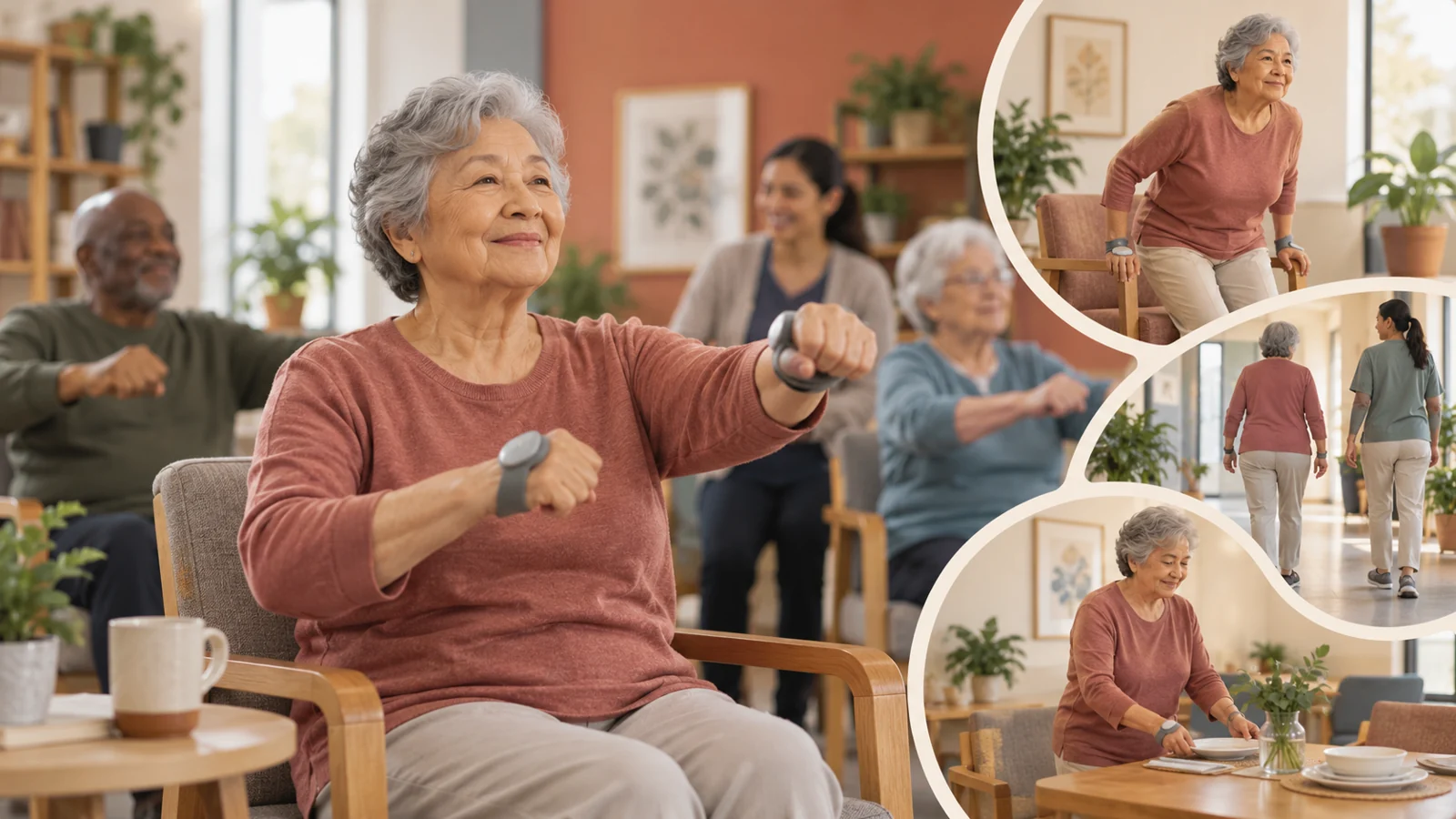
The intervention was designed as a 40-minute session, three times a week for six months. Participants performed it while seated. The first part used gentle preparation movements, including breathing regulation, alternating arm stretches, trunk movement, and alternating leg movements. A middle sequence used five punching techniques, with the left and right arms moving in alternating arcs. The final part returned to breathing, muscle relaxation, stretching, and hand contact with the face and lower back.
The devices on both hands were included to record and track the accuracy of those movements. Some registered physical outcomes also used the SPOZ technology to measure muscle endurance and agility. That makes the study a test of a bundled package: a particular exercise routine delivered with movement tracking. It is not a comparison between the same VA exercise with and without the devices, so the two study arms cannot by themselves show how much of any eventual difference came from the tracking technology.
The program description gives a traditional rationale for the punching movements, referring to stimulating meridians and promoting the circulation of qi and blood. Those are descriptions of the program’s stated rationale, not evidence that the trial demonstrated those mechanisms. The registry also does not establish the accuracy or clinical validity of the devices from the material supplied here. Tracking a movement and validating what that measurement means are separate questions.
The daycare center was the unit of comparison
The study recruited older adults from 10 adult daycare centers using convenience sampling. The centers were then cluster-randomized to either the VA-SPOZ exercise program or routine activities. In plain terms, convenience recruitment describes how the centers and participants entered the study; randomization describes how the participating centers were assigned to the comparison groups.
This arrangement matters because people at the same center may share staff, schedules, spaces, and routines. The comparison therefore concerns the exercise-and-device package as delivered in one set of centers versus routine activities in another set. It does not create a clean test of the devices alone, and it does not automatically show that the results would apply to every older adult with dementia or every care setting.
Measurements were planned before the intervention and again at three and six months. The primary outcomes focused on physical performance. They included balance, the ability to rise from a chair repeatedly, four-meter walking speed, handgrip strength, cardiorespiratory endurance, muscle endurance, agility, and body flexibility. These are useful ways to describe movement capacity, but a change in one test would still need interpretation in relation to what participants can do outside the testing session.
Fitness tests and everyday capability are related but not identical
The trial also registered outcomes for activities of daily living and instrumental activities of daily living. The daily-activity assessment separates several parts of an action: initiating it, planning and organizing the steps and supplies, and completing the performance. That structure is important for dementia care because being physically able to stand or walk does not necessarily mean a person can independently begin, sequence, and finish a familiar task.
The study also included a nighttime-behavior measure from the Neuropsychiatric Inventory Questionnaire. It addresses whether nighttime symptoms are present, how severe they are, and how much distress they cause a caregiver. It is not a direct measurement of sleep duration, sleep stages, or sleep physiology. A registered sleep-related outcome can therefore add information about nighttime behavior and caregiver experience without establishing that the program changes the biology of sleep.
The central interpretive question is whether the program could improve meaningful function, not simply whether it could produce better scores on movement tests. The supplied record provides definitions of the outcomes and the planned comparison, but no comparative numerical findings. It therefore cannot establish the size of any benefit, whether participants adhered to the sessions, what harms or adverse events occurred, or whether any observed change would be clinically meaningful in everyday life.
Nor would improved physical performance scores justify claims that the program reverses dementia or slows the underlying disease process. At most, those scores would speak to specific functional abilities measured over the study period. Connecting them to daily independence would require the daily-activity results and a careful account of how the intervention was delivered and tolerated.
What the registration leaves open
The trial’s design gives researchers a way to compare two groups over six months, but the registration alone cannot answer every question a caregiver or participant might reasonably ask. It does not show whether the routine was acceptable to people with different levels of cognitive impairment, whether the three-times-weekly schedule was workable in ordinary daycare operations, or whether the tracking devices added practical value beyond helping researchers record movements.
Those questions are especially relevant because the program’s possible benefit has several links in it. Participants would need to engage with the seated routine. The movements would need to be measured in a meaningful and sufficiently reliable way. Any physical changes would then need to carry over into initiating, organizing, and completing daily activities. Finally, the program would need to be safe and feasible for the staff and centers responsible for delivering it. The supplied material establishes the questions the trial was set up to examine, not the answers.
What this could mean for everyday dementia care
For people with dementia and their care teams, the potential payoff would be a structured seated activity in adult day care that supports continued participation in everyday tasks. If meaningful functional benefit, acceptable safety, and workable delivery in care settings were established, a program of this kind could help some participants retain the ability to initiate and complete familiar activities. That prospect depends on evidence beyond the registration record, and any added value from the movement-tracking devices would remain a separate question.
Key Sources
- Primary source: Integrating SPOZ Technology to Support and Enhance the Vitality Acupunch (VA) Exercise Program for Older Adults With Dementia
Government or Regulator · Clinical Trial · 2025-04-24
Keep exploring