
Evidence date · 2024-10-08 · Research note 1 of 3
1 2 3
See current Track status →
A sleep disorder can precede a harder question
A ClinicalTrials.gov record published on 8 October 2024 describes a study asking whether artificial intelligence can help identify people with REM sleep behavior disorder (RBD) who may later develop Parkinson’s disease. The investigators also name dementia with Lewy bodies and multiple system atrophy as possible progression outcomes.
The question is about future risk, not about diagnosing a condition that is already present. A scan might contain patterns that researchers hope will help distinguish people more likely to progress from those who remain stable, but that possibility has to be tested against what happens to participants over time. The record now available reports that the study actually started on 7 October 2024.
What participants are expected to undergo
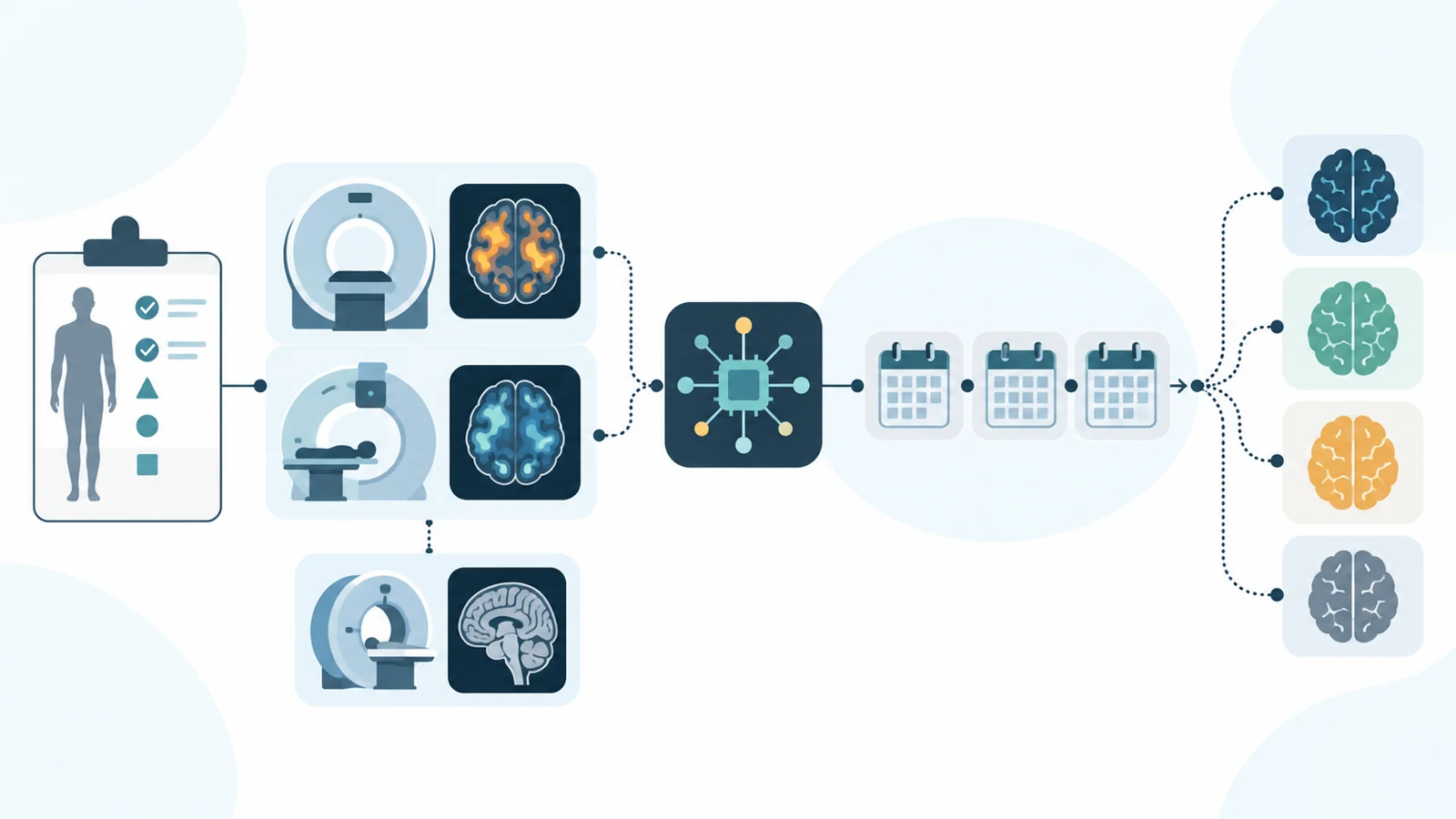
The registered project is an interventional, single-group diagnostic investigation with an estimated enrollment of 20 adults. Participants are expected to receive a clinical evaluation and undergo brain imaging. The principal procedures are an FDG PET/CT scan and a SPECT scan using 123I-FP-CIT, also called a DaTSCAN in the registry. MRI is listed separately to exclude structural brain abnormalities.
These procedures form the planned participant pathway rather than a demonstrated prediction service. The images are intended to give the investigators measurements they can analyze alongside clinical information and later follow-up. The registry describes the study as an effort to use deep learning to identify early imaging biomarkers associated with progression, but the supplied record does not provide a measured accuracy result.
How the prediction would be checked
The central test depends on connecting an early estimate with a later clinical outcome. The primary outcome is planned to assess the model’s sensitivity in identifying participants with isolated RBD who progress to a neurodegenerative disorder during the expected follow-up period. In practical terms, the investigators need to know how often the approach identifies people who are subsequently diagnosed with Parkinson’s disease or another specified disorder.
The secondary outcomes add different measures of performance. They include accuracy, receiver operating characteristic curves and area under the curve, specificity, and positive and negative predictive values for conversion to Parkinson’s disease or another overt alpha-synucleinopathy. These measures answer different questions: whether the predictions separate higher- and lower-risk participants, how often they identify later converters, and how often a prediction is correct in either direction.
The study also plans to compare observed conversion with a 6.3% annual conversion risk cited in the registry. That figure is a benchmark the investigators intend to examine against what they observe. It is not a result of this study and should not be read as an individual participant’s prognosis.
What a 20-person study could leave unresolved
A small, single-group study can show how the planned measurements behave in the people who take part, but it cannot by itself establish that the same prediction performance will hold across broader patient populations. The estimated enrollment also does not tell us how many people will ultimately complete follow-up, convert to a diagnosed disorder, or contribute usable data.
The current registry record lists the study as recruiting and shows no posted results. It gives estimated primary completion and completion dates of August 2026, while the listed outcome timeframes describe follow-up expected to last 48 months. The supplied material does not reconcile those timelines, so neither should be treated as proof that the study has reached a particular endpoint.
For the October 2024 perspective, the important development is the registration of a human diagnostic study that links imaging, artificial intelligence and prospective clinical follow-up. The record establishes an intended test of prediction, not achieved sensitivity, specificity, predictive value or patient benefit.
What earlier risk estimates could change
Reliable prediction could eventually support more individualized follow-up for people with isolated REM sleep behavior disorder and better-informed conversations about the possibility of progression. Those uses depend on the model making dependable estimates in appropriate patients and on evidence that acting on those estimates helps rather than merely adding another uncertain result to clinical decision-making.
Earlier recognition would also be a different achievement from effective treatment. The registered study is designed to investigate whether imaging-based risk estimation can be connected to later diagnoses; it does not establish that prediction can prevent Parkinson’s disease, dementia with Lewy bodies or multiple system atrophy, or improve outcomes after progression occurs.
Key Sources
- Primary source: Artificial Intelligence in Molecular Imaging: Predicting Parkinson's Risk in REM Sleep Behavior Disorder
Government or Regulator · Clinical Trial · 2024-10-08