
Research Signal – Source date 2023-12-31
The idea behind creatine supplementation is straightforward: brain cells need a dependable energy supply, and creatine helps cells manage energy when demand rises. That makes it plausible to ask whether more creatine could protect the nervous system from progressive diseases such as Alzheimer’s, Parkinson’s disease, Huntington’s disease or amyotrophic lateral sclerosis.
The answer assembled by the December 31, 2023 review The potential role of creatine supplementation in neurodegenerative diseases is more limited. The review brings together laboratory, animal and human research. It describes a coherent biological rationale and encouraging findings in some experimental systems, but it also reports that most clinical trials did not reproduce favorable results. Creatine’s role in cellular energy therefore does not, by itself, show that taking more can prevent or slow common neurodegenerative disease in people.
Why brain cells attract the creatine question
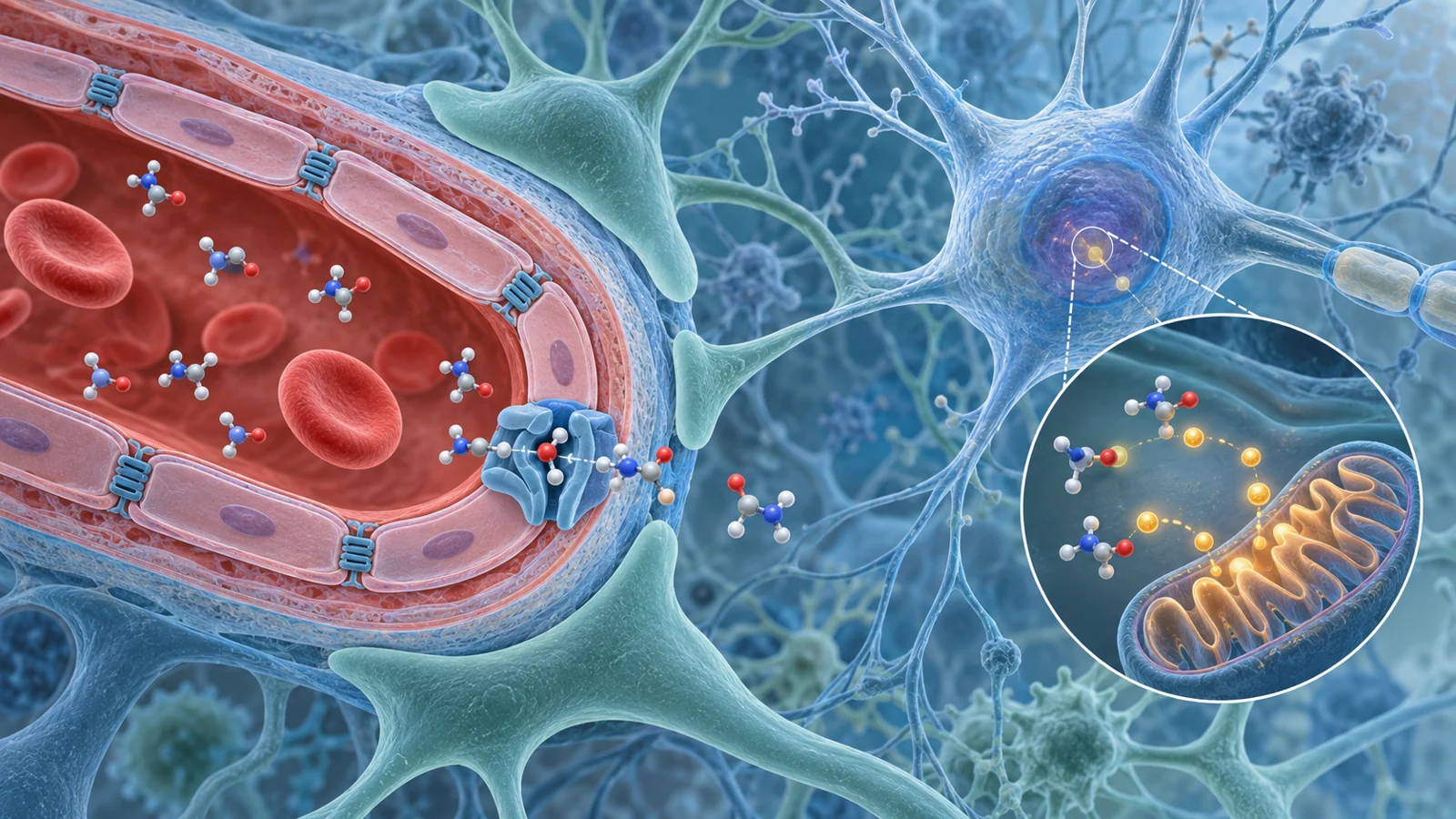
Adenosine triphosphate, or ATP, is the cell’s immediately usable energy supply. Nerve cells spend energy continuously on tasks such as maintaining their electrical state and communicating with other cells. The creatine–phosphocreatine system acts as an energy buffer: phosphocreatine can transfer a high-energy phosphate group back to adenosine diphosphate, helping replenish ATP when a cell’s demand is high.
The brain is especially vulnerable to energy problems because it has high energy requirements. The review connects brain energy depletion with mitochondrial stress, reactive oxygen species and damage associated with neurodegenerative disease. In cell and animal studies, creatine supplementation was associated with protection against several experimental signs of energy failure, including ATP depletion, excess reactive oxygen species, calcium accumulation and disruption of mitochondrial function.
These observations explain the scientific interest without turning them into a treatment result. The review also discusses possible antioxidant and anti-inflammatory actions, but those effects remain secondary to the central energy rationale and are described in experimental settings. A mechanism that helps a cell cope with stress in a laboratory model is not the same as a demonstrated ability to preserve neurological function in patients.
More intake is not the same as more creatine in the right brain cells
Creatine reaches the body through food and through the body’s own synthesis. The review identifies fish, red meat and, to a lesser extent, dairy products as dietary sources. It also describes synthesis involving the enzymes l-arginine glycine aminotransferase and N-guanidinoacetate methyltransferase. In the brain, creatine production and uptake involve different cell types and the creatine transporter SLC6A8.
Transport is particularly important because dietary creatine must cross the blood–brain barrier before it can affect the relevant neural compartment. The review describes SLC6A8 at the barrier and in brain cells including neurons and oligodendrocytes, while astrocytes are involved in local synthesis. This arrangement means that an increase in intake is only one part of the biological chain. The compound must be available, transported into the brain and taken up where energy handling is under strain.
That delivery problem is a research constraint, not an established explanation for disappointing clinical outcomes. The supplied evidence does not show that inadequate brain delivery caused the unsuccessful trials. It does show why a simple assumption—more consumed creatine automatically means more useful creatine inside vulnerable neurons—would be too strong.
What the ALS experiments reveal about translation
The review’s discussion of amyotrophic lateral sclerosis makes the difference between experimental protection and patient benefit concrete. In a mouse model of ALS, creatine supplementation was associated with reduced neuronal loss, less damage linked to reactive oxygen species and behavioral recovery. The same section reports that human studies did not reproduce beneficial effects on motor or respiratory function.
The review suggests that treatment timing could contribute to this gap: treatment in humans may have begun later in disease development than treatment in animal studies. That is a proposed explanation, not a demonstrated cause of the different outcomes. The review raises timing and disease stage as issues for future research, but its broader clinical summary remains unfavorable: most clinical trials across the neurodegenerative conditions considered did not reproduce favorable results.
That finding is neither proof that every possible creatine regimen must fail nor evidence that creatine already works as a neuroprotective treatment. It places the burden on future research to show which disease, stage, dose and delivery strategy—if any—can produce a meaningful human benefit. The experimental findings do not establish a dosing regimen that prevents or slows common neurodegenerative diseases in people.
Deficiency disorders test a different biological question
Inherited creatine-deficiency disorders help clarify why supplementation can be useful in one neurological setting without settling the broader neurodegeneration question. Mutations affecting creatine synthesis or transport can reduce the brain’s available creatine and lead to serious developmental and neurological problems. In this situation, the biological problem is directly tied to the creatine system itself.
The review reports significant effects of supplementation in disorders involving the synthesis enzymes AGAT and GAMT. It also describes models in which supplementation restored memory-related performance, abnormal creatine-kinase activity and disrupted redox balance associated with creatine deficiency. These findings make biological sense when the missing function is production: supplying creatine may partly compensate for a defect upstream in the pathway.
Transporter deficiency presents a different obstacle. When SLC6A8 is impaired, creatine has greater difficulty entering the brain, so supplementation has been less effective against neurological symptoms. The review mentions a creatine derivative being studied in hippocampal slice systems because it could cross biological membranes more readily, but that experimental approach does not establish a treatment for people with transporter deficiency.
The boundary is important. A response in a creatine-synthesis disorder shows that correcting a specific metabolic shortage may help under some conditions. It does not establish that raising creatine in people with common neurodegenerative diseases will protect neurons, because those diseases involve a different biological setting and may not be caused by inadequate creatine supply.
What targeted brain-energy support could change
The authors identify preventive neuroprotection in people at risk as the most promising direction for future research. If an intervention could reach the relevant brain tissue, support vulnerable energy metabolism and demonstrate meaningful benefit in people, it might eventually help preserve neurological function before irreversible disease progression becomes advanced.
As of December 31, 2023, that remained a conditional possibility rather than an established prevention outcome. The next scientific challenge was not simply to recommend more creatine, but to determine whether a suitable regimen can reach the right neural compartment and produce a real patient benefit. The review gives creatine a credible biological question to investigate, not a proven answer for preventing progressive brain disease.
Key Sources
- Primary source: The potential role of creatine supplementation in neurodegenerative diseases.
DOI or Journal Page · Clinical Trial · 2023-12-31
Keep exploring