
Research Signal – Source date 2023-04-11
A skin cell that has stopped dividing may still influence the tissue around it. That is the central complication in research on cellular senescence, an essentially irreversible cell-cycle state associated with aging. Removing these cells or quieting the signals they release could eventually help some skin problems, but eliminating senescence everywhere would overlook its role in normal repair.
A review published on April 11, 2023, examines this tension in skin research. It brings together findings from cell cultures, reconstructed skin models, animal experiments and selected human observations. Its focus is not a demonstrated rejuvenation treatment. Instead, it organizes why skin is a useful place to study senescence, which pathways researchers are trying to influence and what would have to be solved before plant-derived compounds could become practical therapies.
When a stopped cell still changes skin
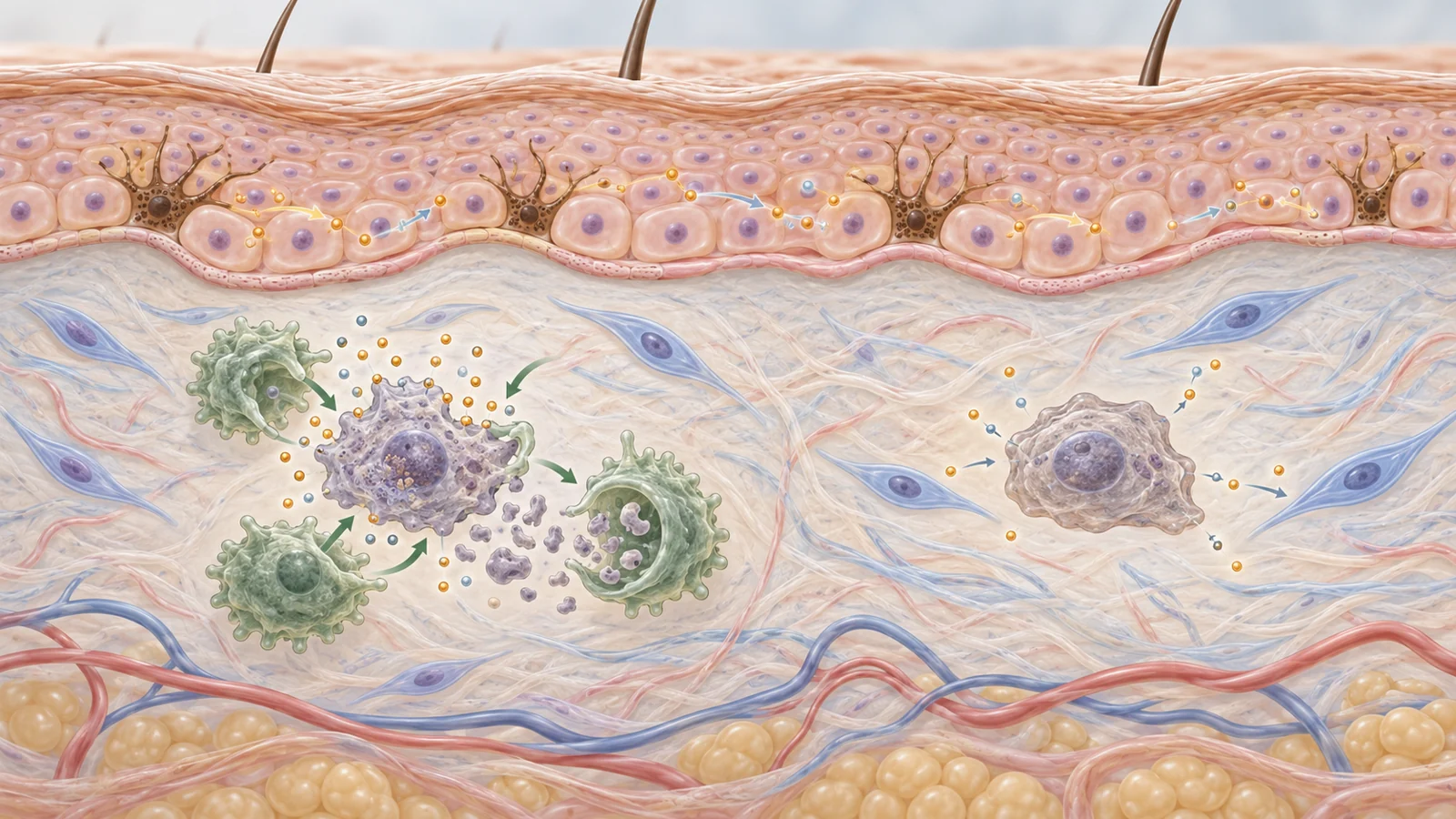
The most important effects may come from what senescent cells do after division has stopped. They can remain metabolically active and release a mixture of molecules known as the senescence-associated secretory phenotype, or SASP. In plain terms, the SASP is a changing set of secreted signals that can alter inflammation, neighboring cells and the tissue structure around the senescent cell.
In the dermis, fibroblasts help organize the extracellular matrix, the network that gives connective tissue much of its structure. The review describes senescent fibroblasts as contributors to inflammation and matrix disruption. Their altered behavior can affect the local tissue environment rather than remaining an isolated problem inside one cell. Fibroblasts also communicate with the epidermis. One example discussed in the review is insulin-like growth factor 1, or IGF-1, which dermal fibroblasts release to support keratinocyte proliferation. Senescent fibroblasts produced less IGF-1 in an experimental setting, potentially changing how the epidermis responds to ultraviolet stress.
Melanocytes provide a different example in the epidermis. These pigment-producing cells help protect nearby keratinocytes, but senescent melanocytes can show altered markers and send paracrine signals to surrounding cells. In a three-dimensional human epidermal model, those signals reduced basal keratinocyte proliferation and contributed to epidermal thinning. The biological effect therefore depends on communication between cell types, not simply on whether an individual cell is dividing.
Repair depends on timing
Wound healing proceeds through overlapping stages of inflammation, cell proliferation and tissue remodeling. The review describes senescence as potentially useful during a short, controlled period of this process. Short-lived senescent fibroblasts appeared at healing wound sites in reported experiments, and their secretions included platelet-derived growth factor AA. That signal can promote myofibroblast differentiation, while the broader secretory response may support remodeling through antifibrotic and proangiogenic effects.
Duration changes the interpretation. Chronic accumulation of senescent cells is associated with impaired skin function and delayed repair in the review’s examples. The review describes higher levels of senescence in chronic nonhealing ulcers, citing diabetic mouse models alongside venous and radiation ulcers. Clearance with the senolytic combination dasatinib plus quercetin was reported to mitigate radiation ulcers. Separately, transferring irradiated fibroblasts beneath the skin of young mice delayed wound healing in a way that resembled healing in naturally older mice.
The findings do not describe a simple switch between good and bad cells. Responses also differed by age and setting. In one biopsy-wound observation summarized by the review, younger skin showed induction of p21 and p53 during healing, whereas older skin did not show the same response. These examples support a more specific question for treatment research: which senescent cells should be retained temporarily, which have become persistently disruptive and how can the difference be recognized in living skin?
Removal and signal control are different strategies
A senolytic is intended to eliminate senescent cells. A senomorphic, also called a senostatic, aims to suppress senescence-related behavior or the secretory phenotype without causing the cell to die. Those are biologically different interventions. Removing a cell changes the population; quieting its secretions leaves the cell in place while attempting to reduce its influence on the surrounding tissue.
The review discusses naturally occurring plant compounds as possible examples of both kinds of activity, but their names do not predict a finished treatment. Quercetin, found in foods including onions, grapes, berries, cherries, broccoli and citrus fruits, has been associated in the reviewed studies with changes involving MAPK activity, fewer stress-induced senescent cells and lower levels of inflammatory signals such as IL-8 and interferon-beta. Fisetin, a related flavonol found in sources including apples, persimmon, grapes, onions, cucumbers and strawberries, has been reported to affect the PI3K/AKT/mTOR pathway, topoisomerase and inflammatory cytokines including TNF-alpha and IL-6.
These descriptions refer to reported molecular actions in particular experimental systems. They do not mean that eating a food, taking a supplement or applying an extract will reproduce the same effect in human skin. A compound that changes a pathway in cultured cells may behave differently when it encounters intact tissue, other cell types or a different level of exposure.
From a molecule to a skin exposure
For a candidate to become a skin treatment, researchers would need to connect molecular activity with an exposure that reaches the intended cells at a useful concentration. Dose matters because plant polyphenols can have different effects at different levels. The target cell matters too: a compound that affects senescent fibroblasts may not affect senescent melanocytes in the same way. The review notes that high antioxidant doses can even damage DNA and induce premature senescence in proliferating cells under some conditions.
Bioavailability adds another practical hurdle. A compound may be chemically active in a dish but poorly available to cells in living skin. Formulation and delivery would determine whether a topical preparation can reach the relevant layer and remain there long enough to matter. The source of the compound can also change its metabolic profile, making standardization important if different plant preparations are expected to produce comparable exposures.
Skin is attractive for this work because it is accessible and may allow local delivery. The review presents topical senescence-targeting treatment as a possibility, particularly for limiting age-associated skin changes, rather than as an established approach. Local application could also change the risk-benefit question compared with a treatment intended to reach senescent cells throughout the body. Neither plant origin nor a familiar food source establishes a safe or effective dose for that purpose.
Why the laboratory setting matters
The review’s discussion of senescent melanocytes shows why a promising mechanism can behave inconsistently. In one reconstructed human epidermis model, the Bcl-2 family inhibitor ABT-737 effectively eliminated senescent melanocytes. Other reported work in human and mouse melanocytes found increased expression of the related survival protein Bcl-w and resistance to ABT-737 or ABT-263. The contrast suggests that senolytic performance may depend on the cell type, the model and the particular form of senescence being studied.
That variability matters for skin because the organ contains several interacting populations with different histories and functions. A treatment that removes one senescent population might leave another unaffected, while broad suppression of secretions could interfere with a useful repair response. The experimental setting may also influence whether a compound appears to work: a monolayer of cells, a reconstructed epidermis, an animal wound and a person with aging-related skin changes do not provide the same biological environment.
For plant-derived compounds, the review says the research base is made up mostly of in vitro studies, with a smaller number of in vivo models. It calls for mechanistic clinical trials to establish safety, dosing and clinical efficacy. Changes in p16, p21, inflammatory signals or senescent-cell counts would be useful steps in understanding the biology, but they are not by themselves improvements in wrinkles, skin function or patient outcomes.
The review also discloses relevant financial interests: two authors had interests connected with senolytic drugs, including patents and pending patents held by Mayo Clinic. The other authors declared no conflict of interest. That disclosure does not resolve the scientific questions, but it gives readers important context for interpreting a review that discusses therapeutic development.
What this could change
For people with aging-related skin dysfunction, the prospective benefit is a locally applied treatment that reduces senescence-related disruption while preserving the cells and signals needed for normal tissue repair. Such an approach could eventually help maintain skin structure and function in areas where persistent senescent cells are contributing to an unhealthy tissue environment. That capability remains conditional on finding an effective exposure, delivering it to the right cells and demonstrating safety and meaningful benefit in clinical studies. From the review’s April 2023 perspective, plant-derived compounds are candidates for that investigation, not proven rejuvenation therapies.
Key Sources
- Primary source: Cellular senescence in skin-related research: Targeted signaling pathways and naturally occurring therapeutic agents.
DOI or Journal Page · Review or Meta-Analysis · 2023-04-11
Keep exploring