
Research Signal – Source date 2023-03-21
A cancer cell that stops dividing sounds like a problem that has been solved. Cellular senescence is more complicated. Senescent cells enter a stable state of growth arrest, but they can remain biologically active, changing the cells and tissue around them. In cancer, those effects may help immune cells find damaged cells, or they may help create conditions in which a tumor persists.
A review published on March 21, 2023, examines this tension in the context of aging, cancer immunity and treatment. Its central message is not that chronological age determines how a tumor will behave. It is that cancer cells, normal tissue, immune cells and the material between them can influence one another—and that these relationships matter when treatment is given to older adults.
Why stopping division is not silence
Senescence is a response to stress such as DNA damage, telomere shortening, oncogenic signals, metabolic strain or oxidative damage. A senescent cell no longer proceeds through the cell cycle in the usual way. It may change shape, alter its internal activity and remain in the tissue rather than disappearing immediately.
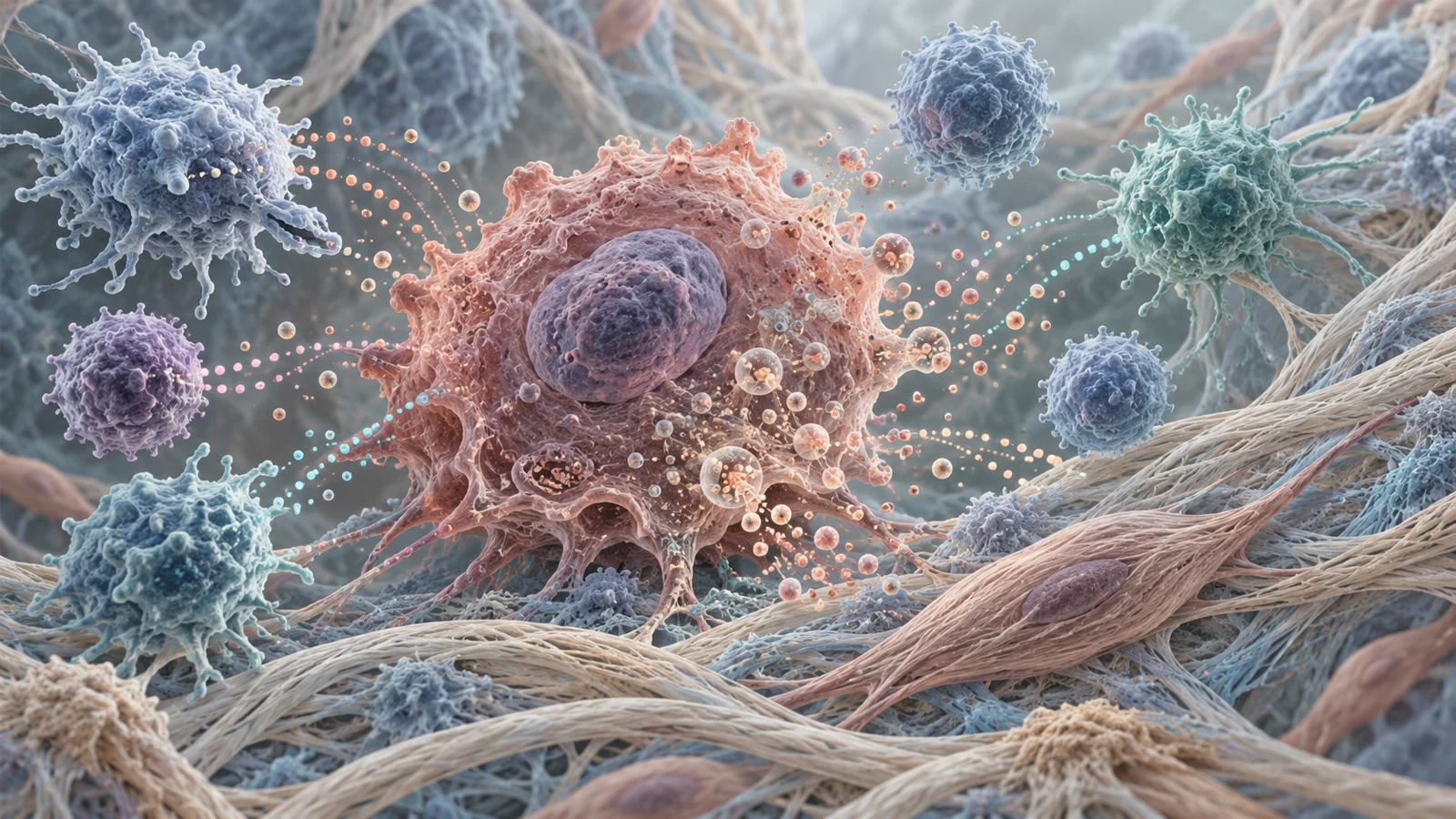
The cell’s continued activity is important because it can communicate with its surroundings. Senescent cells acquire what researchers call the senescence-associated secretory phenotype, or SASP. The term refers to the collection of cytokines, chemokines, growth factors, proteinases and other substances that senescent cells release.
Those substances can recruit immune cells and alter nearby tissue. In one direction, inflammatory signals such as interleukin-1 alpha, interleukin-6 and interleukin-8 can help attract M1-like macrophages, helper T cells and natural killer cells. These infiltrating cells may support the removal of senescent tumor cells and, through bystander effects, affect nearby cancer cells that are not senescent.
The same kind of communication can produce a less favorable environment. Interleukin-6 and interleukin-8 can help create chronic inflammation, promote matrix-remodeling enzymes and support processes associated with tumor invasion. Interleukin-6 can also recruit myeloid-derived suppressor cells, which can inhibit CD8-positive T cells and natural killer cells. Other immune populations associated with suppression include regulatory T cells, M2-like macrophages and N2 neutrophils.
The outcome depends on the tissue, the stress that induced senescence, the mix of immune cells already present and the wider inflammatory network. Senescence is therefore not a single switch that turns a tumor on or off. It is a state in which an arrested cell can alter the neighborhood, with consequences that may change over time.
A tumor is a neighborhood, not just a mass
The tumor microenvironment includes immune cells, blood-vessel cells, fibroblasts, pericytes, adipocytes and the extracellular matrix. The matrix is the physical material surrounding cells, including collagen, fibronectin, laminin and elastin. It gives tissue structure, but it also affects how cells move, attach, receive growth signals and use energy.
Fibroblasts are especially important because they produce collagen and other structural components while also releasing cytokines, chemokines, growth factors and enzymes. Cancer-associated fibroblasts can remodel the matrix through enzymes called matrix metalloproteinases. Matrix organization can influence cancer-cell movement and blood-vessel formation.
The matrix is not uniform. Differences in the cross-linking and arrangement of its proteins change physical properties such as stiffness. Cells sense these features through adhesion complexes and related signaling pathways, which can influence the cell cycle and energy metabolism. The matrix also contains growth factors, giving it a signaling role alongside its structural one.
Aging adds another layer of variation. Fibroblast renewal and behavior differ between organs, influenced by local conditions such as vascularization, mechanical stress and hormonal responses. Some fibroblasts become senescent with age, while other forms of senescence arise from cancer-related stress or treatment. Chronological aging, cellular senescence and immune aging overlap in some settings, but they are not interchangeable descriptions of the same process.
Treatment can change the neighborhood
Cancer treatment can create senescence as well as directly damage or kill tumor cells. Chemotherapy and radiotherapy may push cancer cells into a senescent state through DNA damage and related stress responses. That can be useful if growth is halted and the immune system can recognize and clear the affected cells.
Treatment can also alter surrounding normal cells. The review discusses mouse work in which chemotherapy-induced senescent fibroblasts produced an inflammatory aging-related response. Removing those fibroblasts reduced short- and long-term effects of chemotherapy-related toxicity in the model and also reduced measures associated with recurrence and metastasis.
The finding does not establish that clearing senescent fibroblasts improves survival or quality of life for older people with cancer. It does show why the treatment environment deserves attention. A therapy may act on malignant cells while also changing fibroblasts, immune cells, bone-marrow-supporting cells or other parts of the tissue. In older patients, whose organs and reserve may already be affected by age-related changes, those surrounding effects can be clinically important.
The review also describes concerns about chemotherapy’s effects on stem-cell function and bone marrow. In mouse experiments, mesenchymal stem cells from older animals were more sensitive to doxorubicin than cells from younger animals. Such findings do not translate directly into a dosing rule for patients, but they reinforce the need to distinguish damage to cancer from damage to healthy support systems.
What older trial groups can tell us
Clinical evidence about immunotherapy adds an important but separate perspective. The review summarizes age-stratified results from large randomized trials comparing pembrolizumab with platinum-based chemotherapy. In KEYNOTE-024, the reported overall-survival hazard ratio was 0.64 for participants aged 65 or older and 0.60 for those younger than 65. In KEYNOTE-042, the corresponding figures were 0.82 and 0.81. A hazard ratio below 1 favors pembrolizumab on this survival measure; each estimate compares treatments within an age group. For the older KEYNOTE-042 group, however, the reported interval was 0.66–1.01, which includes the no-difference value of 1.
These summaries suggest that older participants can benefit from immunotherapy in the trial settings described. They do not show that senescence caused those responses, nor do they establish that treatment effects were identical or different across age groups. The numbers also do not settle how treatment performs in people over 75 or 85. The review notes that patients in the oldest age ranges remain relatively uncommon in cancer trials, even though cancer is concentrated in older populations.
Chronological age alone is therefore a poor substitute for a fuller picture of immune function, frailty, other health conditions, tumor biology and the surrounding tissue. The practical question is not simply whether a patient has crossed an age threshold. It is how the particular tumor and host are interacting, and whether the likely benefit is worth the treatment burden for that person.
The translation problem
Turning these biological ideas into treatment research requires reliable ways to identify the relevant cells. Senescence has no single universal feature that cleanly separates it from every other form of growth arrest. The review discusses multi-gene signatures and experimental detection approaches, but it also emphasizes the difficulty of recognizing senescence consistently in living tissue.
Selectivity is another obstacle. A therapy that induces senescence preferentially in cancer cells could restrain tumor growth. The same broad effect in healthy tissue could instead add toxicity or worsen age-related decline. Researchers therefore need to know not only whether a treatment changes a senescence marker, but which cells changed, how long the change lasts and what those cells do to their neighbors.
Animal models also need careful interpretation. The review cites a breast-cancer xenograft example in which tumors began later, grew more slowly and metastasized less in mice older than 10 months than in mice eight to ten weeks old. Bone-marrow-derived cells from young mice were sufficient to activate a more tumor-supportive environment when transferred into aged mice. An older host, in other words, did not automatically produce faster tumor growth in that model.
That example limits any universal story about aging and cancer. It also shows why the age of an animal is only one part of a model. The tumor type, immune system, stromal cells and experimental setting all shape what the result means for human disease.
What this could change
A more precise understanding of senescent cells could eventually support cancer treatments for older adults that combine growth arrest with more selective immune clearance. The potential benefit would be practical: restrain malignant cells while limiting harmful changes in healthy tissue, reducing avoidable treatment burden and protecting quality of life.
That possibility depends on several conditions being met. Researchers would need dependable ways to identify the relevant senescent cells, interventions that favor cancer over normal tissue, and clinical studies that represent the oldest patients as well as younger older adults. The March 2023 review presents this as a conditional direction for research, not as an established therapy or a treatment-selection rule.
Key Sources
- Primary source: Aging microenvironment and antitumor immunity for geriatric oncology: the landscape and future implications.
DOI or Journal Page · Review or Meta-Analysis · 2023-03-21
Keep exploring