
Research Signal – Source date 2022-04-28
The phrase “anti-aging” can point to several very different claims. A supplement might alter a cellular pathway in a laboratory model, improve a particular health problem in people, or be promoted as a way to extend life. Those are not interchangeable outcomes.
A review published on April 28, 2022, brings together clinical and preclinical research on dietary supplements and natural products in the context of accelerated biological aging. Its central interpretation is relatively measured: these interventions may be more promising for healthspan—the time spent in good functional health—than for lifespan itself. The distinction matters because a change in a molecular marker or a disease-related outcome is not automatically evidence that people will live longer.
Aging research starts with more than one target
Accelerated biological aging describes the gradual decline of organ and tissue function alongside disruption of normal physiological processes. The review places supplements within a wider biology of aging that includes telomere attrition, cellular senescence, loss of proteostasis, mitochondrial dysfunction, stem-cell exhaustion, and epigenetic and genomic changes.
These processes overlap, but they are not one switch that can simply be turned back on. The review also emphasizes nutrient-sensing pathways, which allow cells and organisms to respond to the availability of energy and nutrients. Caloric restriction, pharmaceutical interventions, genetic changes, and dietary compounds can all be used to investigate these pathways. Much of the strongest mechanistic work comes from laboratory organisms, while human research often focuses on a particular disease, biomarker, or exposure.
That is why “anti-aging” is an incomplete description. The relevant question is what changed, in whom, and under which conditions.
A vitamin is not the same kind of intervention as a laboratory compound
The review groups together several broad categories. Dietary supplements can provide vitamins, minerals, amino acids, or botanicals intended to complement a diet. Natural products are chemically complex substances derived from nature and may have naturally varying compositions. Some compounds discussed in the review are also used as experimental tools because they help researchers perturb a pathway and study its role in aging.
Shared natural origins do not make these materials interchangeable. A vitamin may be considered an essential micronutrient, while berberine, curcumin, resveratrol, or icariin are naturally derived compounds with different chemistry, biological targets, and research histories. A substance that is useful for probing a mechanism in cells or animals is not automatically a validated consumer product, and a finding from one purified compound cannot be assumed to apply to every commercial formulation.
The review’s catalogue is therefore best read as a set of research examples rather than a ranked list of products. It asks how different interventions interact with aging-related biology and what kinds of outcomes have been observed so far.
The cellular logic runs through energy and maintenance
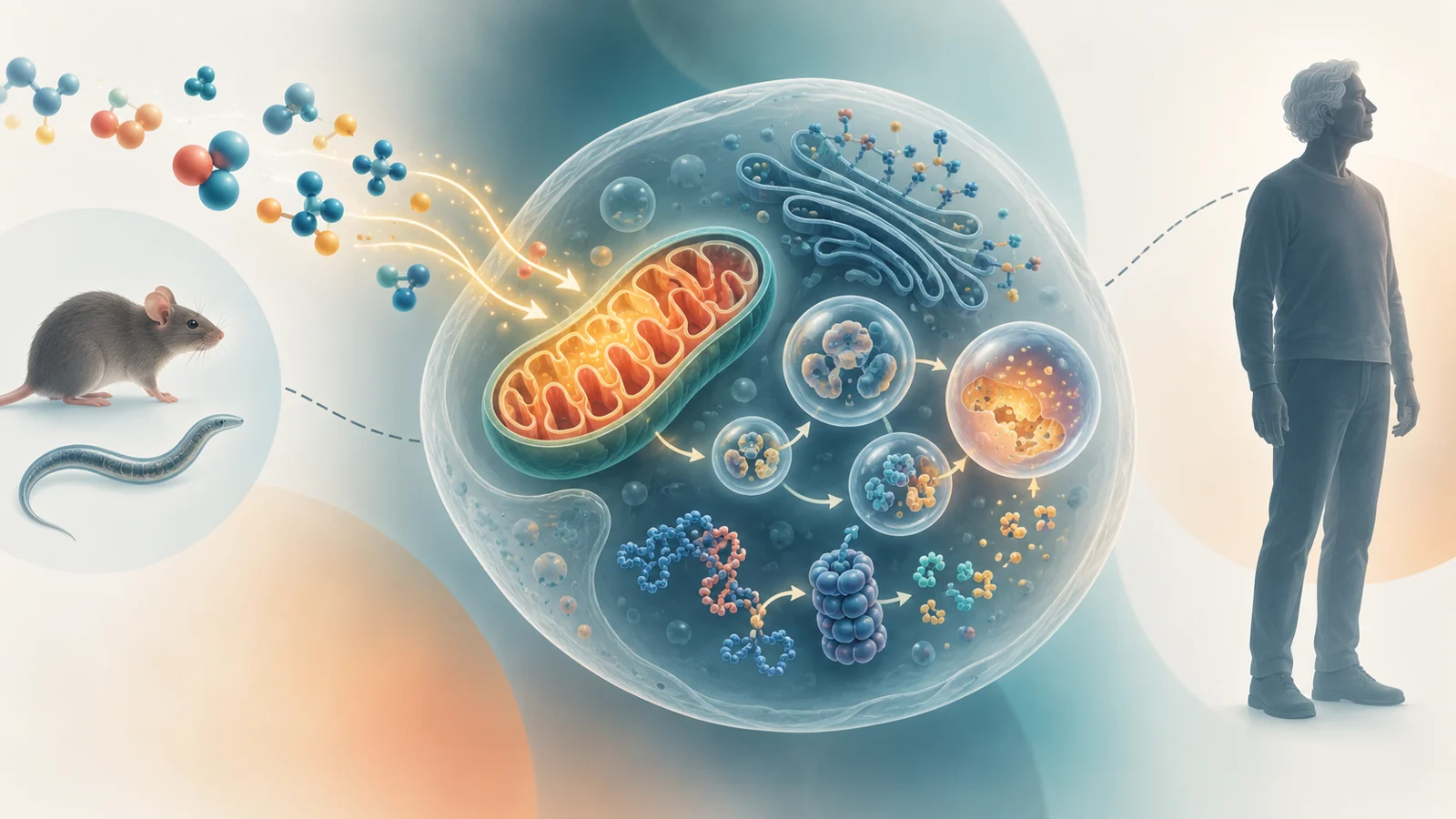
Mitochondria are involved in ATP production, calcium balance, reactive oxygen species, apoptosis, mitophagy, and iron-sulfur cluster formation. Their function changes with age, and mitochondrial dysfunction is treated in the review as one of the major biological features associated with aging. Nutrient-sensing pathways connect that energy state to decisions about growth, repair, metabolism, and cellular maintenance.
Several pathways receive attention, including SIRT/NAD+, AMPK, mTOR, and insulin or insulin-like growth factor signaling. These systems are related, but they do not all perform the same job. AMPK and SIRT1, for example, are discussed in connection with energy sensing and mitochondrial regulation. Compounds such as berberine and resveratrol are used in the review to illustrate those relationships, while PGC-1α appears as part of the discussion of mitochondrial biogenesis.
The mTOR system shows why pathway manipulation is more complicated than switching a beneficial signal on or off. mTOR complex 1 promotes anabolic activity, including protein and lipid synthesis, while also suppressing autophagy, the process that helps break down and recycle cellular material. mTOR complex 2 is associated with cell survival, cytoskeletal organization, and glucose and lipid metabolism. The review notes that excessive mTORC1 activity is linked with age-associated disease processes, but also that suppressing mTORC2 can reduce lifespan and create adverse metabolic changes. A useful intervention would therefore need to act with enough selectivity to preserve necessary functions rather than broadly blocking a pathway because one part of it is implicated in aging.
This mechanistic language explains why a compound can look compelling in a molecular diagram while its practical effect remains uncertain. The pathway is real; the translation from pathway to durable human benefit is the harder question.
Similar claims can hide very different outcomes
The examples in the review illustrate why population, intervention or exposure, and measured outcome should be kept visible.
Berberine is discussed in relation to people with type 2 diabetes and metabolic problems such as impaired glycemic control, insulin sensitivity, insulin secretion, endothelial function, and lipid balance. The review also describes a proposed mechanism involving AMPK activation, downstream SIRT1 activity, mTOR suppression, autophagy, and mitochondrial biogenesis. Here, the practical focus is a disease-related metabolic outcome, with molecular pathways offered as an explanation for how it might occur.
Icariin presents a different kind of evidence. In aging rodents, the compound was associated with improved brain-related function, motor coordination, and learning measures, alongside changes in oxidative, inflammatory, and aging-related signaling markers. The review also discusses neuronal autophagy and mitophagy through the AMPK/mTOR/ULK1 pathway and changes in gut microbial profiles. These are functional and cellular findings in an animal model, not observations of longer healthy life in people.
Omega-3 fatty acids provide a third pattern. The review describes associations between higher circulating omega-3 levels and lower risk of premature death from cardiovascular disease, cancer, and other causes. Separately, it describes observational associations between dietary omega-3 intake and cognitive performance. A circulating level is an exposure or biological measurement, not the same thing as assigning people to take a supplement. The association therefore cannot by itself show that supplementation causes the mortality outcome.
None of these examples needs to be dismissed to be interpreted correctly. They answer different questions. Metabolic control in people with diabetes, improved function in aging rodents, and a human association involving circulating fatty acids should not be collapsed into a single claim that a product slows aging in everyone.
Experimental context can change the meaning of a result
Resveratrol is a useful example of why a promising mechanism does not guarantee the same outcome across settings. The review describes preclinical evidence involving mitochondrial function, redox and inflammatory systems, and cellular signaling. It also notes that resveratrol extended lifespan in some model organisms and in mice fed a high-fat diet, but did not extend lifespan in mice receiving a normal diet. The result depends on the biological and dietary context in which the compound is tested.
Curcumin raises a different interpretive issue. It is widely studied and is discussed in connection with autophagy and mitophagy, inflammation, oxidation, AMPK, SIRT1, mTOR, and mitochondrial function. The review explicitly flags concerns about bioavailability and about interpreting results involving the compound. A substance can be administered in an experiment, produce a measurable response under those conditions, and still require careful analysis before that response is treated as a reliable effect in human tissues.
These examples also explain the review’s call for larger, well-controlled studies that reflect the conditions of older age and everyday behavior. Human aging is heterogeneous, and a useful intervention would need to produce durable functional benefits with acceptable safety in relevant populations. Laboratory mechanisms can guide that work, but they cannot substitute for it.
What this could change
The most valuable possibility raised by this research is not a promise of indefinite life. It is the prospect of helping older adults preserve physical and cognitive function for longer and spend less time in frailty. Nutrients or naturally derived compounds could eventually contribute to that goal if their molecular effects translate into sustained, meaningful improvements in human health and remain safe under real-world conditions.
The April 2022 review supports that possibility as a direction for research, especially around mitochondrial maintenance and nutrient sensing. It does not establish a general supplement regimen that extends human lifespan. The practical payoff depends on showing that pathway changes become durable functional benefits in people, rather than stopping at attractive results in cells, animals, or disease-specific measurements.
Key Sources
- Primary source: Dietary Supplements and Natural Products: An Update on Their Clinical Effectiveness and Molecular Mechanisms of Action During Accelerated Biological Aging.
DOI or Journal Page · Review or Meta-Analysis · 2022-04-28
Keep exploring