
Research Signal – Source date 2021-10-14
Aging research has increasingly focused on a curious kind of cell: one that has stopped dividing but has not stopped functioning. These senescent cells remain metabolically active. Some can release inflammatory signals and other substances that affect nearby tissue. The growth arrest itself can be protective, because it helps prevent damaged cells from continuing to divide. When senescent cells persist and accumulate, however, their secretions and altered behavior may contribute to chronic disease.
That creates an appealing therapeutic idea. Instead of trying to repair every damaged cell, perhaps a drug could identify and remove cells whose continued presence is harming tissue. Such drugs are called senolytics. The challenge is that senescent cells are not a single, uniform population, and a survival mechanism that protects a senescent cell may also matter in healthy cells.
A review published on October 14, 2021, organized the emerging discovery strategies around that problem. It described ways to identify vulnerable senescent cells, redesign compounds to improve selectivity, and test whether a promising biological mechanism can translate into a useful treatment.
The first question is how a senescent cell survives
One route begins with molecular evidence. Researchers compare senescent cells with dividing cells using information about gene activity, proteins, lipids, or metabolism. The aim is to find survival systems that senescent cells rely on more heavily than their healthier neighbors. These systems are known as senescent cell anti-apoptotic pathways, or SCAPs.
The logic is similar to finding a structural weakness. If a senescent cell depends on several anti-death signals to remain alive, blocking the right combination may push it toward apoptosis, a controlled form of cell death. The review describes several candidate systems, including tyrosine kinase and ephrin signaling, the BCL-2 protein family, PI3K and AKT signaling, p53-related pathways, and HIF-1α.
This approach produced one of the best-known early senolytic combinations: dasatinib and quercetin, often abbreviated as D plus Q. Dasatinib inhibits multiple tyrosine kinases and was effective against senescent preadipocytes in the experiments summarized. Quercetin, a naturally occurring flavonoid, affected several survival pathways and preferentially killed senescent endothelial cells. Used together, the two compounds more efficiently induced apoptosis across both described cell populations.
The important lesson is not simply that combining two compounds is better. It is that the cell population used for discovery changes what the result means. A compound that appears selective in senescent preadipocytes may behave differently in endothelial cells, fibroblasts, or another tissue. Discovery therefore depends on the biological setting as much as on the chemical structure. A positive result in one model identifies a vulnerability to investigate, not a universal property of all senescent cells.
Screening finds effects that molecular maps may miss
A second route starts with compounds rather than a preselected pathway. Researchers can screen drug libraries against different kinds of senescent cells and look for preferential cell killing. This may reveal activity that was not predicted from an initial molecular analysis, especially when several survival mechanisms operate at once.
The two approaches can also reinforce each other. Screening can identify a compound with a useful effect, while transcriptomic, proteomic, lipidomic, or metabolic analysis can help explain which survival dependency made the cells vulnerable. The result is a cycle between observation and mechanism: test a chemical, identify the susceptible population, examine its biology, then refine the compound or select a better-matched target.
The review also described a third source of ideas: comparing genetic variants associated with exceptional longevity. Early findings discussed in the paper suggested that some rare variants in centenarian cohorts might be associated with a lower senescent-cell burden with age. The proposed implication was that drugs aimed at pathways altered in those individuals could eventually influence senescent-cell accumulation. This remained a route for investigation, not a demonstrated treatment for human aging.
Drug engineering can change where toxicity appears
Navitoclax provides a clear example of why discovery is only the beginning. It inhibits several members of the BCL-2 protein family, including BCL-2, BCL-XL, and BCL-W. Because these proteins help regulate cell survival, blocking them can trigger apoptosis in some senescent cells. In the experiments summarized by the review, navitoclax selectively killed senescent endothelial cells and fibroblasts but not primary human preadipocytes.
Navitoclax also presented a development problem. The review describes severe thrombocytopenia and neutropenia—low platelet and neutrophil counts—in patients treated with navitoclax. It suggests that inhibition of multiple BCL-2 family proteins may contribute to this toxicity. A compound can therefore have a compelling senolytic mechanism and still be difficult to use as a medicine.
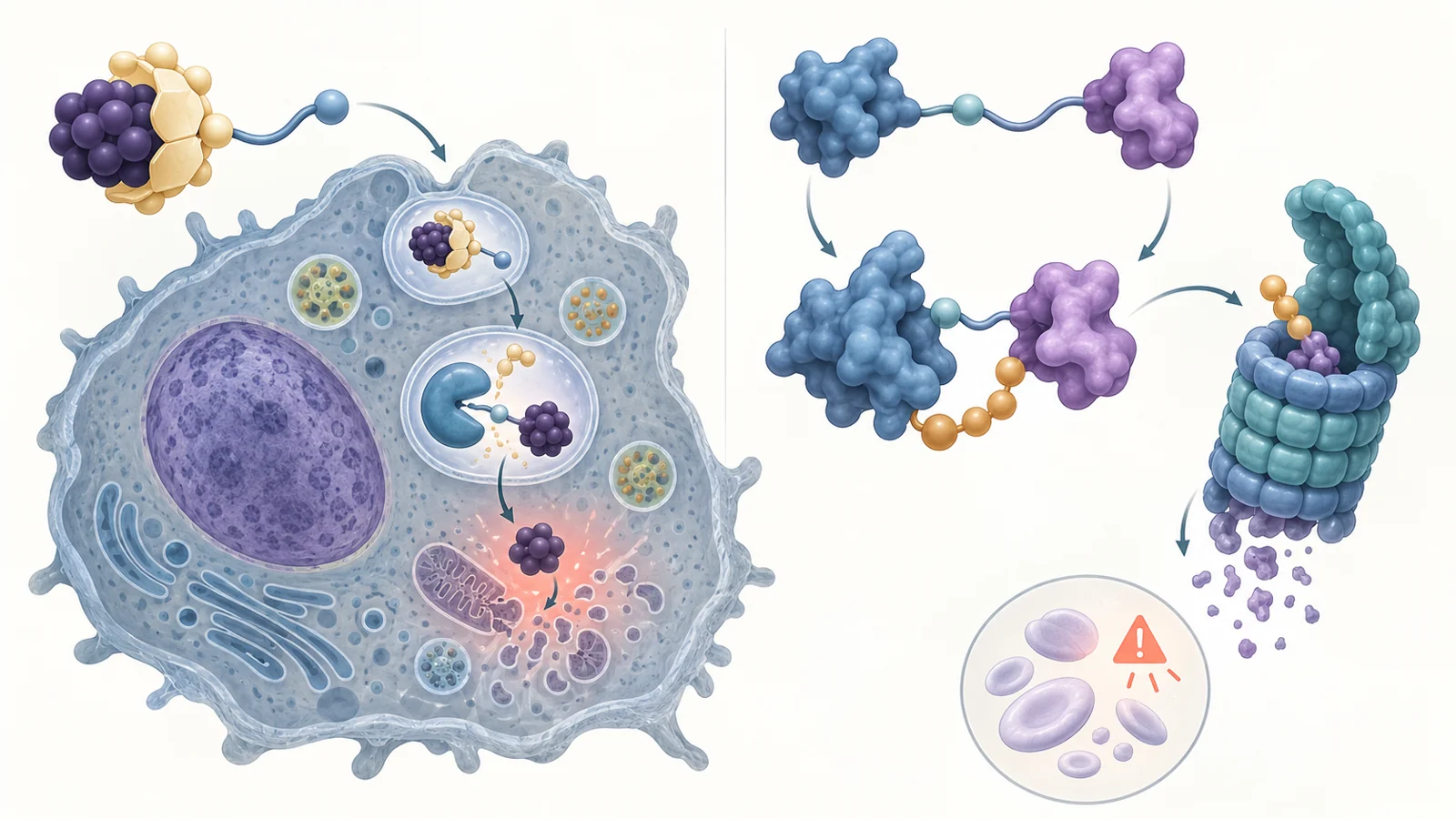
One response is to build a prodrug that becomes toxic only after an activation step. In the examples discussed, researchers attached an acetylated galactose group to compounds such as navitoclax. Senescent cells can process the galactose-linked design through lysosomal β-galactosidase activity, releasing the toxic action inside the cell environment where that activation occurs. Nav-Gal, the galactose-modified form of navitoclax, reduced platelet toxicity relative to navitoclax in the reported experiments.
That finding illustrates the value of changing the delivery logic rather than abandoning the target. The compound still uses a BCL-2-family vulnerability, but the galactose-linked form adds an enzyme-dependent step. Other examples in the review applied the same general idea to gemcitabine, a seco-duocarmycin analogue, and 5-fluorouracil. These prodrugs preferentially killed senescent cells in the reported cell and animal experiments.
A different redesign uses targeted protein degradation. The PROTAC-based senolytic PZ15227 connected an ABT-263-derived BCL-XL inhibitor to a pomalidomide moiety. Pomalidomide recruits the cereblon E3 ligase, part of the cell’s protein-disposal machinery, so the linked molecule directs BCL-XL toward proteasomal degradation. In aged mice, the review reports that PZ15227 cleared senescent cells more potently than ABT-263 and showed less platelet cytotoxicity.
These two examples solve different engineering problems. Nav-Gal makes toxic activity dependent on an enzymatic activation step. PZ15227 changes the fate of a target protein by recruiting a disposal system. Their reported advantages belong to the particular experimental settings in which they were studied. Neither comparison establishes the elimination of toxicity or a clinically validated safer treatment for people.
A prior treatment can create a new vulnerability
Senolytics may also be useful as the second step in a sequence. Cancer treatments can push tumor cells, as well as some normal cells, into senescence. A later senolytic could then be applied to remove cells that have entered that altered state. The review refers to this as a one-two punch strategy.
A melanoma example shows why timing matters. ABT-263 had little effect on the cancer cells in the initial condition described. After an earlier treatment with an aurora kinase inhibitor induced senescence, the melanoma cells became susceptible to ABT-263. The first treatment changed the cell state; the second exploited the resulting vulnerability.
This approach could be useful in cancer research because it treats susceptibility as something that can be engineered over time. It also makes the experimental sequence central to interpretation. A senolytic that is inactive against untreated cancer cells may still have a role after another therapy has altered those cells. The cancer examples in the review support investigation of such combinations, but they do not establish improved survival or reduced relapse in patients.
A promising mechanism still has to cross the clinical gap
The diversity of senescent cells complicates every stage of translation. Cells differ by tissue, species, individual, and the event that caused senescence. Replicative stress, DNA damage, oxidative stress, oncogene activation, radiation, chemotherapy, and inflammatory signals can produce related but biologically different states. Their survival pathways, metabolism, and secreted factors may not match.
The review gives ABT-263 as a practical example. It selectively induced cell death in senescent human umbilical vein endothelial cells, IMR-90 fibroblasts, and mouse embryonic fibroblasts, while primary human preadipocytes were less affected. The review suggests that differences in the predominant survival pathways may help explain this cell-type selectivity. Testing one population cannot settle how the compound will behave in another tissue.
UBX0101 shows a different boundary, this time between a biological response and a clinical outcome. The review describes UBX0101 as an inhibitor of the MDM2-p53 interaction that induced apoptosis in senescent chondrocytes in a mouse model of osteoarthritis. It also reports that a phase 2 trial of intra-articular UBX0101 for osteoarthritis did not meet its clinical endpoints.
The two observations answer different questions. The mouse result supplied a rationale for testing the compound in a disease context. The clinical trial asked whether that rationale translated into a meaningful outcome for patients. The reported trial result does not, by itself, explain why the treatment failed to meet its endpoints, and it should not be generalized to every senolytic. It does show why cell killing, tissue response, and patient benefit must be evaluated separately.
What this could change
The practical promise of senolytic research is a future treatment that removes disease-contributing senescent cells while preserving the function of surrounding tissue. For people whose frailty or chronic disease is driven in part by an accumulating senescent-cell burden, that could mean a new way to improve tissue performance without treating aging as a single condition.
Reaching that capability depends on matching the drug to the right senescent-cell population, controlling harm to healthy cells, and demonstrating meaningful patient outcomes with acceptable risks. As of the review’s 2021 perspective, discovery methods such as pathway analysis, compound screening, enzyme-activated prodrugs, and targeted protein degradation were expanding the available options. Their value would ultimately be measured by whether a carefully chosen target-cell match can become a treatment that helps people, not merely a compound that kills cells in a model.
Key Sources
- Primary source: Recent advances in the discovery of senolytics.
DOI or Journal Page · Review or Meta-Analysis · 2021-10-14
Keep exploring