
Research Signal – Source date 2021-09-28
Skin aging is easy to see in a mirror, but its biological consequences extend beyond wrinkles and age spots. Skin becomes thinner and less elastic, its outer barrier can become more permeable and stiff, and recovery after injury can slow. The dermis also loses collagen-producing capacity as fibroblasts change in number, shape and behavior.
A 2021 research synthesis asks whether cellular senescence could be a useful target for these changes. Its focus is not a single newly conducted skin-aging trial. Instead, it brings together findings from cells, constructed skin tissue, animals and human studies to explain why two kinds of senotherapeutics might matter: senolytics, which aim to clear senescent cells, and senomorphics, which aim to quiet harmful signals released by those cells.
The attraction is clear. The treatment problem is harder. A senescent-cell response can sometimes help a wound organize repair, while a persistent population of senescent cells can help keep tissue inflamed and dysfunctional. Any useful treatment would need to control damaging activity without disrupting the work skin still needs to do.
Skin aging is also a loss of resilience
Cellular senescence is a response to damage or stress in which a cell exits the cell cycle and stops dividing. It is different from a temporarily quiescent cell that can resume proliferation, and from a cell that has completed a normal differentiation program. Senescent cells show a collection of features, including increased levels of the cell-cycle inhibitors p16INK4a and p21CIP1, but no single marker is enough to identify every senescent cell.
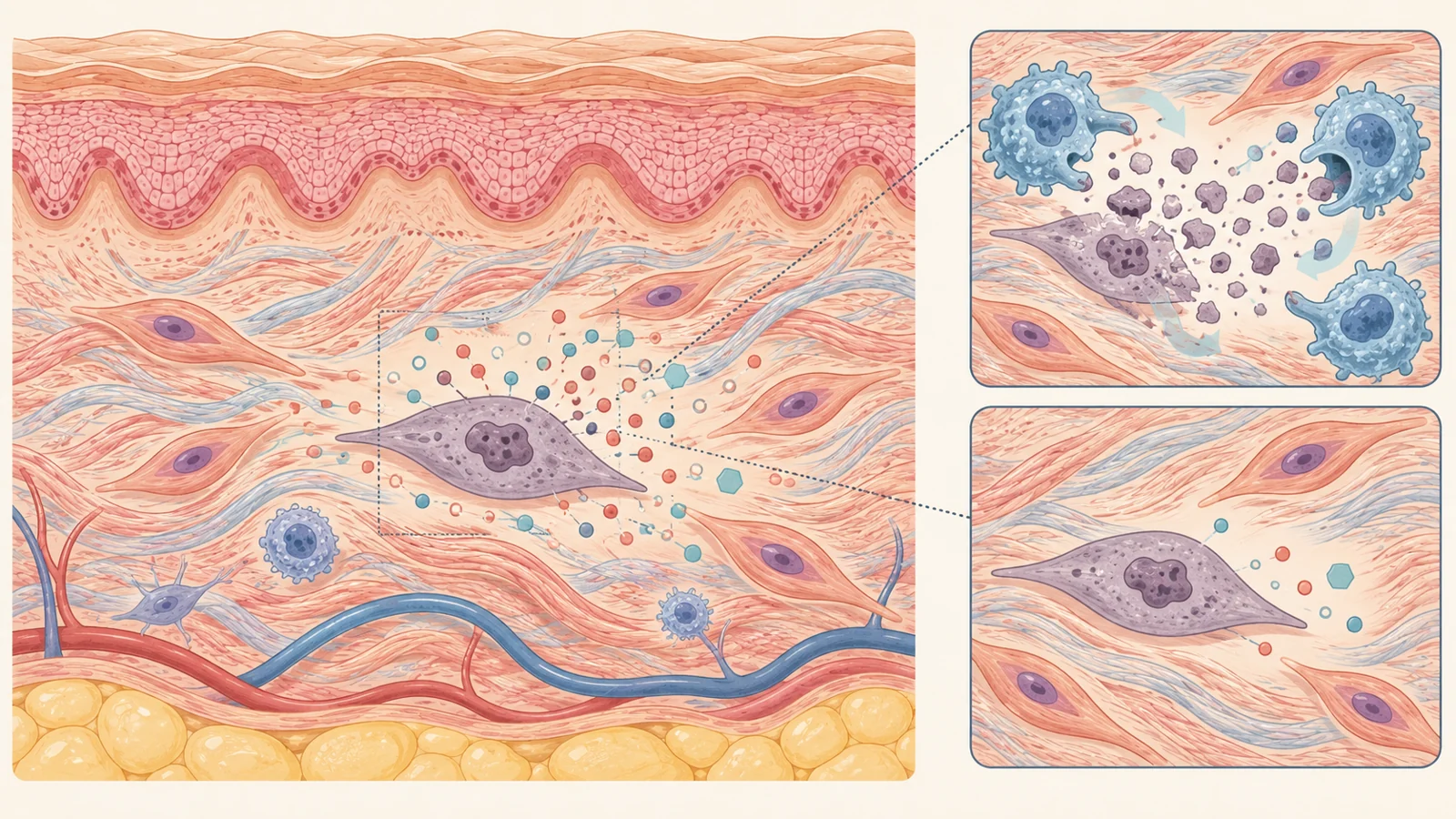
The consequences can begin inside the affected cell. When a progenitor or repair-related cell no longer contributes to tissue renewal, regeneration may weaken. In skin, the fibroblasts embedded in the dermis are especially important because they produce collagen and other extracellular-matrix components that help give tissue strength and structure. The review describes age-associated fibroblast changes alongside reduced collagen production and altered support for nearby epidermal cells.
Senescent fibroblasts can also affect the surrounding tissue through the senescence-associated secretory phenotype, or SASP. This mixture of inflammatory cytokines, chemokines, metalloproteinases, growth factors and other molecules can influence neighboring cells. The review connects senescent fibroblasts with higher levels of factors such as MMP2, MMP9, IL-6 and IL-8, as well as reduced secretion of IGF-1. Those changes can influence keratinocyte growth and differentiation, collagen production and damage in epidermal cells.
This creates two related but distinct problems. A senescent cell may stop making its own useful contribution, while its secretions can make nearby cells behave differently. A treatment that removes the cell and one that changes its secretions are therefore acting on different parts of the biology, even when both are described as senotherapeutic.
Two ways to target the same biology
Senolytics are designed to exploit survival pathways that senescent cells depend on. The review discusses compounds that target pathways involving proteins such as Bcl-2 family members, Akt, PI3K, FOXO4 and p53-related mechanisms. The goal is selective senolysis: removing cells with senescent features while leaving other cells sufficiently intact.
The review discusses dasatinib plus quercetin as a senolytic combination. In cultured human oral keratinocytes and skin fibroblasts driven into senescence by radiation, the combination promoted senescent-cell clearance. The cited experimental work also reported lower p16INK4a and SASP measures and higher Ki67, alongside mitigation of radiation-induced ulcers in mouse oral-ulcer and rat skin-ulcer models. These observations connect the intervention to senescent-cell biology across several settings, but they are not interchangeable evidence of a human skin-aging benefit.
The review also describes ABT-737, which targets Bcl-2 and Bcl-xL. It cleared senescent cells in a constructed living epidermis exposed to repeated UVA and UVB and was associated with reduced mitochondrial reactive oxygen species and less epidermal atrophy in that model. In mice, the compound was associated with senescent-cell elimination and greater hair-follicle stem-cell proliferation. FOXO4-DRI is discussed as another senolytic approach, targeting the interaction between FOXO4 and p53 in mouse models of accelerated and natural aging.
Senomorphics take a different route. Rather than requiring cell clearance, they suppress damaging SASP activity through pathways that include NF-κB, mTOR, IL-1α and p38 MAPK. Rapamycin, an mTOR inhibitor, is the source’s main skin-related example. In a UVA-induced photoaging model, rapamycin was associated with lower senescence and SASP markers, lower oxidative and genotoxic stress, greater autophagy and higher type I collagen expression in human dermal fibroblasts. Nanoparticle delivery also reduced senescence-related features, SASP and reactive oxygen species while improving migration and proliferation in cultured fibroblasts.
Clearing a cell and quieting its secretions are not merely two names for the same intervention. One changes which cells remain in the tissue; the other changes what an existing cell is doing. That difference becomes important when interpreting the human observations summarized by the review.
What the human observations actually show
One cited clinical trial involved people with diabetic kidney disease who received dasatinib plus quercetin. The review reports reductions in skin epidermal cells positive for p16INK4A and p21CIP1, along with reductions in circulating SASP factors. These findings are relevant to whether a systemic senolytic regimen can alter senescence-associated markers in human skin and blood. They do not, by themselves, show improved visible or functional skin aging in otherwise healthy older adults.
A separate interventional study summarized by the review examined topical rapamycin in adults older than 40 with evidence of photoaging. The reported observations included improved clinical appearance, increased collagen VII and reduced p16INK4A and other histological markers associated with aging and senescence. Here, the measured outcomes include both an appearance assessment and tissue changes, which gives the finding a different meaning from the diabetic kidney disease result.
Neither example establishes that rapamycin cleared senescent cells, or that marker changes caused the reported appearance change. A lower marker level can be biologically informative without proving that skin has been broadly rejuvenated. The studies sit within a larger synthesis whose evidence comes from different populations, routes, models and outcomes. Reading them accurately means preserving those contexts rather than combining every observation into one treatment effect.
The evidence ladder also matters. Cultured fibroblasts and keratinocytes can reveal how a compound changes cell behavior under defined conditions. Constructed epidermal tissue can add a layer of organization and tissue interaction. Animal injury models can show how senescence-targeting approaches behave during repair. Human studies bring clinical and tissue observations, but each still answers the particular question its population, route and measurements were designed to address.
Repair depends on timing
Senescence is not simply a biological mistake that should always be erased. The review notes that transient senescence can support skin development, childbirth and wound healing. In a healing wound, senescent fibroblasts can help limit excessive collagen deposition, reducing the risk that repair produces too much fibrosis. SASP-associated metalloproteinases can contribute to collagen breakdown as tissue is reorganized.
The same response becomes more concerning when it persists. Senescent cells that are not cleared can maintain a pro-inflammatory environment, weaken tissue homeostasis and contribute to chronic wounds. Fibroblasts from chronic wounds show several senescence-associated features, including reduced proliferation, oxidative stress and inflammatory cytokines. Their continued presence may hinder the repopulation needed for closure.
Treatment therefore faces a timing problem. During one phase of repair, some senescence-associated activity may help organize the wound. Later, lingering senescent cells may become part of the problem. A drug that removes cells too broadly, or quiets signals at the wrong moment, could interfere with a useful process even if it improves another measure. The relevant question is not simply whether a compound lowers a marker, but whether it changes tissue behavior in a way that remains beneficial across the treatment context.
From promising compounds to workable treatment
Selecting a candidate is only one part of developing a skin senotherapeutic. Senescent cells are heterogeneous, and the populations that matter may differ by skin layer, cause of damage, age and disease context. The review points to single-cell and spatial multi-omics as approaches that could help identify which cells become senescent, which survival pathways they use and how they influence the local microenvironment.
Delivery adds another design problem. A topical treatment may concentrate action in skin, while an oral treatment could affect senescent cells throughout the body. The appropriate route depends on the target population and the desired balance between local effect and broader exposure. The source discusses the potential of both topical and oral approaches, but it does not establish a preferred regimen.
Schedule matters as well. Senotherapeutics may need to be used at a particular stage of accumulated damage, wound repair or chronic inflammation. Long-term use raises further questions about off-target effects and interference with other roles of senescence. Improving specificity, directing a compound to the relevant tissue and determining when treatment should begin or stop are practical requirements, not afterthoughts.
For readers, the key interpretive habit is to keep three outcomes separate: a change in cultured-cell behavior, a change in markers within human skin, and a visible or functional improvement in people. They can support the same biological story, but they are not equivalent proof. The topical rapamycin observation is important partly because it included an appearance measure; the diabetic kidney disease observation is important for a different reason, showing that a systemic intervention was associated with changes in skin markers. Neither resolves the larger treatment-design problem alone.
What this could change
A successful skin senotherapeutic could eventually help older adults preserve more than a smoother appearance. By selectively controlling damaging senescent-cell activity, treatment might help maintain skin strength, barrier resilience and the ability to recover from injury while reducing the inflammatory effects that contribute to chronic dysfunction.
That benefit remains conditional on solving the central biological tension. Researchers would need to identify the harmful senescent populations, establish durable schedules and delivery methods, and show that treatment does not disrupt useful repair or create unacceptable off-target effects. If those conditions are met, targeting senescence could become a way to preserve important skin functions during aging rather than simply pursuing a cosmetic change.
Key Sources
- Primary source: Targeting Cellular Senescence with Senotherapeutics: Development of New Approaches for Skin Care.
DOI or Journal Page · Peer-Reviewed Paper · 2021-09-28
Keep exploring