
Research Signal – Source date 2026-02-12
Parkinson’s disease is usually described through the loss of dopamine-producing neurons. A review published on February 12, 2026, asks whether part of that damage may be connected to a less obvious change: the aging immune system becoming less protective while remaining persistently inflammatory.
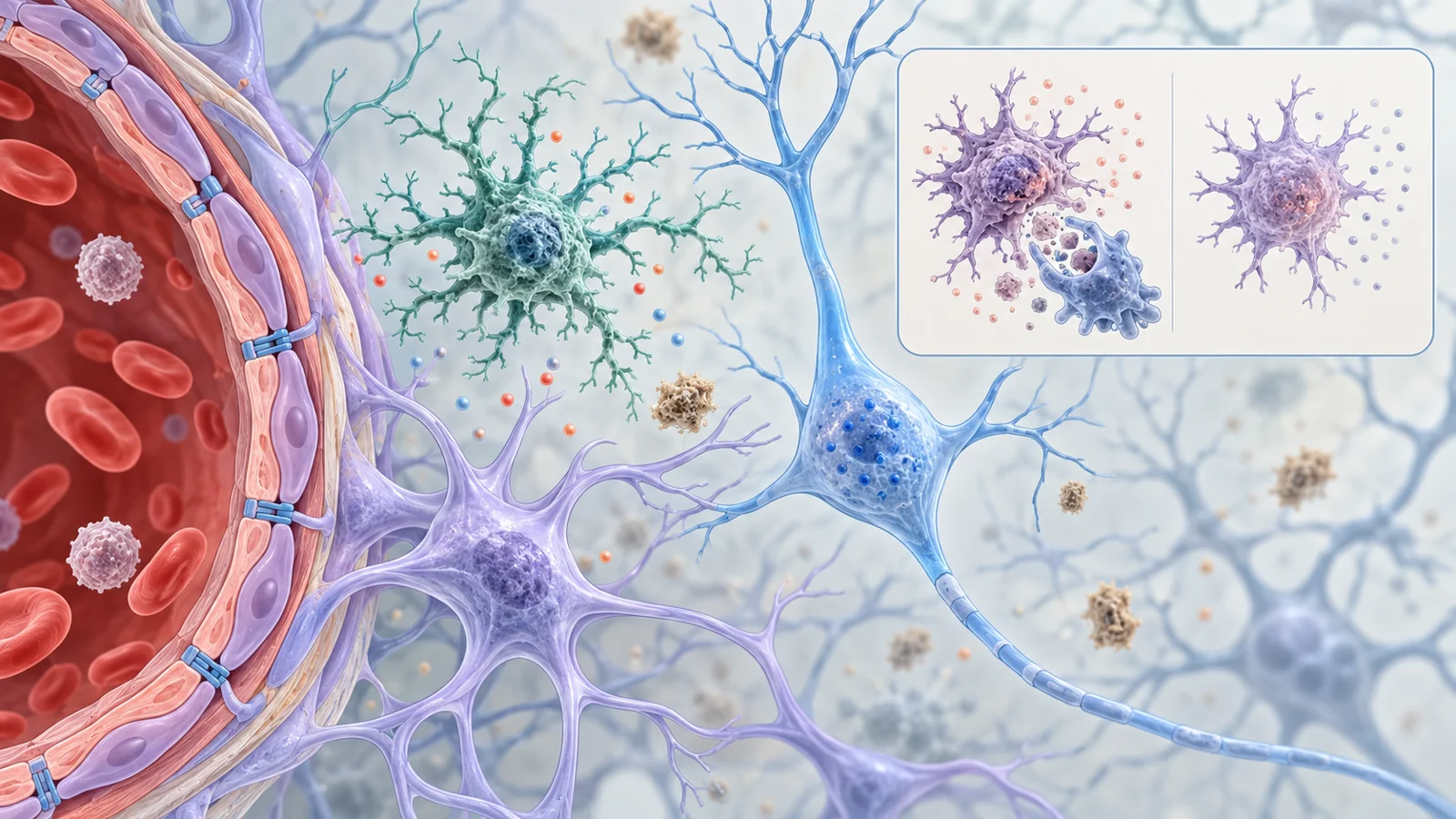
That apparent contradiction is central to the idea of immunosenescence and inflammaging. Immunosenescence means age-related dysfunction in immune defenses. Inflammaging describes the chronic, low-level inflammatory environment that can accompany those changes. The review brings these processes together with blood-brain barrier damage, altered glial activity and the accumulation of abnormal alpha-synuclein, a protein whose misfolded aggregates are implicated in Parkinson’s disease.
The therapeutic question is not simply whether inflammation is present. It is whether particular aging-related immune processes can be identified and changed without removing useful immune functions.
How weaker defenses can still produce inflammation
Aging can reduce the immune system’s ability to respond cleanly while leaving the body in a more inflammatory state. The review describes thymic involution, which reduces the output of naïve T cells and narrows the range of immune receptors available to recognize new threats. At the same time, senescent, terminally differentiated memory T cells can accumulate. Examples discussed in the review include CD28-negative and CD57-positive subsets.
Innate immune cells also change. Macrophages and dendritic cells may have reduced phagocytic capacity or impaired antigen presentation. These are protective functions: they help immune cells identify, contain and clear material that should not remain in tissue. When they decline, immune surveillance becomes less effective. Yet the surrounding system can still produce inflammatory signals over long periods.
This is how declining immunity and damaging inflammation can coexist. The immune system may be less capable of resolving threats, while its altered cells and tissues maintain signals that keep inflammation active. In Parkinson’s disease, the review links this systemic environment to changes in the brain’s protective interfaces and resident immune cells. The proposed relationship is biologically plausible, but its timing and causal order in people remain unsettled.
A more permeable barrier changes the brain’s immune environment
The blood-brain barrier normally helps regulate what moves between the circulation and the central nervous system. With aging, structural components of that barrier can deteriorate, including tight-junction proteins such as claudin-5 and the endothelial glycocalyx. Greater permeability could allow inflammatory mediators and peripheral immune cells to reach the brain more readily.
Inside the brain, microglia act as resident immune cells. They monitor the local environment, respond to abnormal material and help clear cellular debris. In an aging brain exposed to more inflammatory pressure from the periphery, microglia may remain activated for too long or respond in ways that become harmful to nearby neurons. Other glial cells can also enter senescence and alter the chemical environment around them.
The review describes this combination as neuroinflammaging: systemic immune aging, a weakened blood-brain barrier and senescent glial activity converging in the central nervous system. In Parkinson’s models, this environment is associated with greater vulnerability of dopamine-producing neurons. The proposed sequence matters because it identifies several possible intervention points rather than treating “inflammation” as one undifferentiated target.
Why abnormal alpha-synuclein can keep the response going
Alpha-synuclein is a normal neuronal protein, but abnormal forms can misfold and aggregate. The review connects age-related declines in immune clearance with the persistence of pathological alpha-synuclein and the formation of Lewy bodies, a hallmark associated with Parkinson’s disease. Aging can also disrupt intracellular systems that help handle misfolded proteins, including the autophagy-lysosomal and ubiquitin-proteasome systems.
Senescent microglia may be less effective at removing abnormal alpha-synuclein. Aggregated alpha-synuclein can in turn stimulate microglial pattern-recognition receptors and the NLRP3 inflammasome, an inflammatory signaling complex. In mouse experiments using alpha-synuclein preformed fibrils, the review reports heightened neuroinflammation, T-cell infiltration and faster neuronal loss in aged animals.
Senescent cells add another layer. Their senescence-associated secretory phenotype, often called SASP, is the mixture of molecules they release into surrounding tissue. These secretions can include inflammatory cytokines such as IL-6, IL-1β and TNF-α, chemokines that recruit immune cells, growth factors that may affect barrier integrity and proteases such as matrix metalloproteinases. The composition varies with the cell type, initiating stress and local environment.
Together, impaired clearance, activated microglia and senescent-cell secretions can reinforce one another. More abnormal protein can provoke inflammatory signaling; persistent signaling can make the local environment less capable of restoring balance; and further neuronal injury can add material that the aging system struggles to process. This reinforcing mechanism is a useful explanation for how inflammation might contribute to progression, but it is not yet proof that one link controls the timing of human Parkinson’s disease.
What senolytics would change
Senolytics are drugs intended to eliminate senescent cells. In the Parkinson’s models summarized by the review, clearing senescent glial cells reduced inflammatory activity and protected dopamine-producing neurons. In alpha-synuclein preformed-fibril mice, the senolytic compound ABT-263, also known as navitoclax, was associated with prevention of neuronal loss and motor decline.
A different strategy would leave senescent cells alive but suppress their harmful secretions. SASP inhibition aims to reduce the inflammatory messages released into the surrounding tissue. Other approaches target selected cytokines or signaling pathways, including IL-1-related signaling, JAK/STAT activity or the NLRP3 inflammasome. These options change different parts of the process:
- Senolytics change the number of senescent cells.
- SASP-directed treatments change what those cells release.
- Cytokine-targeted treatments interrupt particular inflammatory messages.
The distinction is practical. Eliminating a cell may have a broader effect than blocking one secretion, but it also raises a greater risk of removing a cell that has another useful role. A narrow cytokine intervention may be more selective, yet inflammatory pathways often participate in several processes at once. The review also discusses regulatory T-cell therapies and immune-rejuvenation approaches, but these would involve reshaping immune regulation rather than simply removing a local cell population.
A drug reaching the brain is only one piece
A promising mechanism still has to become a workable treatment. The compound must reach the relevant cells in the brain, at an effective exposure, without causing unacceptable effects elsewhere. The review uses a small human study in mild Alzheimer’s disease to illustrate why drug detection and clinical benefit are separate questions.
Among five participants who completed a 12-week treatment involving dasatinib and quercetin, dasatinib was detected in the blood of all five and in the cerebrospinal fluid of four. Quercetin was detected in blood but not at a detectable level in cerebrospinal fluid. The observation suggests that dasatinib can enter the central nervous system, although at relatively low concentrations in that study.
It does not show that the compound reaches the relevant senescent cells in Parkinson’s disease, that the exposure is sufficient to change their behavior or that treatment improves symptoms or slows neuronal loss. The participants had Alzheimer’s disease, not Parkinson’s disease, and the finding concerns measured exposure rather than therapeutic effect. For a Parkinson’s treatment, brain penetration would have to be connected to a defined biological target and then to a meaningful change in disease course.
Useful senescent cells complicate the target
Identifying senescent cells is a separate challenge from delivering a drug to the brain. The review describes commonly discussed markers such as p16INK4a and senescence-associated beta-galactosidase, but emphasizes that no single marker reliably identifies the same harmful cell population across tissues and conditions. Senescent cells are heterogeneous: their molecular profiles, secretions and sensitivity to drugs can differ.
Some senescent cells may also contribute to beneficial processes, including tissue repair and wound healing. A non-selective clearance strategy could therefore remove cells that are harmful in one setting but useful in another. The goal would not be to erase senescence everywhere. It would be to distinguish a disease-relevant population, understand when it is driving pathology and intervene without disrupting necessary repair.
That requirement makes patient selection important. A blood or cerebrospinal-fluid measurement might eventually help identify an inflammatory state, while advanced imaging could help show neuroinflammation or alpha-synuclein aggregates. But candidate markers would need to be tested across large, diverse groups and linked to treatment response before they could guide decisions for individual patients.
Human timing remains unresolved
The review is explicit about a major gap between mechanism and intervention. The temporal and causal relationships between systemic immunosenescence and inflammation within the central nervous system still require validation in longitudinal human studies. A biological process can be associated with Parkinson’s disease without being the event that initiates progression, the factor that accelerates it or the best point for treatment.
Timing may differ among patients and across disease stages. Immune aging is not identical from one person to another, and the same inflammatory pathway may have different consequences depending on the state of the blood-brain barrier, glial cells and protein-clearance systems. A treatment that is useful during one phase could be less useful later, or could require a different target altogether.
This is also where animal evidence has to be interpreted carefully. Mouse models can show that clearing senescent glia changes neuroinflammation or preserves neurons under defined experimental conditions. They do not by themselves establish that senolytic treatment slows Parkinson’s progression in people. Human-relevant models, longitudinal cohorts and validated biomarkers will be needed to connect a proposed mechanism to the patients most likely to benefit.
What this could change
The practical payoff would be a way to preserve dopamine-producing neurons and slow the loss of function that Parkinson’s can bring. That becomes a credible clinical possibility only if researchers can identify an immune-aging process that is genuinely modifiable in patients, deliver the intervention into the brain and distinguish harmful senescent activity from useful cellular functions.
Success could eventually mean treatments chosen for a person’s immune and brain biology rather than for Parkinson’s disease as one uniform condition. Senolytics, secretion-blocking drugs or targeted immune modulators might then be used to interrupt a defined process before it causes further neuronal damage. For now, the review supports a promising therapeutic direction and a demanding set of conditions, not an available disease-modifying treatment.
Key Sources
- Primary source: Immunosenescence and inflammaging in Parkinson's disease: mechanisms and therapeutic prospects.
DOI or Journal Page · Review or Meta-Analysis · 2026-02-12
Keep exploring