
Research Signal – Source date 2022-12-16
Aging-related illness is usually treated after it appears: heart failure is managed once the heart can no longer keep up, and diabetes is addressed once glucose regulation has become abnormal. But what if some disease risk could be reduced earlier by protecting the biological systems that gradually become less reliable with age?
That is the prevention question behind the 2022 synthesis Aging and aging-related diseases: from molecular mechanisms to interventions and treatments. It brings together several levels of biology, from damaged proteins and mitochondria to senescent cells, altered tissue communication and organ-specific disease. The goal is not to announce a single antiaging treatment. It is to explain why researchers are interested in intervening in the processes that contribute to illness before substantial damage develops, and why that ambition still needs careful translation into human benefit.
The prevention question starts inside cells
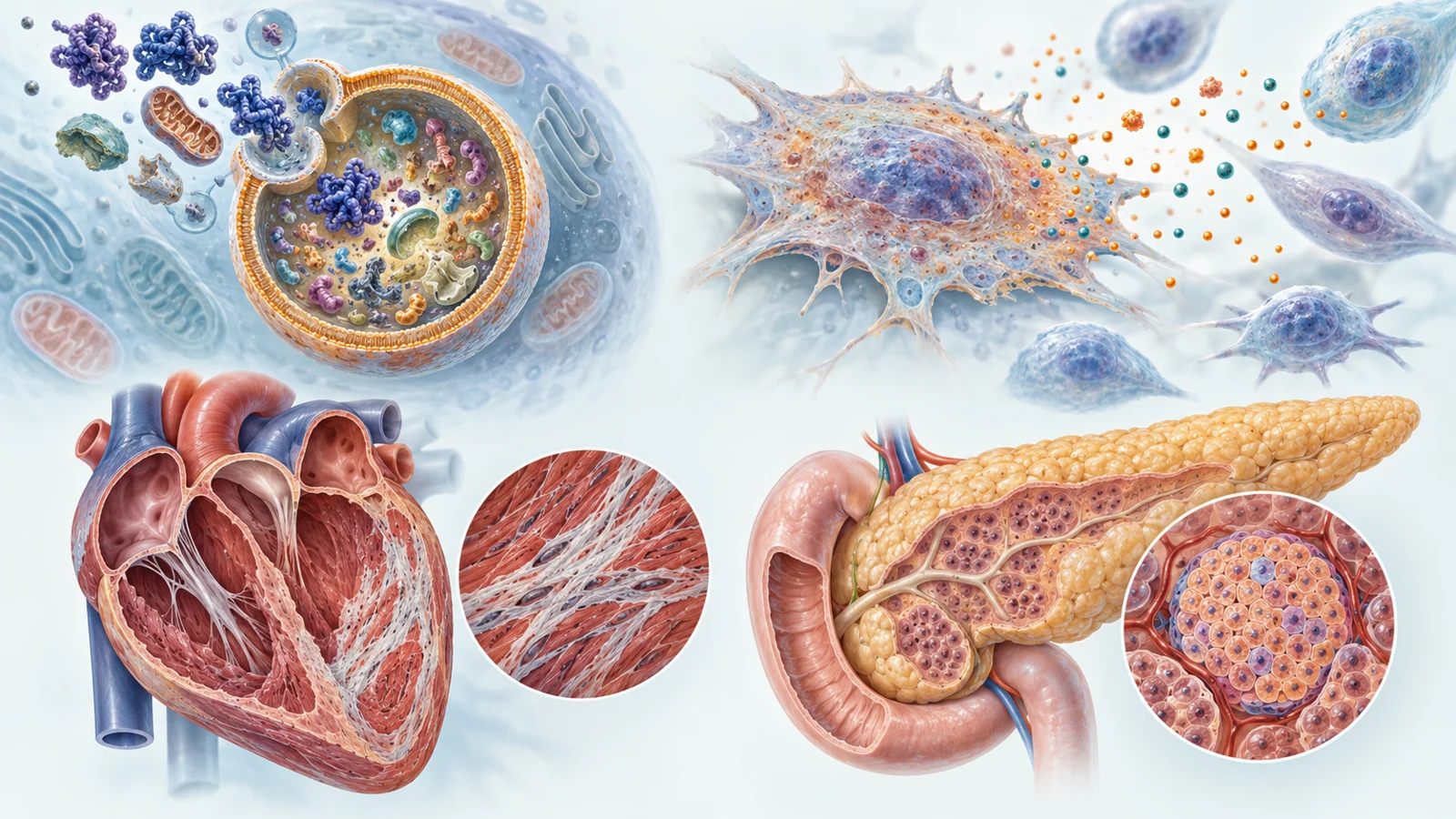
The review organizes aging mechanisms into molecular, cellular and systemic changes. At the molecular level, it discusses genomic instability, telomere dysfunction, epigenetic alterations, loss of proteostasis, impaired autophagy and mitochondrial dysfunction. At the cellular level, it considers cellular senescence, exhaustion of stem cells and changes in communication between cells. Deregulated nutrient sensing connects these processes to broader physiological control.
These categories are not separate explanations competing to be the one cause of aging. They describe interacting ways in which cells can lose the ability to maintain themselves, respond to stress or support neighboring tissue. A protein may fold incorrectly. A damaged cellular component may not be removed efficiently. A mitochondrion may become difficult to control. A cell that has stopped dividing may remain metabolically active and alter its surroundings.
The attraction of this approach is practical. If several diseases share some underlying maintenance problems, then intervention before disease becomes advanced might preserve function across more than one tissue. Yet a shared mechanism is only a starting point. The useful outcome would have to be demonstrated in the organ, patient group and function that matter.
Maintenance systems that keep damage in check
One basic cellular task is proteostasis, the management of proteins so they are produced, folded and maintained in workable forms. The review describes chaperones as one part of this system. They bind unfinished peptide chains, helping prevent premature folding and supporting the correct shape. They also help limit protein denaturation during cellular stress. When proteostasis is impaired, misfolded proteins can become especially relevant to neurodegenerative disease.
Autophagy is another maintenance process. It is the cell’s way of breaking down and recycling components, including defective organelles and misfolded protein aggregates, through lysosomes. In the synthesis, reduced autophagic activity is described across tissues and species as an age-associated change. When lysosomal breakdown becomes less effective, damaged material can accumulate and contribute to cellular dysfunction.
Damaged mitochondria provide a more specific example. Mitochondria are cellular structures involved in energy-related functions, but they also need quality control. Mitophagy, a selective form of autophagy, removes mitochondria that are damaged or no longer needed. The review also discusses mitochondrial-derived vesicles as a quality-control route involved in maintaining mitochondrial stability during early cellular stress. These mechanisms show why “cellular maintenance” is more than a general metaphor: it includes distinct operations for handling proteins, organelles and stress.
The intervention idea follows from the biology. Preserving or restoring these operations could, in principle, reduce the burden placed on cells over time. But an improvement in a maintenance pathway would still need to produce a meaningful functional benefit in people. Better recycling inside a cell is not automatically the same as fewer heart-failure symptoms, preserved cognition or longer life.
Senescent cells change their neighborhood
Cellular senescence describes a state in which a cell stops dividing. The review distinguishes replicative senescence, which can follow a limited number of cell divisions and telomere shortening, from stress-induced premature senescence associated with factors such as DNA damage and oxidative stress. Both involve cell-cycle arrest through pathways including p53/p21 and p16Ink4a/retinoblastoma signaling.
A senescent cell is not simply an inert cell that has disappeared from the tissue. Senescent cells can release a collection of cytokines, inflammatory factors and adhesion factors known as the senescence-associated secretory phenotype, or SASP. These secreted signals can alter nearby cells and the surrounding tissue environment. The reported effects include chronic inflammation and the passive senescence of otherwise healthy cells.
This creates two related but different intervention ideas. One is senolysis, or removing senescent cells. The other is changing the harmful signals they release, such as by targeting aspects of the SASP. Those approaches address different points in the biology. Clearing a cell and altering its communication are not interchangeable strategies, even if both aim to reduce the effects of senescence.
The review summarizes mouse findings in which clearing senescent cells alleviated several aging-related diseases and prolonged lifespan. It also describes evidence that systemic signals can influence distant tissues, including an experiment in which young cerebrospinal fluid improved memory function in aged brains through effects on oligodendrocyte progenitor cells. These findings make cellular communication an important research direction, while leaving open how such interventions would perform across human tissues and over long periods.
One biology, different organs
The consequences of aging-related cellular changes depend on the tissue in which they occur. The heart offers one example. The synthesis links senescent cardiomyocytes with conduction abnormalities, mitochondrial dysfunction, oxidative stress and metabolic dysfunction. Senescent heart cells may also encourage neighboring healthy cells to become senescent and activate cardiac fibroblasts through paracrine signaling. Fibroblast activation can contribute to cardiac fibrosis, while the SASP of senescent cardiomyocytes may promote progression of heart failure.
The pancreas presents a different functional problem. Pancreatic beta cells secrete insulin and help maintain glucose and lipid balance. In pancreatic beta cells from people with type 2 diabetes, the review reports shortened telomeres, which may impair beta-cell proliferation and insulin secretion. In mice with short telomeres, the synthesis reports impaired insulin secretion and glucose intolerance, as well as increased beta-cell senescence in pancreatic islets.
Both examples involve aging-related cellular stress, but the practical failure is not the same. In cardiac tissue, altered cell behavior can affect conduction, fibrosis and the heart’s ability to function. In pancreatic beta cells, the central consequence is impaired insulin release and disrupted glucose regulation. A molecular process shared across tissues does not guarantee that one treatment will produce the same useful result in every organ.
What clinical outcomes can and cannot tell us
The synthesis includes examples that make this point concrete. In the FINGER trial, a multidomain lifestyle intervention was summarized as benefiting cognition in older people with an elevated risk of dementia. That is a clinically meaningful outcome for the people whose cognitive function is being assessed. It is not, by itself, a demonstration that the intervention slowed aging throughout the body or prevented every aging-related disease.
The review also lists a trial of dapagliflozin in chronic heart failure with preserved ejection fraction. After 12 weeks, treatment was summarized as improving patient-reported symptoms, physical limitations and exercise function, and as being well tolerated in that study population. These are different endpoints in a defined form of heart failure. They help answer whether patients felt and functioned better under the conditions studied; they do not answer whether the treatment extended life, prevented dementia or altered organism-wide aging.
The distinction matters because “aging” is a broad biological process, while a clinical trial usually measures particular outcomes in particular people over a particular period. A cognition result and a heart-failure symptom result can both be valuable without being interchangeable evidence for a general antiaging effect. Disease prevention claims need their own long-term evidence, including evidence that an intervention remains safe and useful as people age.
The hard bridge from mechanism to prevention
The path from a cellular target to durable prevention has several stages. First, researchers need to understand which aging-related process is changing and in what tissue. Next, an intervention must alter that process without creating unacceptable effects elsewhere. Finally, people must experience a lasting benefit that matters in everyday life, such as retained physical function, cognition or independence, rather than only a change in a laboratory marker.
The mouse senescent-cell findings illustrate the gap. They support the idea that senescent cells can contribute to disease and that clearing them can improve outcomes in mice. They do not settle whether clearing comparable cells in humans would extend lifespan or broadly prevent aging-related illness. Human tissues, disease histories and treatment risks are more varied, and a mechanism that looks beneficial in one organ may have a different consequence in another.
The authors therefore call for long-term studies and larger evidence-based investigations of feasibility and safety. Those studies would need to establish whether proposed interventions can be delivered reliably, whether benefits persist, and whether reducing one form of cellular stress creates new problems. The ambition is disease prevention, but the test is sustained human function.
What this could change
A successful approach to aging biology could eventually help older adults retain everyday function and independence by delaying or preventing several forms of age-related illness before substantial organ damage develops. That possibility depends on interventions producing durable and safe effects in people, not simply on identifying a pathway that changes with age.
If useful biological targets are shared across diseases while their effects remain sensitive to each organ’s function, prevention could become more precise: maintaining cardiac performance would require a different measure of success from preserving insulin secretion or cognition. The public benefit would be fewer years lived with disability and a greater chance of healthy longevity. Reaching that point requires the unresolved bridge between cellular mechanism, feasible treatment and lasting clinical outcomes to hold.
Key Sources
- Primary source: Aging and aging-related diseases: from molecular mechanisms to interventions and treatments.
DOI or Journal Page · Peer-Reviewed Paper · 2022-12-16
Keep exploring