
Evidence date · 2026-03-01 · Research note 2 of 2
1 2
See current Track status →
Since the previous research note · Earlier expectation not tested
Track continuity
Since the previous research note: How microbes and adjusted seawater could make biocement
Previous expectation: Coastal water-treatment facilities might produce useful construction material while removing atmospheric carbon, provided the integrated process proved durable, manageable and environmentally acceptable.
What this study adds: The current review supplies a broader account of microbial carbonate-forming mechanisms, construction applications and implementation challenges. The supplied abstract does not establish a test of that integrated coastal process.
What changed in this study
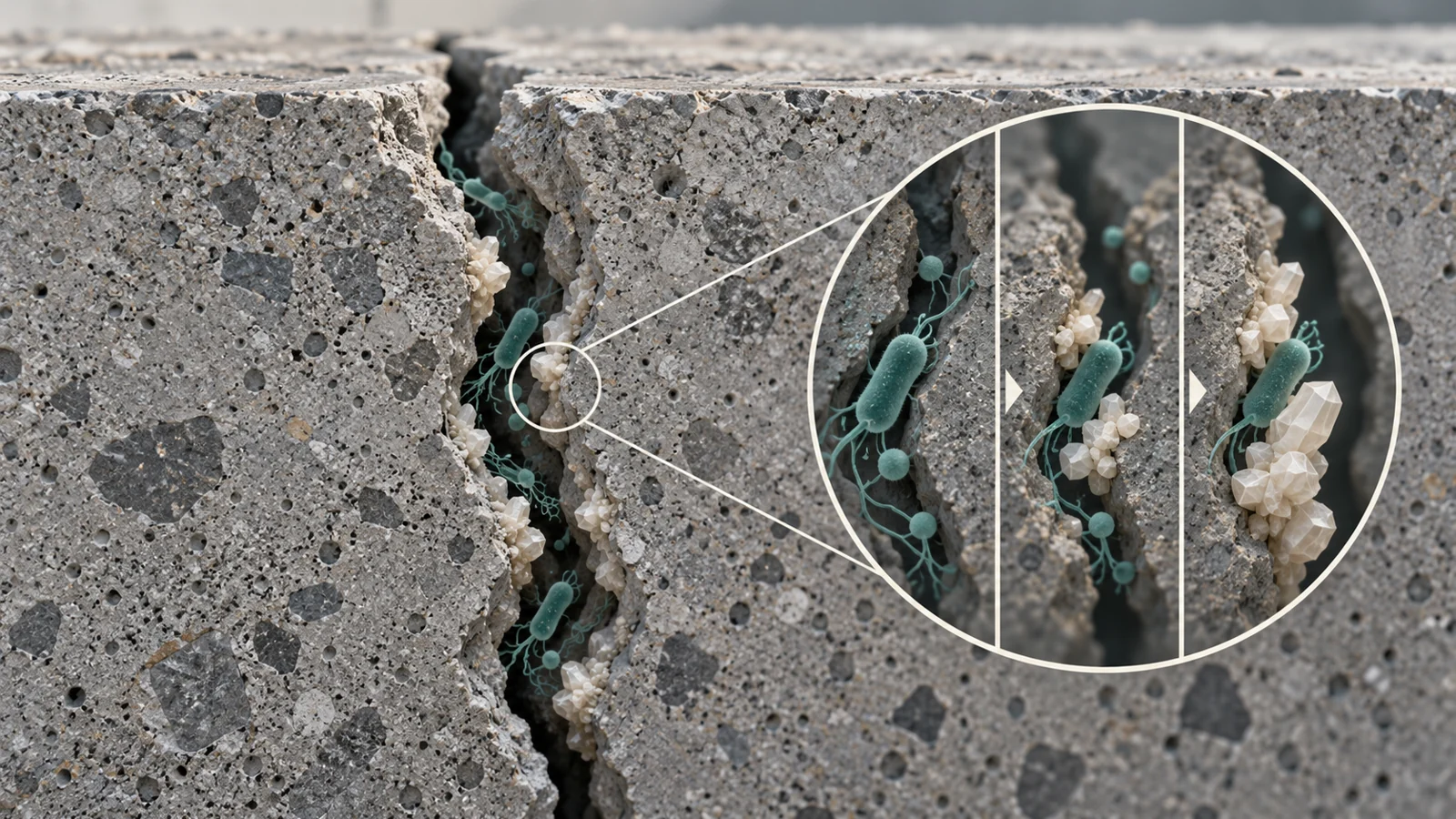
A crack in concrete is easy to see; the biological and chemical conditions that might place a new mineral there are harder to control. A review published on March 1, 2026, brings together the mechanisms by which microorganisms influence carbonate mineral formation and the research directions built around them, including self-healing concrete. It presents a field of possibilities, not a demonstrated repair result for a particular concrete system.
From living activity to mineral growth
Microorganisms can directly mediate mineral formation and deposition, or influence them indirectly by changing the conditions in which minerals form. The review connects several microbial activities with carbonate saturation, meaning conditions that favor carbonate minerals forming, and with nucleation, the beginning of mineral growth.
Photosynthesis and ureolysis are two examples named in the review. Other mechanisms it discusses include methane oxidation, sulfate reduction, denitrification, carbonic anhydrase activity, iron reduction, and mediation by extracellular polymeric substances, often shortened to EPS. The important point is not that every microbe follows one pathway. Different kinds of activity can affect whether the local chemical environment favors carbonate minerals and where new mineral growth begins.
A major focus is microbial-induced calcite precipitation, or MICP. In plain language, MICP means microbes helping calcite, a carbonate mineral, form. The review treats MICP as a potentially cost-efficient biomineralization technique and examines its molecular mechanisms alongside its expanding application areas. That characterization does not establish a performance comparison among particular systems.
When a mineral-forming process meets concrete
Self-healing concrete makes the practical question tangible. The idea is not simply to find a microbe associated with mineral formation; it is to determine whether that activity can be incorporated into a construction material in a way that remains useful under real operating demands. The review discusses self-healing concrete alongside heavy-metal remediation, wastewater treatment, biomedical applications, nanoscale technologies, 3D printing, and carbon sequestration.
Those applications show the breadth of the research direction, while the construction case adds a sharper translation boundary. Scale is one demand: a process must work at a useful size and output, not only as a compelling biological mechanism. Long-term stability is a separate demand, concerning whether the mineral-forming function and the resulting material remain dependable over time. Environmental effects and safety are separate again, because a construction process must be acceptable in the setting where it is used.
The review identifies all of these as challenges. Its abstract supports a research direction, not claims of crack-repair performance, recovery of structural function, service-life extension, or field deployment for a particular concrete system. It also does not provide a basis here for a quantified emissions benefit, net atmospheric carbon removal, or a comparative cost finding. The useful contribution is the joined explanation of mechanisms, possible applications, and the practical constraints that stand between them.
What this could change
Concrete that uses microbial mineral formation to help close cracks could eventually reduce repair demands for infrastructure owners and the disruption those repairs create for users. That is a conditional possibility drawn from the review’s discussion of self-healing concrete, not a demonstrated outcome. It depends on reliable mineral formation at useful scale, stability over time, and environmental and safety performance that remain acceptable in practice.
Key Sources
- Primary source: Microbial Carbonate Mineralization: A Comprehensive Review of Mechanisms, Applications, and Recent Advancements.
DOI or Journal Page · Review or Meta-Analysis · 2026-03-01