
Evidence date · 2022-09-17 · Research note 1 of 2
1 2
See current Track status →
A building material with a carbon complication
Turning seawater into a cement-like material sounds like it could address two problems at once: the need for construction materials and the need to remove carbon dioxide from the atmosphere. The chemistry is less straightforward. Forming calcium carbonate can consume seawater’s alkalinity, the part of its chemistry that helps absorb and buffer carbon dioxide. Under some conditions, mineral formation can therefore reduce the ocean’s capacity to take up atmospheric carbon or even favor carbon dioxide release.
A 2022 paper proposes a way to pair that mineral step with photosynthesis. Cyanobacteria first remove dissolved inorganic carbon from seawater as they grow. The harvested cells then help guide calcium carbonate formation in a separate reactor. The result would be a carbonate-rich microbial composite called biocement, while the combined process is intended to retain a net atmospheric carbon benefit.
This is a process design and feasibility analysis, not a measured result from a working integrated installation. Its calculations show how the proposed system might behave under selected biological, chemical and atmospheric-uptake assumptions. They also make the practical demands visible: large water flows, substantial photobioreactor volume and careful control of what returns to the sea.
One seawater feed becomes two working streams
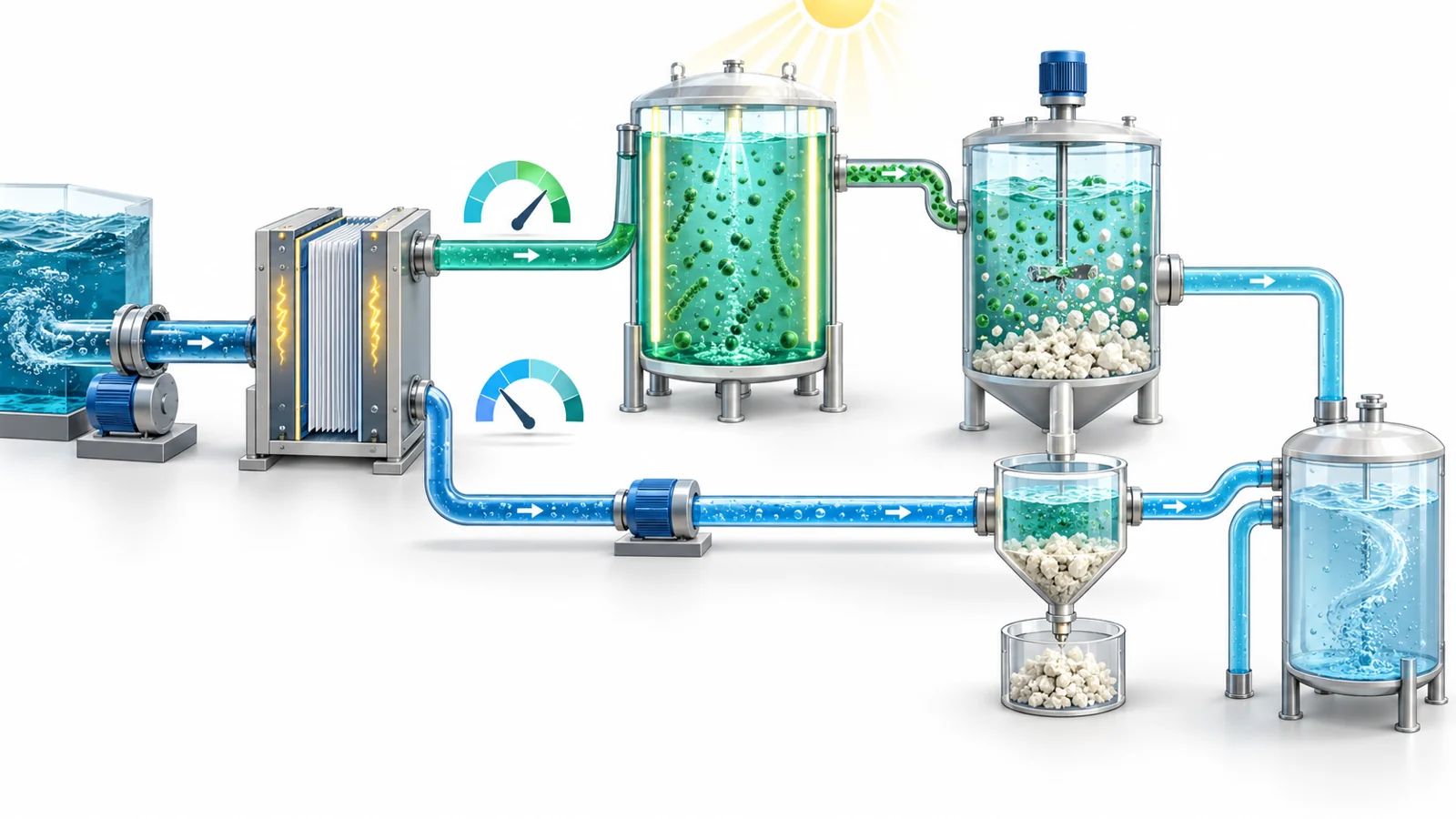
The proposed system starts with bipolar membrane electrodialysis, or BPMED. An electric field drives water dissociation at the junction between two membrane layers. Hydrogen ions move in one direction and hydroxide ions in the other, allowing the device to produce seawater streams with different pH values without simply adding a bulk acid or base.
Those streams are assigned different jobs. The lower-pH stream goes to a sunlit photobioreactor containing photosynthetic cyanobacteria. In the model, the target pH is 7.5. It is acidified relative to the incoming seawater, but it remains slightly alkaline rather than resembling a corrosive acid solution. The higher-pH stream, modeled at pH 9.3, goes to a precipitation reactor.
Keeping the reactors separate is central to the design. The photobioreactor is arranged around biological carbon fixation, while the precipitation reactor is arranged around mineral formation. Once the cyanobacteria culture reaches the chosen density or residence time, the cells are separated from the growth stream and transferred into the second reactor.
In the alkaline stream, dissolved carbonate species become highly supersaturated. The cyanobacterial cells act as nucleation sites, giving calcium carbonate surfaces on which to form. The mineral-rich product can then be recovered through settling and filtration. The two liquid exit streams are recombined before discharge, but the modeled effluent remains alkaline, with a pH of about 9.35.
The process is therefore not simply a membrane machine that pulls carbon dioxide from seawater. It is a linked sequence in which electricity adjusts the chemistry, microbes capture dissolved carbon and their harvested biomass helps turn seawater minerals into a separable solid.
The cells become part of the mineral process
The biological stage matters because the proposed carbon balance depends on more than the amount of carbonate produced. Cyanobacteria can use dissolved carbon dioxide or bicarbonate during photosynthesis. In the process described by the paper, that carbon becomes organic material in the growing cells. The cells are later incorporated into the carbonate-forming stage, so the resulting composite contains both mineral carbon and biologically fixed carbon.
The model treats those two pathways together. Carbonate precipitation by itself consumes alkalinity. In simplified seawater chemistry, calcium ions and bicarbonate can form solid calcium carbonate while releasing carbon dioxide and water. The loss of alkalinity reduces the ocean’s effective capacity to absorb more atmospheric carbon dioxide. Photosynthesis can push in the opposite direction by removing dissolved inorganic carbon while preserving alkalinity more effectively.
The proposed benefit appears only when the biological removal is large enough to compensate for the alkalinity consequence of mineral formation. That is the central carbon puzzle behind the biocement idea. The mineral is not automatically a carbon sink merely because it contains carbon; the surrounding seawater chemistry and the source of that carbon determine the atmospheric result.
The carbon balance depends on alkalinity
For an illustrative calculation, the authors assume that one mole of dissolved inorganic carbon removed from seawater corresponds to one mole of atmospheric carbon dioxide removed. They also use an average ocean uptake efficiency of 0.81 mole of atmospheric carbon dioxide per mole of added alkalinity. Because carbonate precipitation consumes roughly two units of alkalinity for each unit of inorganic carbon incorporated into the mineral, the model assigns a larger atmospheric-uptake penalty to that precipitation step.
The calculation then asks whether photosynthetic carbon fixation can outweigh that penalty. It is not a direct measurement of whole-process net removal. Electricity for electrodialysis, pumping, mixing and separation, nutrient inputs, membrane replacement and the later fate of the product all matter to a full accounting. The model instead provides a way to connect selected stream chemistries and growth rates to a possible removal scenario.
One important input is the biological growth rate. The paper uses a bioaccumulation rate of 1 gram of cyanobacteria per liter per day as a reasonable literature-based value for its illustrative calculation. It also uses an empirical carbon-content relationship for the selected cyanobacteria example, in which 1 gram of growth fixes about 0.5012 grams of dissolved inorganic carbon. Change the growth input and the estimated carbon consumption, reactor size and downstream carbonate production change with it.
Under those assumptions, the modeled process would require about 38.2 cubic meters of seawater for each kilogram of atmospheric carbon dioxide removed. A scenario targeting 1,000 tonnes of atmospheric carbon dioxide removal per year would require photobioreactors with a combined volume of approximately 987 cubic meters. If the acidic stream were also used for alkalinity regeneration, the modeled water demand would fall to 12.8 cubic meters per kilogram and the photobioreactor volume to about 382 cubic meters.
Those figures are useful as physical scale markers. They do not describe the output of a plant that has already achieved those rates. They show what follows from the chosen growth, equilibrium and atmospheric-replenishment assumptions.
Biology sets the pace of the plant
A larger water flow cannot simply be turned into proportionally more biocement. The cells must remain in the photobioreactor long enough to grow. The paper identifies washout as a key constraint: if the dilution rate, defined as flow divided by reactor volume, exceeds the organism’s growth rate, cells leave the reactor faster than they reproduce. Increasing flow therefore requires a larger reactor, faster growth or a different operating mode.
Light delivery adds another limit. A scaled photobioreactor needs enough exposed surface, mixing and mass transfer for photosynthesis to continue throughout the culture rather than only near the illuminated boundary. Flat panels, airlift systems, tubular reactors and hybrid configurations each involve different compromises in light access, circulation and scale-up. Marine cyanobacteria can grow in nutrient-poor seawater, but nitrogen, phosphate and iron may still constrain productivity. Adding nutrients could increase growth while also changing the environmental burden that belongs in the carbon accounting.
The process also depends on equipment surviving a chemically demanding environment. Mineral buildup can increase membrane resistance and reduce BPMED efficiency. The proposed layout offers a specific design advantage here: carbonate precipitation takes place in a downstream reactor rather than inside the membrane flow cell. Reversible redox solutions can also keep seawater away from the electrodes, reducing one route to electrode scaling. Those choices may ease maintenance, but they do not remove the need to establish membrane durability and operating costs at larger scale.
Coupling the system to desalination plants is presented as one possible route around some infrastructure barriers. Desalination facilities already move large amounts of seawater and produce concentrated streams with higher conductivity, which could help reduce the electrical demand of electrodialysis. Co-location could also reduce the need to build a separate intake and discharge network. It remains an infrastructure opportunity to test, not an established operating advantage for this particular integrated process.
The receiving water still matters
A carbon benefit would not make the discharge chemistry irrelevant. The proposed precipitation step removes calcium from seawater and changes carbonate saturation. In the paper’s stoichiometric calculation, the aragonite saturation state falls by about 0.65 between influent and effluent. Because many marine organisms build calcium-carbonate structures, a local reduction could create pressure for calcifying organisms if the discharge were concentrated or poorly sited.
The authors also calculate a modeled outlet pH of about 9.35. Dilution with additional seawater might be needed to bring the discharge below pH 9 under the guideline discussed in the paper. Mixing would change the local exposure, but it would not by itself demonstrate that an ecosystem can tolerate the full process. The paper notes that calcium is much more abundant in seawater than dissolved inorganic carbon and calculates a calcium concentration decrease of about 6% between the influent and effluent streams, before dilution into the ocean. Local receiving-water conditions, residence time and sensitive organisms could still differ from that broad chemical picture.
This is why discharge assessment belongs alongside carbon accounting. An installation would need to show not only how much carbon enters the product, but also how its altered pH, alkalinity, calcium concentration and carbonate saturation move through the receiving environment. The ecological discussion identifies those questions; it does not provide field evidence that an operating installation is harmless or damaging.
A possible bridge to construction
The solid product gives the proposal a practical reason to exist beyond carbon accounting. The paper points to carbonate-encapsulated cyanobacterial material as a possible feedstock for construction products, including future self-healing concrete applications. Earlier microbial-induced carbonate precipitation studies are part of that context, but they do not establish the structural strength, long-term durability or self-healing performance of the composite proposed here.
That distinction matters commercially. A useful product could help offset the energy and processing costs of carbon removal, while construction demand could create a destination for the captured carbon rather than requiring a separate mineralization step. Cement production is a substantial source of human-caused emissions, so a lower-emission material pathway would be consequential if the material met the performance requirements of real buildings and infrastructure.
For now, the proposal connects those possibilities rather than proving them. The integrated process would need to operate reliably, demonstrate a net atmospheric benefit after its own burdens, produce a consistent material and discharge water without unacceptable local effects. Only then could the idea move from an attractive coupling of seawater treatment, microbial growth and mineral production toward a practical construction supply chain.
What this could change
If the integrated process holds up in experiments and pilot operation, coastal water-treatment sites could become places where seawater is processed into both a carbon-bearing construction material and a stream whose chemistry is deliberately managed. Desalination facilities might provide the water-handling infrastructure, cyanobacteria could supply the biological carbon-fixation step and the precipitation reactor could produce a recoverable carbonate-rich composite.
Builders could eventually gain another lower-emission material option, while operators could use product sales to offset part of the cost of carbon removal. That outcome depends on several conditions arriving together: verified net atmospheric removal, suitable strength and durability, manageable electricity and maintenance demands, and discharge effects that remain acceptable for local marine life. The 2022 proposal supplies a process-design baseline for testing that chain; it does not yet make biocement a ready replacement for ordinary cement.
Key Sources
- Primary source: Biocement from the ocean: Hybrid microbial-electrochemical mineralization of CO<sub>2</sub>.
DOI or Journal Page · Peer-Reviewed Paper · 2022-09-17