
Research Signal – Source date 2021-01-13
A cell that has stopped dividing sounds like one that should be removed. During wound healing, however, eliminating such cells can impair repair. The puzzle is not a minor technicality: the same cellular state may help organize a damaged tissue and, if it persists, contribute to ongoing inflammation or scarring.
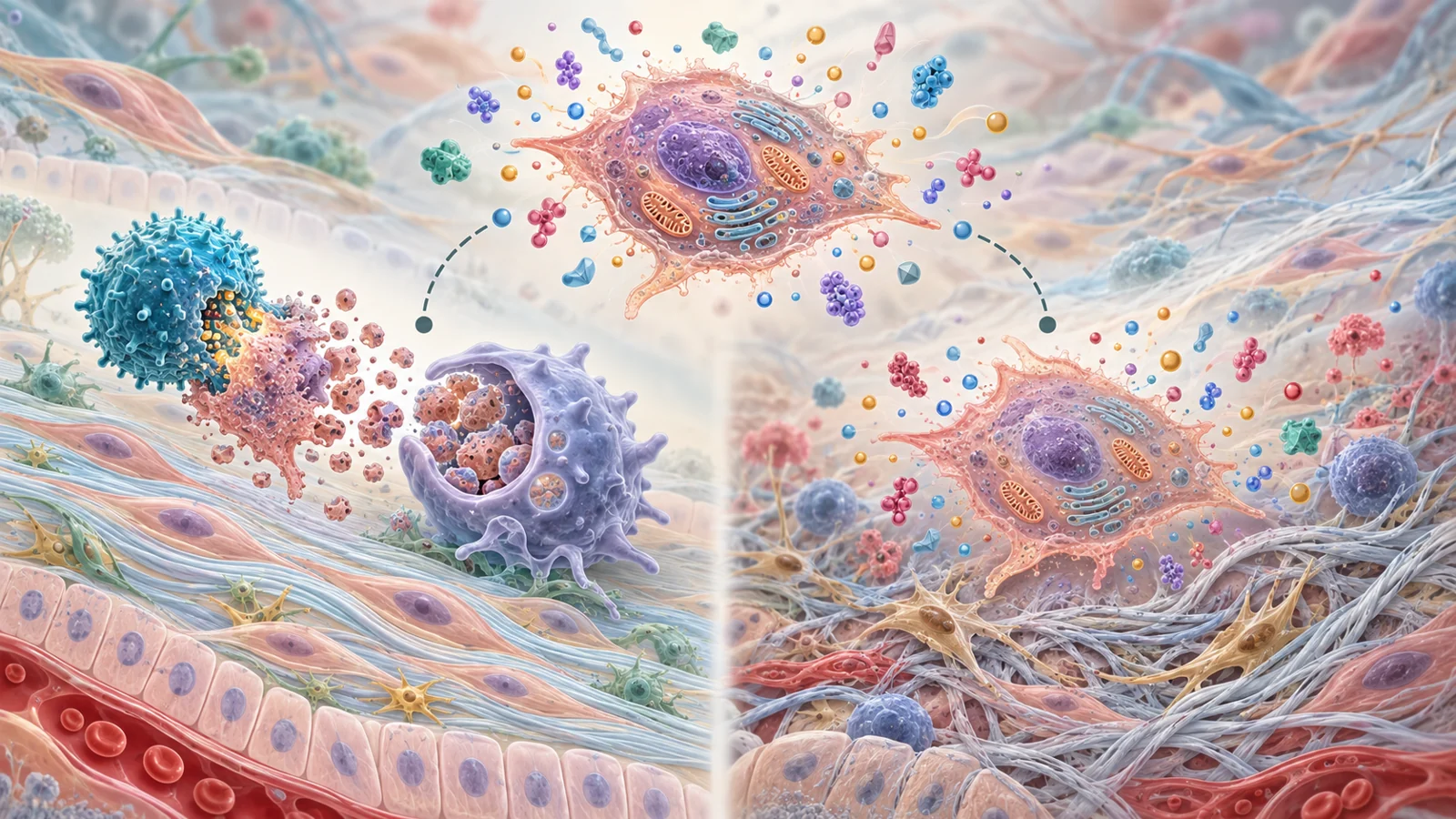
A review published on January 13, 2021, titled Senescence under appraisal: hopes and challenges revisited, examines that tension. Its authors propose that cellular senescence may be part of an inflammation-resolution programme. In their model, a senescent cell stops producing daughter cells, remains metabolically active, sends signals that help coordinate repair, attracts immune cells, and is eventually removed. Trouble arises when the programme is not completed efficiently.
The proposal is a way to reconcile apparently opposing findings, not a universal itinerary demonstrated in every tissue. It also changes what a useful treatment would need to accomplish. Simply finding and removing every senescent cell could discard cells that are still serving a temporary repair function.
Stopped division is not a shutdown
Cellular senescence begins with a durable loss of proliferative capacity. Stress can activate proteins such as p53 and cell-cycle inhibitors including p16 and p21. These brakes prevent the molecular machinery needed to move from the first phase of the cell cycle into DNA copying and division.
The cell is therefore no longer able to keep producing descendants even when growth signals are available. That differs from quiescence, a standby state in which a cell has paused division but can potentially resume it when conditions change. Senescent cells continue to grow in size, accumulate lysosomes and maintain substantial metabolic activity. They are not simply switched off.
They are also not the same as cells undergoing apoptosis. Apoptosis is a cell-death process. Senescent cells can remain alive for long periods, during which they release a characteristic mixture of signalling molecules. The review refers to this mixture as the senescence-associated secretory phenotype, or SASP.
The SASP can influence neighbouring cells, encourage aspects of tissue repair, alter cell plasticity and stem-cell activity, and draw immune cells toward the senescent cell. It can also spread aspects of senescence to nearby cells. This makes the state biologically active after division has ended. A cell may have lost its ability to multiply while gaining a temporary role in changing the environment around it.
Repair depends on a cleanup sequence
The review’s proposed resolution model gives immune surveillance a central role. Senescent cells can display signals recognised by natural killer cells, T cells and other immune components. Natural killer cells and T cells can help kill targeted cells, while macrophages and other phagocytic cells help engulf and clear the resulting cellular material.
Killing and clearance are related but separate events. An immune cell may damage or kill a senescent cell; another phagocytic cell may then be needed to remove the remains. The authors describe this final removal as a crucial completion step, sometimes characterised as the kill-it phase of the programme. A tissue may therefore need both effective recognition and effective disposal.
When the sequence works, the signals released by senescent cells may help call in the cells needed to resolve the temporary response. When surveillance or clearance is inefficient, the same signalling activity can continue for too long. Persistent signals may sustain inflammation, alter neighbouring cells and contribute to tissue damage rather than resolution.
This model does not mean that every senescent cell follows the same path, or that immune removal is sufficient in every disease. The review’s central point is narrower and more useful: the outcome may depend on whether a temporary, active state is brought to a successful end.
Cell identity changes the meaning of senescence
The liver offers a concrete example of why the identity of the affected cell matters. Hepatocytes perform much of the organ’s everyday work. Senescence in these cells has been associated in the review with dysregulated fat deposition and hepatic steatosis. Hepatic stellate cells, by contrast, are involved in the response to injury and can contribute to scar formation. Senescence in stellate cells may limit fibrosis by shifting their behaviour toward tissue remodelling.
The difference is not merely that one cell is in a good environment and another is in a bad one. The cells have different jobs, and their secreted signals act on different surrounding structures. A similar contrast appears in the heart: senescence in cardiomyocytes was associated with worse outcomes in a mouse myocardial-infarction model, while senescence in cardiac fibroblasts promoted aspects of repair.
The signals themselves also vary. Some forms of senescence produce secretomes with strong inflammatory features, while others lack particular inflammatory cytokines or are predominantly non-inflammatory. The trigger can matter, as can the cell type and the presence or absence of persistent DNA-damage signalling.
For treatment design, this means that senescence is not a single inflammatory substance distributed throughout the body. It is a family of states with overlapping features and different consequences. A therapy aimed at one population may need to leave another population alone, even when both are described with the same broad label.
The therapeutic options do different jobs
The review discusses several ways of intervening in the programme, and they should not be treated as interchangeable.
One approach is to induce senescence. In cancer, some established treatments push tumour cells into a non-dividing state through DNA damage or interference with cell-cycle machinery. This can stop proliferation, but persistent secretory activity or effects in healthy tissues may limit the value of the strategy. The intended benefit may therefore depend on what happens after induction.
A reviewed cancer strategy illustrates a possible sequence. Cells made senescent by treatment became vulnerable to a later senolytic intervention in experimental settings. The first operation creates a state with a new weakness; the second attempts to eliminate those cells. Induction and elimination can look like opposing ideas, yet they may be deliberately paired when the sequence is controlled.
A second approach is senolysis, meaning selective killing of senescent cells. The review describes candidate drugs aimed at vulnerabilities involving survival proteins, signalling pathways, lysosomes and other cellular systems. Their usefulness depends on how selectively they act. Different forms of senescence may not share the same vulnerabilities, and a compound that kills one senescent population may affect activated non-senescent cells as well.
A third approach is to modify the secretions rather than remove the cell. Senomorphic treatments are intended to reduce damaging inflammatory activity in the SASP while allowing the cell to carry out useful repair-related functions. This could be advantageous where elimination would remove a needed temporary participant, but the proposed benefit remained a therapeutic possibility requiring further corroboration.
Promoting effective immune recognition and phagocytic clearance is another part of the wider strategy. In the authors’ model, a treatment that changes the cell without allowing the tissue to complete cleanup may leave the underlying problem unresolved.
A better fibrosis result may have more than one explanation
Fibrosis experiments show why treatment effects need careful attribution. The review notes that bleomycin is widely used to create fibrosis in animal models, but the compound also causes direct DNA damage and can induce senescence. Senescence produced by that experimental trigger may not behave like senescence that develops during human wound healing or fibrosis.
There is another complication. Some drugs described as senolytics can kill activated myofibroblasts that are not senescent. Those cells are major drivers of scar formation. If fibrosis improves after treatment, the improvement may therefore reflect the removal of activated scar-forming cells, senescent cells, or both. The result alone does not identify which population caused the change.
Measurement is difficult for the same reason. No single marker identifies every senescent cell. Common indicators include reduced proliferation, cell-cycle inhibitors, enlarged lysosomal compartments, DNA-damage features and secreted inflammatory factors, but individual forms of senescence may lack some of these signs. A convincing identification generally needs evidence of arrested proliferation together with maintained growth or metabolic activity, supported by additional markers suited to the particular system.
This is more than a laboratory classification problem. If a treatment is meant to spare useful repair cells while eliminating harmful ones, researchers need to know which cells were actually affected. Otherwise, a promising result can be assigned to senescent-cell removal when the active ingredient acted through a different population or pathway.
Early human studies answer narrower questions
The review describes a field beginning to move from experimental systems toward human investigation. Its survey of the World Health Organization clinical-trial repository, retrieved in July 2020, identified 250 senescence-related trials, including 180 interventional studies and 69 observational studies. The review reported that 41 interventional and 27 observational studies were actively recruiting at that time.
The studies covered different questions. A phase I investigation of an intra-articular treatment in knee osteoarthritis focused on safety and tolerability. Other early work examined compounds such as dasatinib with quercetin in Alzheimer’s disease and chronic kidney disease, and fisetin in osteoarthritis. The review reported a reduction in measured senescent-cell burden in the chronic kidney disease study.
A lower measured burden is an important biological observation, but it is not the same as less pain, restored organ function, prevention of age-related disease or longer life. Early human investigations can establish that a treatment reaches a particular population or changes a biomarker without showing that the tissue has recovered its original performance.
Removal may also leave a structural problem behind. Eliminating inflammatory or senescent cells could reduce a damaging signal, yet a tissue may still need new functional cells or a regenerative process. The review makes this point for settings such as osteoarthritis and fibrosis: reducing the harmful population may not rebuild a limited cartilage population or repopulate a damaged organ with healthy parenchymal cells.
The practical question is therefore larger than whether a compound can lower a senescence-associated measurement. It is whether the intervention improves the whole sequence from harmful activity to clearance and then to durable tissue recovery.
What this could change
For people with fibrotic disease, a successful senescence-based treatment could reduce persistent scarring while preserving the temporary cellular activity that helps a wound repair itself. That possibility depends on targeting harmful cell populations or damaging secreted signals selectively, while supporting the regeneration or functional recovery the tissue still needs.
The benefit would not come from treating senescence as waste to be cleared indiscriminately. It would come from matching the intervention to the cell, its secretions, the immune response and the condition of the surrounding tissue. If those bottlenecks can be solved, therapies could make tissue cleanup more precise: limiting chronic damage without blocking the repair work that makes recovery possible.
Key Sources
- Primary source: Senescence under appraisal: hopes and challenges revisited.
DOI or Journal Page · Peer-Reviewed Paper · 2021-01-13
Keep exploring