
Research Signal – Source date 2026-02-24
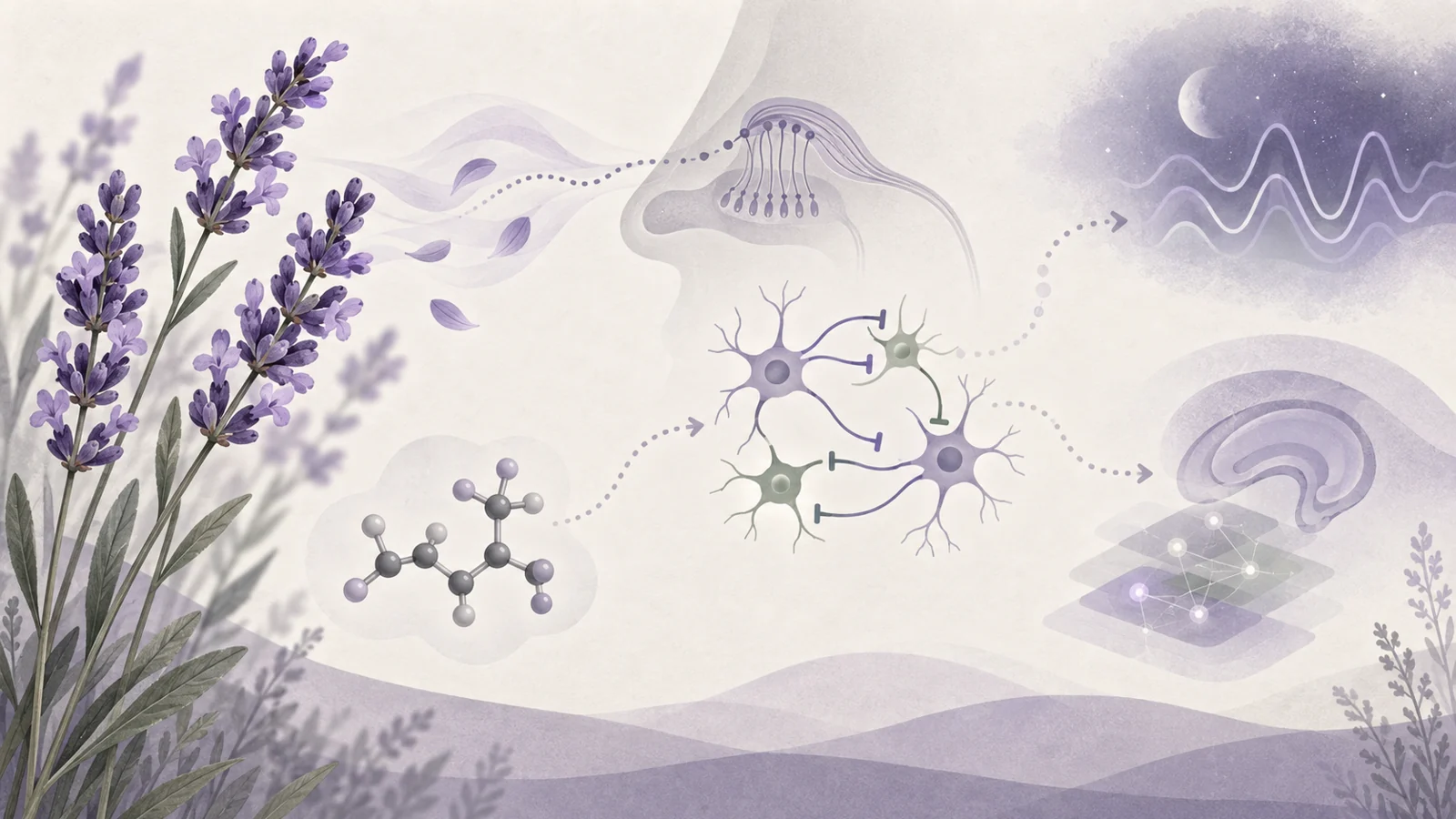
Lavender is often associated with relaxation, but one of its main aromatic compounds is attracting attention for a more complicated reason. Linalool, found abundantly in lavender and also present in Cannabis sativa, affects several forms of nerve signaling in laboratory studies. A review published on February 24, 2026, asks whether those effects could matter to the disrupted brain networks involved in Alzheimer’s disease, beyond the familiar question of whether lavender feels calming.
The question is not whether a pleasant scent can somehow reverse memory loss. It is whether a compound that influences the balance between neural signals that promote activity and signals that restrain it could eventually support sleep, reduce network overactivity or improve the conditions in which memory works. The evidence spans receptor experiments, animal models, sleep recordings and studies of botanical preparations in people. Those are related lines of inquiry, but they do not measure the same thing.
Why excitation and inhibition matter to the brain
Brain circuits work through a shifting balance between excitation and inhibition. Excitatory signals help nerve cells become active and pass information along. Inhibitory signals act more like a braking system, limiting excessive firing and helping activity remain coordinated. Neither side is useful on its own: thinking, remembering and sleeping depend on timing between them.
The review describes evidence that Alzheimer’s disease can involve a disturbed version of this balance. Excessive neuronal activity may disrupt gamma oscillations involved in cognitive processing, produce unusually synchronized firing in the cortex and hippocampus, and interfere with the slow-wave activity associated with sleep. Network hypersynchrony can also increase seizure susceptibility. Poor sleep, in turn, can interfere with the processes that help stabilize memories.
Linalool has been studied as a possible multi-target influence on both sides of this system. In experiments summarized by the review, it affected glutamate-related signaling, including processes involving NMDA receptor complexes. Glutamate is one of the brain’s main excitatory messengers. In seizure models, linalool delayed the onset of some chemically induced seizures and reduced or postponed convulsions under other experimental conditions.
The compound also affected inhibitory signaling. Linalool potentiated GABA-evoked currents at GABA-A receptors in laboratory studies, meaning that the response to the brain’s main inhibitory messenger became stronger. Other experiments found a GABA-like effect that was partly reduced by a GABA-A receptor blocker. These findings offer a plausible explanation for sedative and anxiety-reducing effects, while also raising a broader possibility about neuronal network activity.
The receptor-level story is still incomplete. The review presents these observations as evidence of neuromodulatory potential, not as proof that linalool restores excitation and inhibition in the brains of people with Alzheimer’s disease. A compound can influence a receptor in a tissue preparation and still behave differently after it is absorbed, transformed, distributed through the body and delivered to a particular brain region.
What changed in Alzheimer’s animal models
The strongest memory-related examples in the review come from animals, where researchers can examine behavior alongside brain tissue. In one study, oral linalool given for three months improved learning and spatial memory in older 3xTg-AD mice, a model carrying several Alzheimer’s-like features. Treated animals also showed reductions in beta-amyloidosis, tauopathy and gliosis in the hippocampus and amygdala, along with lower levels of several inflammatory markers.
Those findings make linalool biologically interesting for more than its smell. They connect a behavioral result with changes in pathological and inflammatory measures. Other experiments described in the review similarly found improved performance after linalool administration and signs of reduced oxidative stress, cell injury or apoptosis.
Yet the improved task performance does not identify the pathway that produced it. The animals may have benefited through reduced inflammation, lower oxidative stress, effects on amyloid or tau, changes in synaptic function, altered excitability, or several mechanisms at once. The review specifically notes that linalool’s contribution to synaptic function and excitation–inhibition balance has not been examined as thoroughly as its antioxidant and anti-inflammatory effects.
That unresolved link matters. A mouse can perform better in a memory task while the underlying reason remains uncertain. The animal results support further investigation of linalool as a candidate compound; they do not show that it slows Alzheimer’s disease in patients or that correcting network excitation and inhibition is what caused the behavioral improvement.
Sleep, behavior and cognition are different human outcomes
Human observations involving lavender are more varied than the phrase “lavender helps memory” suggests. The studies summarized in the review examine different populations, preparations, routes and endpoints.
| Human observation | What was measured | What it can and cannot show |
|---|---|---|
| Lavender inhalation in people with dementia | Agitation, anxiety, irritability or related behavioral symptoms | Lavender may be feasible for some behavioral goals, but these outcomes are not direct tests of Alzheimer’s memory and some interventions used more than one aromatic ingredient. |
| Lavender odor during sleep in 34 healthy adults | Single-night changes in non-REM slow-wave and spindle activity recorded with polysomnography | The odor influenced measured sleep physiology in healthy participants; this does not establish sustained sleep or memory benefits in Alzheimer’s disease. |
| Mixed aromatherapy in 28 elderly inpatients with dementia | Cognitive function during a crossover program using lavender and orange in the evening, plus rosemary and lemon in the morning | A cognitive change was observed in a mixed preparation, but the contribution of lavender or linalool cannot be isolated. |
The dementia studies offer a practical reason to keep studying lavender. Several trials focused on agitation or anxiety, and a more recent home-based protocol using caregiver-administered lavender inhalation reported reductions in disinhibition and irritability after three weeks, alongside improvements in some quality-of-life domains. These are meaningful care-related outcomes, especially when distress or agitation makes daily life harder, but they are not interchangeable with a demonstration of memory protection.
The sleep experiment asks a different question. Lavender odor was delivered to healthy adults during sleep, and the recorded effects were concentrated in non-REM sleep. A single night of altered slow-wave or spindle activity is a physiological observation, not evidence of a durable treatment effect. It also does not reveal whether the same response would occur in people with Alzheimer’s disease, whose sleep architecture, sensory processing and medication use may differ.
The mixed-aromatherapy study illustrates the attribution problem from another angle. Cognitive function improved during a program that used several aromatic ingredients at different times of day. The result is relevant to the possibility that olfactory stimulation can influence behavior or cognition, but it cannot tell us how much came from lavender, linalool, the other oils, the routine surrounding treatment or the crossover design.
Delivery changes the meaning of a lavender result
Inhaled lavender essential oil and administered linalool should not be placed on one exposure scale. Lavender oil is a mixture of compounds delivered through smell, while an experiment with linalool may use a defined amount of one molecule through a different route. The body may absorb, distribute and transform them differently, and the amount reaching a relevant neural target may not be comparable.
A mouse sleep experiment described in the review shows why the sensory route matters. Lavender oil inhaled during the animals’ inactive phase increased non-REM sleep, shortened sleep latency and enhanced delta activity. The effects disappeared when olfactory function was interrupted with zinc sulfate or when particular GABAergic neurons in the central amygdala were inhibited. This points to an olfactory–limbic pathway involving smell, brain circuitry and inhibitory neurons.
That result does not mean every lavender effect depends on the same pathway. Other mechanisms involving cholinergic and histaminergic systems have also been proposed in the review. It does show that the route into the experiment is part of the biology. Removing the ability to detect the odor changed the result, so the molecule’s presence in an oil cannot be separated from how the preparation is encountered.
Chemical transformation adds another layer. Linalool can undergo oxygenation or acetylation after exposure to air or after metabolism. In experiments discussed by the review, derivatives such as linalyl acetate no longer potentiated GABAergic currents in the same way as linalool. A lavender preparation, therefore, is not simply a passive delivery system for unchanged linalool. Storage, formulation, metabolism, smell function and tissue exposure can all affect what a result means.
Cannabis adds compounds and attribution problems
Cannabis is relevant to the review because linalool is also a minor component of Cannabis sativa and may appear alongside phytocannabinoids and other terpenes. The idea often called the “entourage effect” proposes that multiple plant compounds interact pharmacologically, changing the overall therapeutic effect or tolerability of a preparation.
Synergy is stronger than simple combination. If two ingredients are merely present together, that does not show that they amplify one another beyond their separate effects. The review describes experimental findings in which whole-plant extracts produced greater effects than isolated THC or CBD, and Alzheimer’s mouse studies in which different THC-to-CBD combinations reversed memory deficits. Those findings support interest in multi-constituent preparations, but they do not establish a clinically effective linalool-specific interaction in Alzheimer’s disease.
The same complexity that may create useful interactions also makes attribution harder. A change in behavior or cognition after a cannabis extract cannot automatically be assigned to linalool, THC, CBD or a particular combination. Some constituents may enhance an effect, others may counteract it, and the balance may change with the preparation.
Reproducibility is therefore a formulation problem as well as a biological one. The chemical profile of cannabis can vary with genotype, growing conditions and differences within a plant. Preparations that are described by the same broad plant name may not contain the same proportions of cannabinoids, terpenes and other metabolites. Lavender essential oil has established composition standards, including ISO standards and pharmacopoeial monographs, which can make studies easier to compare. Standardization does not prove clinical benefit, but without it, a promising result is harder to reproduce or interpret.
What this could change
For a person with Alzheimer’s disease, the most immediate potential benefit would be a reproducible supportive intervention that improves sleep or reduces distressing behavioral symptoms. Better-rested patients and less agitation could make daily care easier for patients and caregivers, even without changing the underlying disease.
That possibility depends on controlled studies showing meaningful, tolerable benefits from a defined preparation. The preparation would need to be clear enough that researchers and clinicians could tell whether the result came from linalool, a broader lavender formulation, a cannabis mixture or the surrounding care routine. The evidence would also need to distinguish a short-lived physiological response from a benefit that persists in ordinary life.
A further possibility concerns memory-related network function. If researchers eventually demonstrate that a defined intervention changes excitatory and inhibitory signaling in a relevant way and that this change improves cognition in people with Alzheimer’s disease, linalool-containing preparations could become part of a broader supportive strategy. The review provides a reason to investigate that connection, not evidence that it has already been made.
Key Sources
- Primary source: Exploring Linalool-Based Phytotherapy for Excitatory/Inhibitory Imbalance in Alzheimer's Disease: A Review of Lavender and Cannabis Therapeutic Effects on Sleep, Seizures, and Cognition.
DOI or Journal Page · Peer-Reviewed Paper · 2026-02-24
Keep exploring