
Research Signal – Source date 2025-11-27
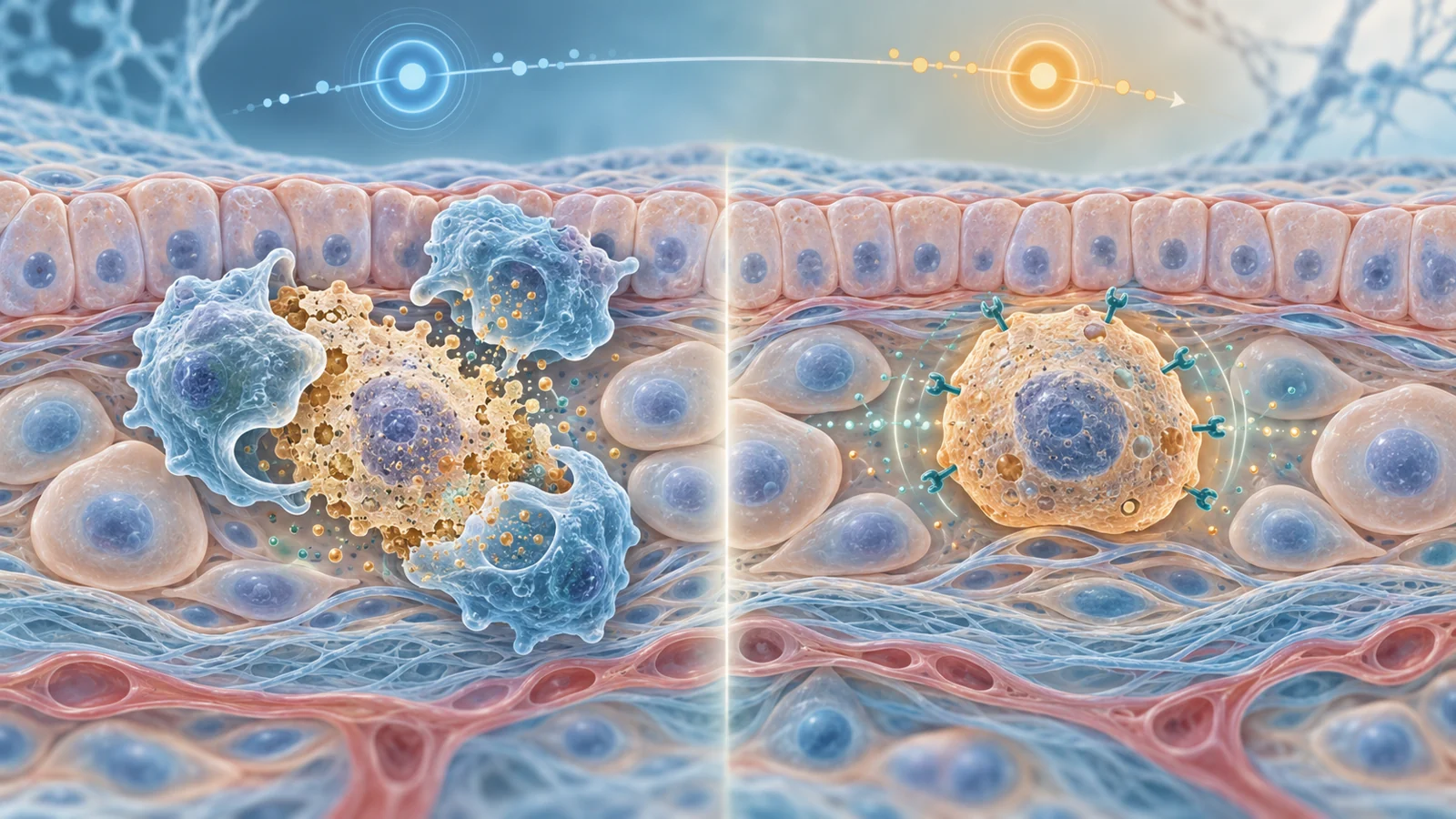
A cell that stops dividing can be doing something protective. By halting growth after DNA damage, telomere shortening, or oncogenic stress, it may prevent a damaged cell from becoming cancerous. The difficulty begins when that arrest persists. Some senescent cells resist normal cell death and continue releasing inflammatory molecules, growth factors, and tissue-remodeling enzymes.
The November 27, 2025 review Senescence Modulation: An Applied Science Review of Strategies in Anti-Aging, Regenerative Aesthetics, and Oncology Therapy examines this transition from protective response to possible source of long-term tissue dysfunction. Its central proposal is to connect three areas often discussed separately: cancer treatment, aging biology, and tissue repair. The review does not establish that one integrated therapy already improves cancer survival and regeneration in patients. It describes a research direction built around a changing therapeutic target.
A protective pause can become a persistent problem
Cellular senescence is a lasting halt in the cell cycle. It can arise through several routes, including replicative wear, DNA damage, oncogene activity, mitochondrial stress, or cancer treatment itself. The resulting cells are not simply inert. Their metabolism changes, their resistance to apoptosis can increase, and they may produce a Senescence-Associated Secretory Phenotype, commonly shortened to SASP.
SASP is a collection of secreted cytokines, chemokines, growth factors, and proteases. In a temporary repair response, such communication may help coordinate what happens around damaged tissue. When senescent cells accumulate or remain active for too long, the same kind of signaling can sustain inflammation and alter the surrounding environment. The review links this persistent activity with tissue dysfunction, chronic inflammation associated with aging, and conditions in which repair becomes less effective.
This creates the apparent contradiction at the center of senescence research. The arrest itself can restrain malignant growth, while the long-term presence of arrested cells can help create a tissue environment that is harmful. The relevant question is therefore not simply whether a cell is senescent. It is what kind of senescence is present, where it is occurring, how long it has persisted, and what the surrounding tissue needs from it.
Two ways to intervene in a senescent cell
The review separates senotherapeutic strategies into two broad categories. Senolytics aim to eliminate senescent cells. Senomorphics leave the cells in place but try to reduce the harmful effects of their secretions, particularly inflammatory signaling associated with the SASP.
That difference matters because reducing inflammatory activity is not the same biological outcome as reducing the number of senescent cells. A senolytic intervention seeks to change cell burden. A senomorphic intervention seeks to change the messages those cells send. The two approaches may therefore be suited to different tissue conditions, or considered in sequence, without being interchangeable.
The review describes several signaling routes that may be relevant to senomorphics. Metabolic and growth-control pathways such as AMPK and mTOR can influence SASP production, while inhibition of inflammatory signaling through pathways such as JAK may reduce the feedback loops that maintain cytokine activity. These examples illustrate a mechanism: the intervention can quiet a damaging communication network without claiming that every senescent cell has been removed.
Senolytic strategies face a different problem. A cell targeted for elimination must share a vulnerability that is sufficiently distinct from the survival needs of healthy cells. The review notes that senescent cells and some cancer cells can depend on overlapping anti-apoptotic pathways, including members of the BCL-2 protein family. That overlap creates a possible bridge between oncology drugs and senescent-cell clearance, but it also makes tissue context and safety central to the translation problem.
Skin inflammation is not the same as rejuvenation
Dermatology shows why a useful clinical effect can still leave the underlying mechanism uncertain. The review discusses psoriasis treatments that neutralize inflammatory cytokines through biologic agents. By interrupting cytokine activity, these therapies can reduce the inflammatory cascade associated with lesions and support clinical remission and quality of life.
Those effects demonstrate the value of controlling inflammatory communication. They do not, by themselves, demonstrate selective removal of senescent cells or reversal of skin aging. A treatment can reduce inflammation while leaving the relevant senescent-cell population present, or while acting through mechanisms that cannot be generalized to other tissues.
The review places this established anti-inflammatory experience beside a more exploratory opportunity in regenerative aesthetics. Senescent cells in skin are discussed as contributors to wrinkles, reduced elasticity, and impaired wound healing. Senolytics and senomorphics are presented as possible additions to approaches such as laser treatment, fillers, nucleic-acid-based injections, stem-cell strategies, or peptides. The proposed advantage is not merely to improve appearance temporarily, but to address a cellular environment that may interfere with repair.
The evidence levels are different across these examples. Cytokine-targeting treatments provide a clinical example of inflammatory modulation in a defined skin disease. Senescence-directed regeneration remains a translational area that includes preclinical work and early clinical research. Moving from one to the other requires evidence that the intended senescent cells are being affected, that the tissue responds appropriately, and that any visible or functional improvement lasts without unacceptable harm.
Cancer treatment can change the next therapeutic task
The oncology proposal becomes clearer when treatment is viewed as a sequence rather than a single intervention. Chemotherapy and radiation can push cancer cells into therapy-induced senescence. Initially, that growth arrest may act as a barrier to tumor progression. But residual therapy-induced senescent cells may continue producing SASP factors that reshape the tumor microenvironment.
The review associates this persistent signaling with inflammation, blood-vessel-supporting activity, treatment resistance, and recurrence-related concerns. It also connects the same broad process to damage in nearby healthy tissues and to the accelerated loss of tissue quality that can accompany cancer treatment. The important shift is temporal: the first treatment may create a new population that becomes the target of a later treatment.
In the proposed sequence, a cancer therapy first applies pressure that induces growth arrest or otherwise attacks the tumor. A subsequent senolytic could then be considered to clear residual senescent cells, or a senomorphic could be used to suppress their harmful signals. The review also discusses pairing immunologic approaches with SASP suppression and integrating nucleic-acid-based therapeutics for more targeted control of senescence pathways.
This is a treatment concept, not an established clinical schedule. The review does not establish an optimal order, dose, combination, or patient-selection rule. Its contribution is to identify why the therapeutic task may change after the initial cancer treatment: surviving cells that are no longer dividing can still influence the next phase of disease and recovery.
Finding the right cells is part of the treatment
A practical obstacle comes before any cell-clearing therapy. Senescence is not a single uniform state with one universal marker. The combination of indicators depends on the stress that induced it, the tissue in which it appears, the cell’s differentiation state, and the stage of the response.
Markers often discussed in the review include cell-cycle arrest indicators such as p16 and p21, SA-β-gal activity, loss of Lamin B1, SASP components such as IL-6 and IL-8, and other signs of metabolic or chromatin change. None of these signals alone can be assumed to identify every senescent cell in every setting. A fibroblast arrested after one kind of stress may not resemble a macrophage or a therapy-induced tumor cell in the same way.
The review therefore favors combinations of signals that answer different questions. One group of measurements can help identify a durable arrest. Another can indicate active secretory behavior. A target-specific marker can suggest whether a particular intervention is likely to work. These are separate stages of reasoning: identifying a cell state is not the same as identifying an actionable target, and either one is different from demonstrating a beneficial outcome after treatment.
The review uses engineered immune cells targeting uPAR-positive senescent cells as a concrete preclinical example. uPAR is a protein on the cell surface that can serve as a recognition target. In the preclinical work discussed by the review, these senolytic CAR-T cells produced durable clearance of uPAR-positive cells and improvements in metabolic fitness and physical performance. The result illustrates the potential of a living-cell therapy to recognize a defined population, but it does not establish universal senescent-cell clearance, human rejuvenation, or longer human life.
The measurement problem also affects oncology. A target that is useful for identifying senescent cells in one tumor environment may not capture the relevant cells in a healthy tissue or after a different treatment. High-resolution single-cell and multi-omic approaches are presented as ways to refine these combinations, but the need for such tools reflects the biological diversity of senescence rather than resolving it.
The safety question reaches beyond tumor control
Eliminating or silencing senescent cells could have consequences if some transient senescence is serving a useful purpose. The review specifically highlights wound healing as a context in which senescence may be beneficial for a limited period. A treatment that removes cells too broadly, or suppresses their communication at the wrong time, could interfere with repair rather than improve it.
Long-term systemic effects are another unresolved concern. An intervention may reach tissues beyond the original tumor or skin site, and the consequences of changing senescence across those tissues may not be visible in an early response. For cancer survivors, a favorable scan or tumor response would not fully describe the outcome if treatment leaves persistent injury, worsens recovery, or creates new risks. Conversely, better tissue quality would not substitute for durable tumor control.
The review therefore calls for clinical development that measures both sides of the intended benefit. Trials would need to connect cancer outcomes with quality of life, tissue recovery, and safety, particularly in people whose healthy tissues have already been stressed by treatment. The relevant standard is not simply whether a therapy clears a marker-positive population. It is whether the intervention improves the overall balance between disease control and the patient’s ability to recover.
What this could change
For people receiving cancer treatment, the long-term promise is a more coordinated therapeutic sequence: first control the tumor, then address residual senescent cells or their harmful signals when the biology supports doing so. If researchers can identify the right cell populations, preserve beneficial transient senescence, and demonstrate both safety and clinical benefit, this approach could make more durable tumor control compatible with less persistent injury to healthy tissues and better recovery or quality of life.
That outcome remains a conditional research goal, not a demonstrated effect of the review’s proposed strategy. Its significance lies in joining two problems that are often evaluated separately. Cancer treatment could eventually be designed not only around whether malignant cells are suppressed, but also around what treatment leaves behind in the tissues patients must live with afterward.
Key Sources
- Primary source: Senescence Modulation: An Applied Science Review of Strategies in Anti-Aging, Regenerative Aesthetics, and Oncology Therapy.
DOI or Journal Page · Peer-Reviewed Paper · 2025-11-27
Keep exploring