
Evidence date · 2022-12-21 · Research note 2 of 3
1 2 3
See current Track status →
Since the previous research note · Partly supported
Track continuity
Since the previous research note: Shaping and joining healable polymers into soft robot parts
Previous expectation: Fabrication that preserves healing and robust connections could allow damaged soft robotic components to remain in service longer.
What this study adds: The December 2022 review assembles examples of retained or recovered actuation after healing, supporting the functional-recovery part of that expectation. The supplied evidence does not directly test the earlier condition about complex fabrication and robust joins or establish longer service life.
What changed in this study
A flexible robot finger needs to bend repeatedly while handling an object. Damage threatens both its ability to move and its ability to bear a load. Giving its material the capacity to heal could help, but “self-healing” leaves an important question unanswered. A component that moves again may have recovered a different share of its strength or stretchability. Understanding the repair means knowing which property returned, and under what conditions.
A review published on December 21, 2022, in Chemical Reviews brings these questions together for polymeric soft actuators—flexible parts made from long molecular chains that turn a stimulus into movement. Its focus is specific: materials that combine healing with visible motion. It excludes self-healing polymers without that motion, actuators without healing, and ordinary hydrogel swelling and shrinking of the kind used in drug delivery.
The experiments assembled in the review show several ways to combine these abilities. Heat, light, or magnetic fields can trigger movement, while molecular rearrangement and renewed bonds help damaged material reconnect. By organizing examples around their mechanisms, movement, and separate operating and healing conditions, the authors make it possible to see what the combination actually involves.
Bringing a cut together and reconnecting the material
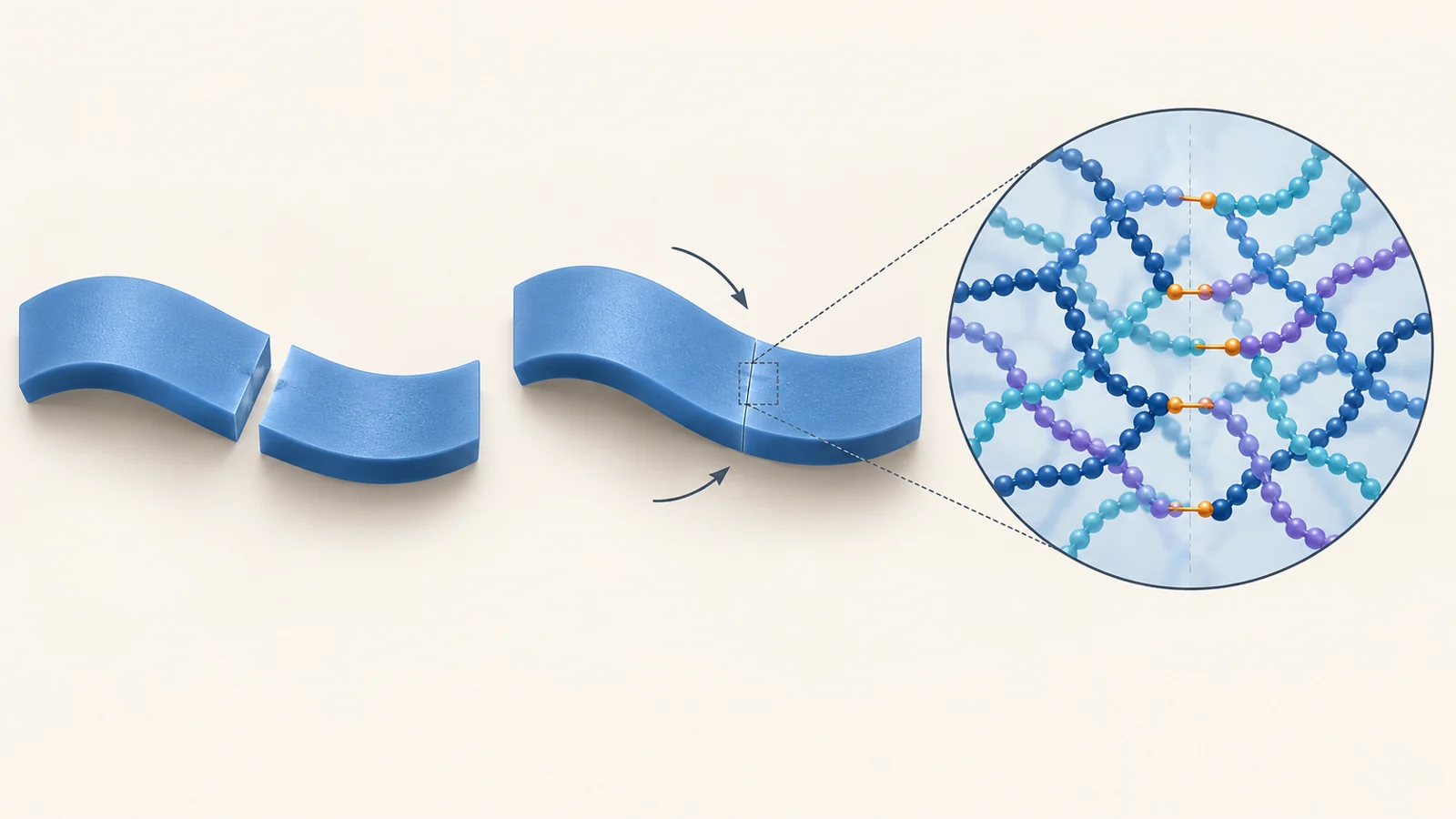
Repairing a damaged flexible strip involves work at two scales. At the visible scale, separated surfaces must come into contact. At the molecular scale, the material must reconnect across that interface. Shape-memory behavior can help with the first step by moving a deformed part toward a previously programmed shape.
A shape-memory polymer can hold a temporary shape until a trigger allows it to return toward its permanent one. In a thermally activated example, heating gives parts of the polymer sufficient mobility to release stored deformation. If that motion brings the damaged faces together, the material has created an opportunity for healing. The movement supplies contact; molecular processes then establish connections across the contact area.
The review describes this cooperation in a 2018 study of a composite containing polylactide, epoxidized natural rubber, and iron oxide particles. Shape recovery helped bring damaged surfaces together. Rubber chains could then diffuse across the interface, while polylactide segments rearranged and became entangled again. Several physical processes contributed to repairing the material.
Other systems use reversible bonds as part of their healing mechanism. Hydrogen bonds, for example, can provide connections between polymer chains that can break and form again. Across the reviewed materials, chain movement, entanglement, and dynamic bonding offer different routes to reconnection. Their effectiveness depends on whether the chains and bonding groups can move and interact under the chosen conditions.
This sequence gives shape recovery a concrete role in repair. It can help close a gap that would otherwise keep the relevant molecules apart. The subsequent reconnection depends on the chemistry and mobility of the polymer, so the visible motion and the molecular repair remain distinct stages even when the same trigger assists both.
Light can move a strip in different ways
The stimulus named on an actuator does not fully explain how it works. Two strips described as light-responsive may turn illumination into motion through very different physical routes.
In one polyurethane composite summarized in the review, copper sulfide nanoparticles absorbed near-infrared light and converted it into heat. Researchers first bent a straight strip at 70 °C and cooled it to hold the temporary shape. Under illumination, heating enabled the strip to recover its original configuration. A comparison material without the nanoparticles did not recover under similar illumination, illustrating the particles’ role in delivering heat to the polymer.
Here, light provides a way to heat the material. As its temperature rises sufficiently, molecular mobility increases and stored strain can be released. The location and duration of illumination therefore help determine where and when the response occurs. The same study also used near-infrared irradiation to trigger healing, linking both functions to the material’s response to heating.
Another route uses molecules that change configuration when exposed to light. The review describes a system containing azobenzene structures, whose light-triggered rearrangement drove actuation. Multiple hydrogen bonds helped hold the polymer assembly together and contributed to its capacity for repair. Researchers fashioned the material into an arm that could grab and release an object, giving the molecular response a recognizable mechanical task.
That gripping demonstration illustrates the movement the system could produce. It should be understood separately from a demonstration of gripping after damage and repair. Its particular value here is showing how a change in molecular configuration can become a visible action. For someone choosing a flexible moving element, the distinction between this route and light converted into heat matters because each connects illumination to the material’s internal behavior differently.
A recovery percentage needs a named property
The review’s numerical results become useful when attached to the property being measured. Mechanical strength concerns resistance to stress before failure. Extensibility concerns how far a material can stretch. Actuation performance concerns the motion it produces. These measurements describe different aspects of a component’s usefulness.
One reported actuator combined a light-responsive polymer layer containing carbon nanotubes with a cellulose layer. It bent by more than 90 degrees in 1.6 seconds under the reported near-infrared conditions. After healing, the study reported recovery efficiencies of 87.68% for mechanical performance and 99.50% for actuation. Even within this single system, the two measurements returned different answers. The near-complete recovery of motion cannot be assigned automatically to its mechanical properties.
A magnetic nanocomposite provides another instructive example. In the study summarized from 2020, the healed material retained magnetic actuation while recovering 46% of its extensibility. That percentage refers to the capacity to stretch, rather than magnetic responsiveness or fracture strength. A moving sample can therefore remain informative about magnetic control while its stretching behavior points to a separate mechanical constraint.
The percentages are not a leaderboard. The formulations, damage assessments, and measured properties differ across the experiments. A useful comparison starts by identifying what each test asks the material to do. For a flexible finger, bending through the required motion and tolerating the deformation involved in handling an object are related demands, but each needs its own evidence.
Repair has its own operating conditions
A material may move under conditions quite different from those needed to heal it. One light-responsive polyurethane film in the review makes that separation especially clear. Under ultraviolet illumination at room temperature, it bent toward the light within five seconds and returned to its initial state about seven seconds after the light was switched off. Healing involved a much longer and hotter treatment: cracks were examined during treatment at 100 °C for 10 hours, and cut pieces were reconnected under the same temperature and duration.
The seconds-long movement and hours-long repair would occupy different places in a device’s schedule. For a component based on such a material, repair could require a dedicated maintenance period and an environment capable of sustaining the treatment. Whether nearby materials and connections could tolerate that environment would become part of deciding where the actuator could be used.
The review also describes healing closer to ordinary room conditions. A silicone-based magnetic composite containing iron oxide nanoparticles achieved 62.2% recovery of fracture strength after 30 minutes at 25 °C. Its reported magnetic actuation was also healable. This example shifts the practical question from providing a prolonged hot treatment to determining whether the recovered load-bearing capacity and repair time would suit the intended task. Room-temperature healing alone does not specify whether repair could happen while the component remains in operation.
The authors emphasize that practical requirements come from the application. A moving element may need a particular stiffness, resistance to impact, adhesion strength, or electrical conductivity. Adding healing and actuation to one formulation increases the challenge of meeting those requirements together. The review identifies that formulation complexity as a reason successful material demonstrations can remain difficult to translate into useful products.
For an assembled device, the relevant repair environment includes everything that must undergo it. Temperature, illumination, time out of use, and the demands placed on the repaired part all affect whether a promising material response becomes a workable maintenance process. The laboratory examples make those conditions tangible without establishing device reliability, replacement savings, or longer service life.
What this could change
If useful motion, sufficient mechanical integrity, and compatible repair conditions can survive integration into actual devices, a damaged soft gripper element could become a component that operators retain and return to service. The causal path is practical: bring the damaged surfaces together, restore the connections needed for the task, complete the repair within an acceptable maintenance window, and use the part again.
That capability could reduce how often flexible moving components need replacement. It could also give developers more freedom to use compliant materials in parts exposed to repeated deformation, provided repair remains compatible with their duties. The December 2022 evidence supports the possibility through examples of retained or recovered actuation. Turning that possibility into longer service would require the material’s movement, load-bearing behavior, and repair environment to work together throughout use.
Key Sources
- Primary source: Self-Healing Polymeric Soft Actuators.
DOI or Journal Page · Peer-Reviewed Paper · 2022-12-21