
Evidence date · 2026-07-28 · Research note 3 of 3
1 2 3
See current Track status →
Since the previous research note · Partly supported
Track continuity
Since the previous research note: How self-healing polymers bring flexible parts back into motion
Previous expectation: Damaged flexible robot components could return to service if repair restores useful movement and mechanical integrity under conditions compatible with their duties.
What this study adds: The current study reports underwater polymer repair using water-assisted network rearrangement and seawater-ion cross-linking, with 23.7 MPa tensile strength after healing in artificial seawater. This supports the material-integrity and repair-environment prerequisites of that expectation; the supplied evidence does not establish recovered actuation or longer device service.
What changed in this study
A material that repairs itself needs enough molecular movement to reconnect after damage, while still holding together under load. Underwater, that balance can be difficult. A study published July 28, 2026, describes a polymer—a material made of long molecular chains—that uses water and dissolved seawater salts to help rebuild its internal connections. The reported advance concerns repair and strength in a material intended for possible use in soft marine robots; it does not establish a repaired, functioning robot.
Water helps the chains rearrange
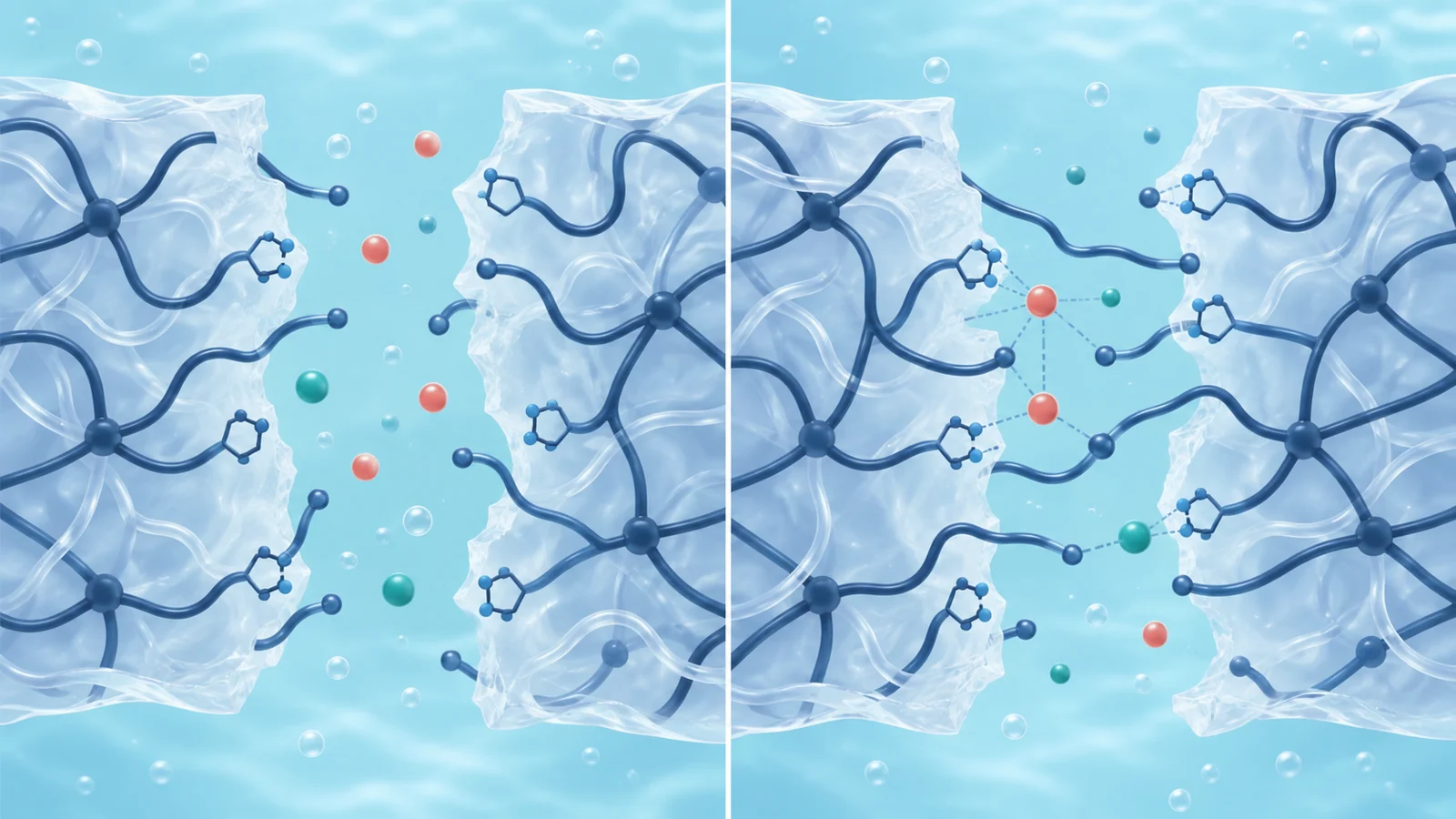
The authors describe a network that adapts to seawater. Their approach combines control over small regions of the polymer’s internal structure with attached chemical groups called catechols. These groups provide sites that can capture certain dissolved metal ions, or electrically charged atoms.
After damage, water participates through a process called plasticization. In plain language, it makes parts of the polymer more mobile, helping the molecular chains rearrange. That mobility supports reorganization of the hydrogen-bonding network—the collection of reversible attractions involving hydrogen that helps hold the material together.
Calcium and magnesium ions supply a complementary part of the repair mechanism. Catechol groups capture these ions from seawater, enabling new links between polymer chains at the fractured surfaces. Such links are called cross-links. Water helps the network rearrange, while the captured ions help connect it across the damaged interface.
This gives the surrounding liquid an active role in repair. The authors attribute the material’s behavior to the combination of its molecular chemistry and its structure at very small scales. The design addresses both sides of the practical problem: allowing rearrangement after damage and maintaining connections that resist pulling in water.
What the 23.7 MPa result measures
After self-healing in artificial seawater, the polymer reached a reported tensile strength of 23.7 megapascals, or MPa. Tensile strength describes resistance to pulling, expressed as force per unit of cross-sectional area. A megapascal equals one newton per square millimeter, so the value describes stress rather than the total weight an object of any size could support.
The distinction matters for a future component. Its dimensions and shape would affect the load it could bear, even if it were made from the same material. The reported number is a measure of the healed material’s strength under the study’s test conditions.
It also cannot tell us what fraction of the original strength was recovered. That calculation would require comparable measurements before damage and after healing. A post-healing strength of 23.7 MPa is not a recovery percentage. The abstract additionally states that the polymers maintain high tensile strength in an aqueous environment, making continued strength in water part of the reported materials result.
The distance from a strength test to marine service
The verified evidence available here is the study’s abstract. It supports the repair mechanism and the reported strength endpoint, but does not allow an independent assessment of the experimental protocols, sample counts, variability, or detailed comparisons. Healing time, temperature, how the fractured surfaces must meet, and performance over repeated damage-and-repair cycles cannot be verified from that abstract. Those limits concern what can be assessed here, rather than establishing what the complete paper contains.
Artificial seawater also defines an important testing boundary. The result does not by itself establish performance under deep-sea pressure, cold temperatures, or the changing loads of an operating machine. For a flexible robot component, resistance to a single pull is only part of the job. Its ability to deform usefully and retain that behavior through repeated operation would also matter. Recovered actuation—the movement a robot generates—and longer device service are not established by the available evidence.
What this could change
If this repair chemistry also preserves useful movement and load-bearing behavior under operating conditions, flexible marine robot components could remain serviceable after damage. Using the surrounding water and its dissolved ions to assist repair could help those parts sustain their function in the environment where they work.
The downstream payoff for robot developers and operators would be longer component service and less frequent replacement. That possibility follows from combining reconnection with usable mechanical performance: a damaged part would need to heal strongly enough, and retain enough flexibility, to keep doing its assigned work.
Key Sources
- Primary source: Materials Nanoarchitectonics from Intrinsic Underwater Self-Healing Polymers for Soft Nanorobotics.
DOI or Journal Page · Peer-Reviewed Paper · 2026-07-28