
Evidence date · 2025-06-26 · Research note 3 of 4
1 2 3 4
See current Track status →
Since the previous research note · Earlier expectation not tested
Track continuity
Since the previous research note: Why an Alzheimer's study pairs five days of magnetic stimulation with sleep and thinking tests
Previous expectation: A brief stimulation course might offer people with mild-to-moderate Alzheimer's disease an additional treatment option if improvements in sleep and cognition were reproducible, tolerable and lasting.
What this study adds: The June 2025 registry description introduces a planned three-coil feasibility and tolerability comparison in older adults with mild neurocognitive disorder, accompanied by cognitive, brain-activity, mood and sleep assessments. Its stated purpose is to inform a later sham-controlled trial.
What changed in this study
Researchers plan to compare three magnetic stimulation coils to learn how older adults with mild neurocognitive disorder tolerate each approach. The June 26, 2025 ClinicalTrials.gov description, registered as NCT07038798, outlines the investigation and repeated assessments of thinking, brain activity, and symptoms. It records planned work; registration alone does not establish that participants have received treatment or benefited from it.
Three coils and two practical questions
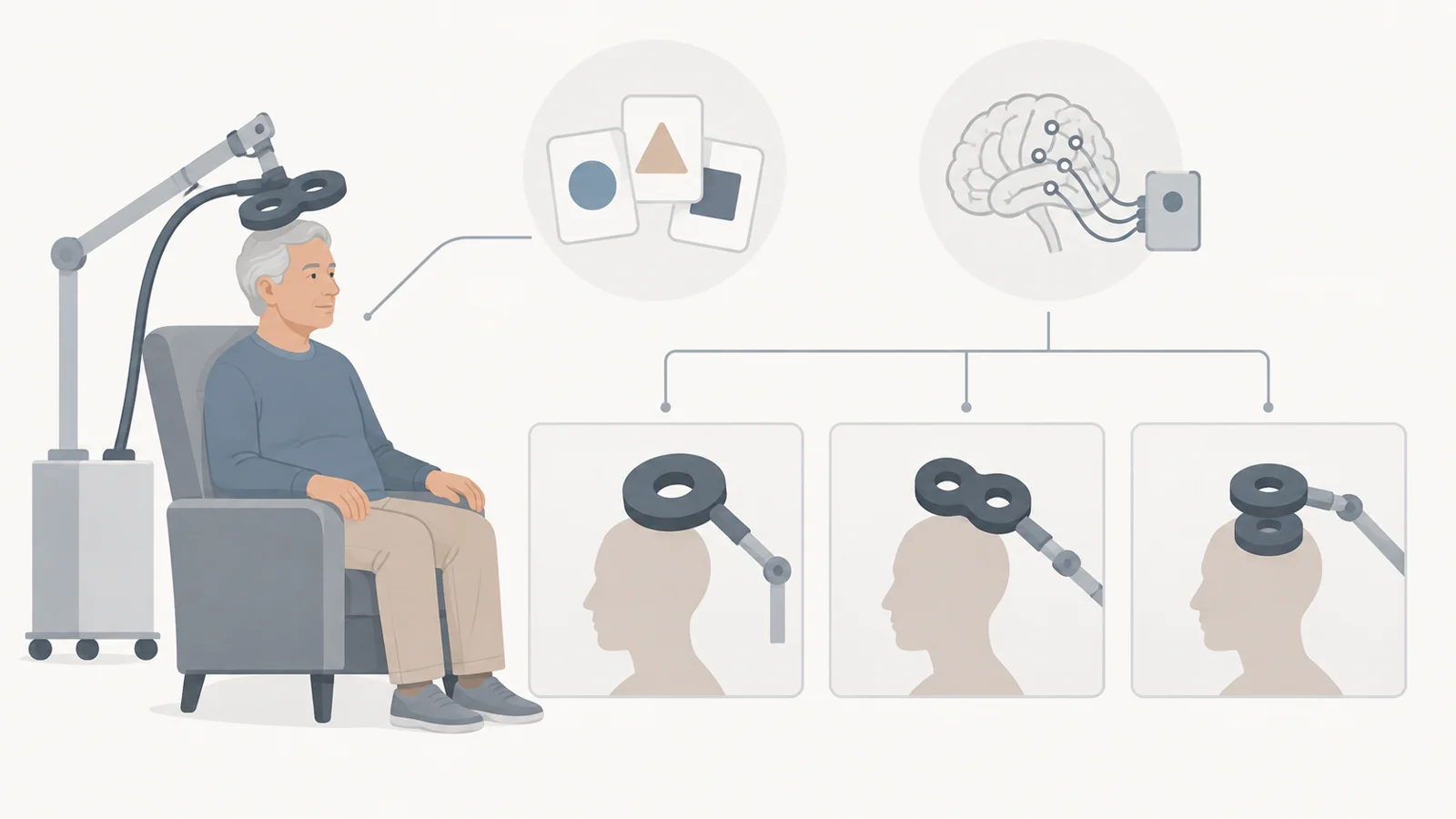
Deep transcranial magnetic stimulation, or dTMS, uses magnetic pulses to stimulate the brain without surgery. Repeated stimulation delivers sequences of pulses over multiple days. A coil is the device used to deliver those pulses.
Participants would be assigned to one of three parallel groups using coils called H1, H4, and H7. These labels identify the study arms. Researchers would examine feasibility and tolerability within each arm, as well as differences between the three approaches.
Feasibility asks whether the planned intervention and assessments can be carried out in this population. Tolerability concerns how participants experience stimulation, including side effects. Examining both could help researchers recognize whether a practical difficulty appears across the approaches or is concentrated in one arm, and decide what needs attention before a larger trial.
Different measurements reveal different parts of the experience
Neuropsychological testing would assess performance on thinking tasks. EEG, short for electroencephalography, would record brain activity. These observations could be examined together to ask whether changes in task performance coincide with changes in recorded activity. An EEG change alone would not establish that someone’s thinking had improved.
Questionnaires would add participants’ own reports of mood and sleep, alongside assessments of mental health symptoms and side effects. A test measures what someone does under assessment conditions; a questionnaire captures what they report experiencing. Keeping those observations separate matters even when they move in the same direction.
The plan schedules EEG, questionnaires, and the CNS Vital Signs cognitive assessment at baseline, at the midpoint, at the endpoint, and at follow-up. The midpoint is specifically after session 10 and before stimulation at visit 11. Baseline observations provide a starting point for comparison, while the later assessments would let researchers examine how observations during the course relate to those made afterward. They could also ask whether test performance, brain activity, and reported symptoms follow similar or different patterns over time.
Why a placebo comparison would answer another question
Comparing the three coil approaches could inform the choice of an approach for further study. Establishing that stimulation causes a meaningful benefit requires a different comparison. Changes during treatment could reflect influences such as expectations or familiarity with repeated tests. The investigators intend to use this preliminary work to inform a later randomized trial with sham stimulation, a placebo comparison that would help distinguish the effects of stimulation from other influences surrounding participation. Randomization is explicitly described for that future trial; the description of assignment to the three coil arms does not establish that allocation here would be random. The abbreviated study description available for this account supports an explanation of the design, but cannot establish how often side effects occur, which coil is better tolerated, or whether cognition improves.
What this could change
If an approach proves tolerable and later sham-controlled research establishes a meaningful cognitive benefit that persists long enough to help patients, older adults with mild neurocognitive disorder could gain an additional non-invasive treatment option for thinking difficulties. Comparing the coils could help identify a workable way to deliver that option, while the repeated assessments could help clarify how any benefit relates to patients’ performance and experience over time.
Key Sources
- Primary source: Deep rTMS for Mild Neurocognitive Disorder in Older Adults
Government or Regulator · Clinical Trial · 2025-06-26