
Research Signal – Source date 2025-05-05
A cell can acquire features associated with youth while its ability to do a particular job remains a separate question. That distinction matters when researchers describe cells as “rejuvenated.” Changing an age-related measurement, preserving a working cell and producing material for replacement tissue are different accomplishments.
The May 5, 2025 review Decoding Aging through iPSC Reprogramming: Advances and Challenges brings together earlier research on these possibilities. Its contribution is to connect the depth of a cellular reset with the identity, function and safety of the resulting cells. It synthesizes experiments in cultured cells and animals, including mice with premature aging; its publication does not announce a new rejuvenation experiment.
Two destinations for a cellular reset
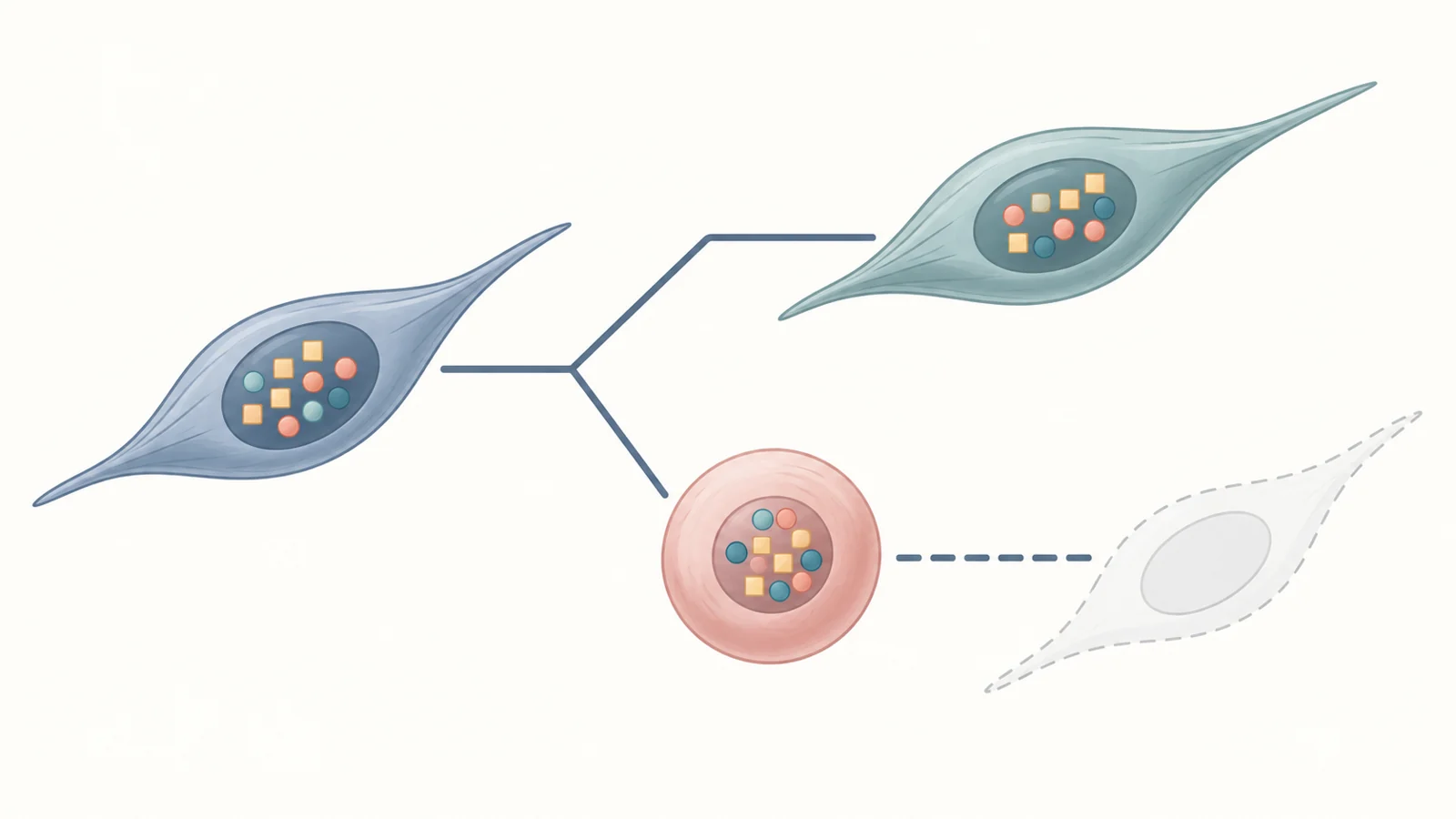
Cellular reprogramming means resetting a cell’s state by changing the programs that govern its identity and behavior. The review describes factors called Oct4, Sox2, Klf4 and c-Myc, collectively abbreviated OSKM, that can drive this process. These proteins regulate gene activity, helping a specialized cell move toward a stem-cell-like state.
Full reprogramming produces induced pluripotent stem cells, or iPSCs. “Pluripotent” means they have the capacity to develop into many different cell types. A specialized starting cell gives up its established identity and gains a wider range of possible developmental destinations.
For replacement-cell applications, that reset is an intermediate step. Researchers must then guide the iPSCs through differentiation, the process of becoming specialized again. The intended product might be a neuron or a heart muscle cell. Success therefore depends on both parts of the journey—creating suitable stem cells and reliably converting them into cells that perform the desired job.
Partial reprogramming has a different endpoint. Researchers expose cells to reprogramming activity for a limited period, aiming to alter age-associated features while retaining their existing identity. A fibroblast, a cell involved in connective tissue, is intended to remain a fibroblast rather than become a broadly adaptable stem cell.
This creates a demanding control problem. The process must change enough of the cell’s regulatory state to produce the intended effect while preserving the programs needed for its current role. The findings described here do not establish a universally usable exposure schedule or guarantee that every cell type will retain its identity for a particular interval. Duration has to be understood alongside the experimental system and the cells being treated.
What the experiments actually measure
The review brings together several kinds of observations that answer different biological questions. In its discussion of iPSCs, it describes longer telomeres—the protective ends of chromosomes—relative to the specialized cells from which they were derived. It also summarizes changes in mitochondrial function and oxidative stress. These concern chromosome maintenance and cellular metabolism, respectively; they are not interchangeable measures of a single biological age.
In aged human fibroblasts, the review describes partial reprogramming associated with lower DNA methylation-based age estimates alongside retained fibroblast markers. DNA methylation consists of chemical marks on DNA that help regulate gene activity. An epigenetic clock uses patterns in those marks to estimate age. A lower estimate means that the measured pattern has shifted toward one associated with younger cells.
Identity markers answer another question. Retaining fibroblast markers, such as vimentin, supports the interpretation that the cells preserve features of their original identity. Together, the clock and marker observations suggest that some age-associated regulatory changes can be separated from a complete loss of specialization. They do not, by themselves, demonstrate restored tissue function or a clinical benefit.
The animal findings concern a different level of outcome. The review attributes improved cellular function, reduced senescence and extended lifespan in progeroid mice to earlier partial-reprogramming experiments. Progeroid mice have a premature-aging condition. A survival result in that setting is an organism-level observation, but it does not establish the same effect in ordinary aging or in humans.
The review also identifies biological differences that complicate translation from mice, including differences in telomerase activity and lifespan. Read together, the cultured-cell and mouse findings support continued investigation of reprogramming. They do not establish safe reversal of whole-body aging or longer human life.
A cell’s memory can help or hinder its destination
A reset does not necessarily remove every regulatory trace of a cell’s past. The review describes epigenetic memory as retained DNA methylation patterns and modifications to DNA-associated proteins that reflect the original tissue. Such marks can influence which genes remain easier or harder to activate.
Whether that memory helps depends on the intended destination. In full reprogramming, residual marks may bias an iPSC toward particular lineages. The review discusses blood-derived iPSCs showing a greater tendency toward blood-forming outcomes than those derived from fibroblasts. A bias toward the desired cell type could assist differentiation; a bias toward another lineage could complicate it.
This is distinct from deliberately preserving identity during partial reprogramming. In that case, retaining the existing specialization is part of the goal. During a full reset intended to support a new developmental path, persistent features of the old identity may restrict the available options. Removing every epigenetic mark is therefore a poor description of what researchers are trying to achieve. The useful regulatory state depends on the cell’s next job.
The review discusses targeted epigenetic editing as one possible way to gain finer control. A modified CRISPR system can use a guide RNA to direct an editing component to a selected DNA location. In the examples discussed, a nuclease-deficient Cas9 protein serves as a targeting platform for enzymes that alter regulatory marks, rather than cutting DNA.
These tools could help adjust selected gene programs involved in reprogramming and differentiation. Their effects also need to persist for an appropriate length of time. The review notes that some methylation changes can fade within days and discusses systems such as CRISPRoff designed to produce more sustained regulation. Delivery into cells, unintended effects at other sites and the durability of the changes remain practical limitations. Targeted control is a proposed means of improving the process, with substantial work still needed to make its outcomes dependable.
Different safeguards address different growth risks
Reprogramming gives cells greater developmental flexibility and can increase their capacity to proliferate. That makes uncontrolled growth a central safety concern. The review identifies tumorigenicity risks associated with reprogramming factors and emphasizes the long-term behavior of the resulting cells.
Some proposed safeguards address how reprogramming instructions enter a cell. Transient mRNA delivery and other non-integrating approaches aim to avoid inserting delivery material into the genome. This reduces a particular source of risk from disrupting DNA through insertion. It does not automatically control every growth-related consequence of resetting the cell’s state.
Other safeguards focus on detecting or stopping problematic cells. The review discusses laboratory assays of proliferation and tumor-suppressor gene expression, along with experimental “suicide genes” that could be activated to destroy engineered cells if growth became uncontrolled. These measures serve different purposes: screening can identify warning signs, while a kill mechanism is intended to provide an intervention after cells have been produced.
None of these proposals establishes that tumor risk has been eliminated. Long-term preclinical observation remains necessary to assess whether reprogrammed cells maintain their intended identity, differentiate appropriately and remain under growth control inside a living organism.
Useful replacement cells need to mature consistently
Even a cell that survives and follows the desired developmental path can remain poorly equipped for an adult tissue’s work. The review identifies functional immaturity as a major obstacle, with some iPSC-derived cells retaining fetal-like characteristics.
Its examples make the problem concrete. Derived heart muscle cells may lack T-tubules, structures involved in coordinating contraction, while derived neurons may have limited synaptic connectivity. A neuron’s usefulness depends on its ability to participate in communication with other cells. A heart cell needs the organization required for its mechanical role. Producing a recognizable cell type is only part of producing a functional replacement.
Manufacturing adds another layer of uncertainty. Donor age, genetic background, starting cell source and culture conditions can all contribute to differences among iPSC lines. Batches may differ in their epigenetic profiles and in how efficiently they become the desired cell type. A promising result from one line therefore leaves a practical question about whether the same process will deliver comparable cells repeatedly.
The review calls for standardized protocols and benchmarks for maturity and safety. For a potential therapy, these would help connect laboratory characterization with a reproducible product whose cells can integrate and perform their intended function. At the May 2025 publication perspective, adequate maturity, consistency across batches and durable behavior in the body remain central barriers to that transition.
What this could change
If researchers can control both the reset and the return to specialization, patient-derived cells could become a source of functional replacements for damaged tissue. Cells collected from a patient could be reprogrammed into iPSCs, directed toward a needed cell type and prepared for possible transplantation. That capability could eventually benefit people whose age-related disease involves the loss or failure of particular tissue cells.
The causal path depends on stable identity, sufficient maturity, reproducible production and lasting growth control. Solving those problems together could turn cellular flexibility into a practical supply of replacement cells tailored to a patient. Partial reprogramming pursues the complementary possibility of improving aspects of a cell’s condition while preserving its existing role. The review’s useful distinction is that these routes aim to deliver different biological products, each with its own requirements for becoming useful medicine.
Key Sources
- Primary source: Decoding Aging through iPSC Reprogramming: Advances and Challenges.
DOI or Journal Page · Review or Meta-Analysis · 2025-05-05
Keep exploring