
Research Signal – Source date 2022-09-21
A drug that changes how a cancer cell reads its genes can push PD-L1 in opposite directions. Some histone deacetylase inhibitors raise this protein in certain tumor models; HDAC6 inhibitors lower it in others. PD-L1 helps put the brakes on T cells, so that split raises a useful question: what does changing the brake tell us about treatment?
A 2022 review brings together evidence from solid tumors on several ways cells regulate PD-L1, including changes to histones, DNA methylation and small noncoding RNAs. Its findings help explain why gene control can have different effects in different settings. They also show why a shifted marker alone cannot tell us whether a person will benefit from a checkpoint treatment or a drug combination.
The same immune brake can move in either direction
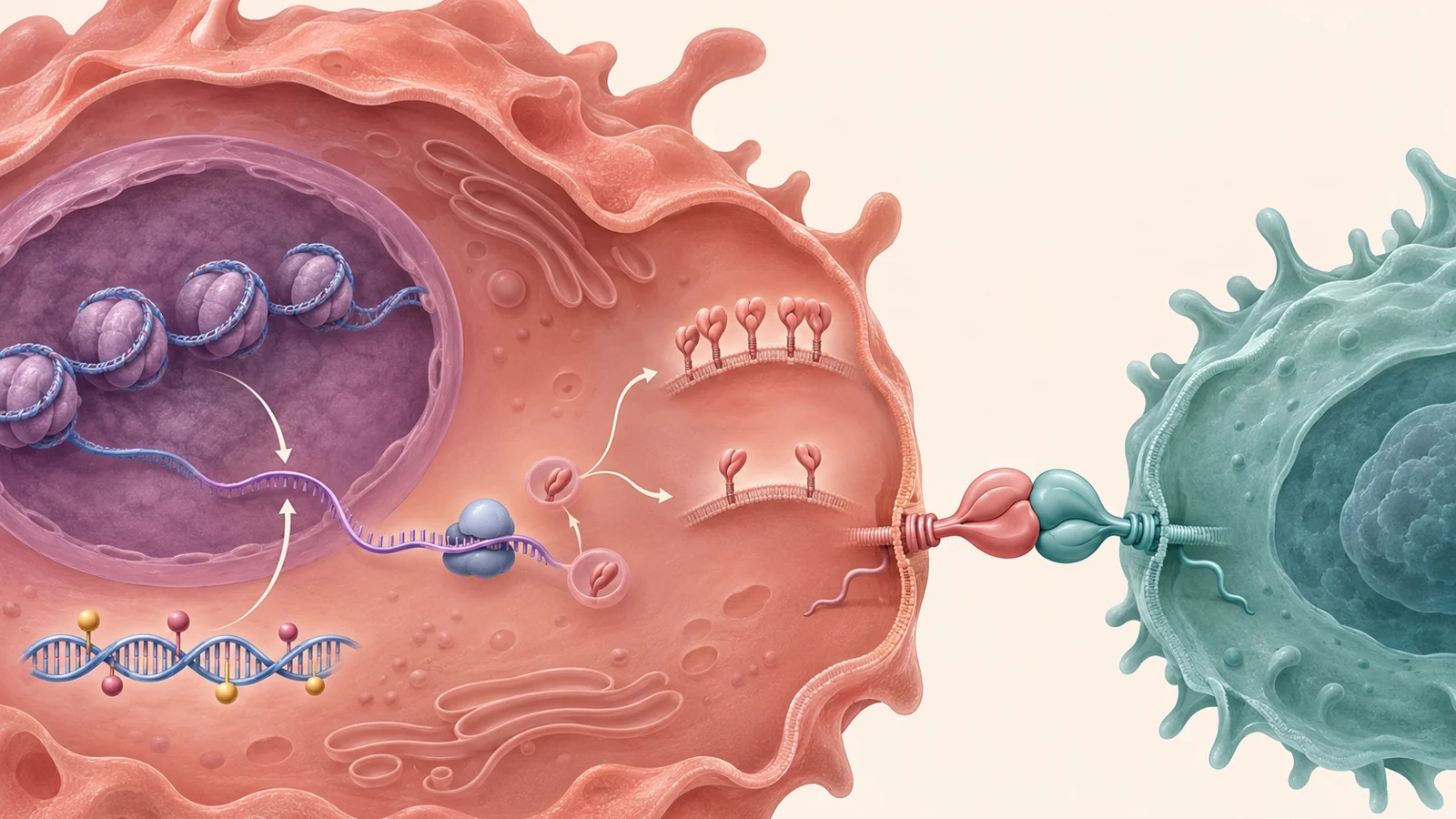
PD-L1 is a protein encoded by the CD274 gene. When it binds to PD-1 on a T cell, it can dampen that cell’s antitumor activity. Checkpoint inhibitors targeting PD-1 or PD-L1 interrupt this interaction, allowing T cells that were held back by the signal to resume attacking tumor cells.
That pathway is only one part of the immune response. The review describes primary resistance, in which treatment does not work from the outset, and acquired resistance after an initial response. Possible contributors include tumors that T cells struggle to recognize, tumor cells that fail to display the signals T cells need to find them, and conditions that weaken T-cell activity or add further immune brakes. Tumors can also change over time. Adjusting PD-L1 may therefore affect one part of a larger system without settling what happens to the whole response.
Histones change how easily cells read DNA
DNA is wound around proteins called histones. Chemical tags added to histones can change how tightly this material is packed, making particular stretches of DNA more or less accessible to the machinery that reads genes. Enzymes add, remove or recognize these tags, so altering their activity can change gene expression without changing the DNA sequence.
Acetylation is one such tag. Adding acetyl groups can loosen the interaction between histones and DNA, opening chromatin and making transcription easier. Removing the groups can shift access in the other direction. The review describes increased histone H3 acetylation at the CD274 promoter—the control region where transcription begins—as one route associated with more PD-L1 in drug-resistant breast, lung and liver cancer cells.
The reported effects of histone deacetylase inhibitors vary. In chondrosarcoma and colorectal cancer models, drugs blocking one group of these enzymes raised PD-L1. Drugs blocking a different enzyme, HDAC6, lowered PD-L1 in colorectal, lung and urothelial cancer models. These are findings across different interventions and models, not a direct comparison showing that one drug class is better. The effect depends on which enzyme is targeted and the cellular context.
DNA methylation provides another form of gene control. It adds chemical marks to DNA without altering its sequence and is often associated with gene silencing. The review cites evidence that DNA hypomethylation may accompany expression of PD-L1 and inhibitory cytokines, contributing to an immunosuppressive setting. Histone changes and DNA methylation are distinct mechanisms, but each can influence whether a cell makes PD-L1.
Small RNAs can act after a gene is read
Gene control also happens after a cell has made messenger RNA, the molecule carrying instructions from DNA to the cell’s protein-making machinery. MicroRNAs, or miRNAs, are short RNA molecules that can bind to messenger RNA and reduce how much protein is produced. Some bind directly to the 3′ untranslated region of PD-L1 messenger RNA, a segment that helps regulate its use.
In lung cancer models, the review describes miR-140 binding to PD-L1 messenger RNA and reducing PD-L1 expression. Let-7 miRNAs were also reported to bind this region and suppress PD-L1 messenger RNA in lung cancer cells. Other miRNAs can influence PD-L1 through signaling pathways rather than binding it directly. These examples show that the same protein can be regulated at more than one step, with effects shaped by the particular RNA and cell type.
Some miRNAs travel between cells in exosomes, small membrane-bound vesicles released into the tumor environment. The review describes exosomal miR-27a-3p from breast cancer cells increasing PD-L1 in macrophages in a model, and exosomal miR-21 from oral cancer cells affecting PD-L1 through PTEN. In a different example, exosomal miR-16-5p was reported to lower PD-L1 in gastric cancer cells. These findings concern particular cancer models and cell interactions; they do not establish a general effect of exosomes across tumors.
A changing marker is not the same as a treatment response
Researchers have measured PD-L1 in checkpoint-treatment studies, and its expression can help characterize tumors. But a change in the amount of PD-L1 is not itself proof that treatment will work better or worse. Tumor recognition by T cells, the ability of those cells to function, antigen presentation and other suppressive signals can all shape the outcome.
This matters when interpreting drug combinations. The review includes a mouse model in which blocking a circular RNA—a different kind of gene-regulating RNA—alongside anti-PD-L1 treatment reduced tumor volume and resistance to the treatment. It is a result from animals, not a patient outcome test of an epigenetic drug and checkpoint inhibitor combination. The review describes such combinations as early in development.
Some drugs that alter epigenetic regulation already had clinical uses for particular cancers by 2022. That history does not establish that pairing one of them with checkpoint blockade is effective or safe. The review also notes potential added toxicity; for example, some histone deacetylase inhibitors can cause lymphopenia, a reduction in lymphocytes. A combination would need evaluation of immune activity, response and harms together, since changing gene control could affect more than PD-L1.
How this could shape the future
For someone whose solid tumor resists a checkpoint medicine, a future treatment choice could match a tested combination to the specific way that tumor is evading immune attack. Resistance would then be approached as a set of different biological problems, rather than one uniform failure. The review contributes a clearer account of PD-L1’s gene controls and of why different drugs can move the protein in opposite directions. Reaching that future would also depend on better ways to identify which patients and tumors might benefit, followed by clinical testing.
A nearer milestone would be a prospective study that connects a defined gene-control intervention with immune activity, patient response and toxicity, using an appropriate checkpoint-treatment comparison. Checkpoint medicines and some epigenetic drugs already existed in 2022; the new capability would be knowing how to combine and select them for a particular tumor, with evidence that the approach helps patients safely.
Key Sources
- Primary source: Epigenetic modifications: Critical participants of the PD‑L1 regulatory mechanism in solid tumors (Review).
DOI or Journal Page · Review or Meta-Analysis · 2022-09-21
Keep exploring