
Research Signal – Source date 2022-01-22
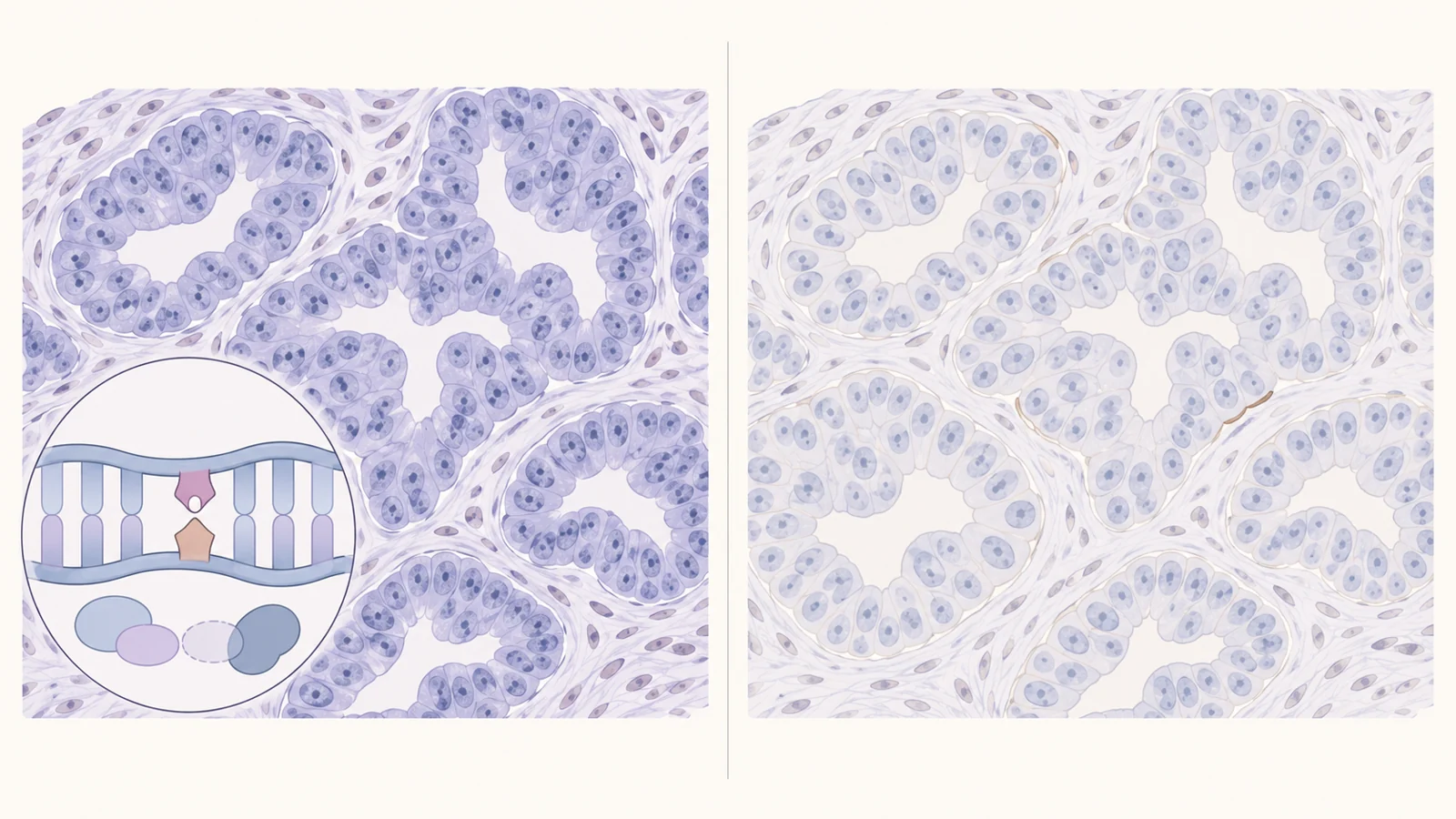
A prostate tumor can carry signs of faulty DNA repair without showing much PD-L1, an immune checkpoint marker measured in tumor tissue. In the analyzable cases assembled in the 2022 review, only 8 of 67 prostate cancers with mismatch-repair deficiency or microsatellite instability were PD-L1 positive. The two findings may be biologically related, but they are not interchangeable—and neither alone reliably tells whether an individual patient will benefit from immune treatment.
The paper, published January 22, 2022, reviewed studies that measured PD-L1 alongside DNA-repair markers and other prostate cancer genes.
The paired results were less common than one selected study suggested
Mismatch repair is a system that corrects copying errors made when DNA is replicated. When it fails, errors can accumulate, sometimes producing microsatellite instability (MSI) and many mutations. Those changes may create abnormal proteins that help the immune system recognize a tumor. PD-L1 is a separate feature: a protein on some tumor cells that can engage an inhibitory receptor on immune cells and dampen their activity.
The review followed PRISMA guidance and searched Web of Science, PubMed, and Scopus. After removing duplicates, two reviewers screened 560 records; 148 papers were ultimately included across the larger review. This installment focused on studies that assessed PD-L1 together with mismatch-repair or MSI status, BRCA genes, or PTEN, with brief discussion of other genes.
A key interpretive choice was to exclude a series of 206 cases in which both MSI-high status and PD-L1 positivity were selection criteria. Because the study admitted cases based on the very combination being evaluated, its results could not show how often the two features occur together in a broader set of prostate cancers. After excluding that series, 74 of 677 analyzed cancers (11%) showed MSI or loss of at least one mismatch-repair protein. Among the 67 cases with both relevant information and mismatch-repair deficiency or MSI, 8 (12%) were PD-L1 positive.
The 8-of-67 figure is a pooled fraction from selected, analyzable cases across different studies. It is not a population-wide prevalence estimate, and it does not mean that every tumor with a repair defect will behave the same way. The review also found that studies differed in how they tested and scored PD-L1 and repair status, making direct comparisons difficult.
BRCA points to another repair route, with little paired evidence
BRCA1 and BRCA2 help repair DNA breaks through a process called homologous recombination. Their loss is therefore a different repair problem from mismatch-repair deficiency. The review notes that BRCA alterations already matter to a separate treatment pathway: poly-ADP-ribose polymerase (PARP) inhibitors can be used for some patients with BRCA-mutated prostate cancer.
Across the small set of analyzable cases, 15 of 39 (39%) had BRCA1 or BRCA2 aberrations. But the review could clearly identify PD-L1 status for only a small subset: one of 10 cases with BRCA aberrations was PD-L1 positive. These counts do not establish a consistent pattern between BRCA status and PD-L1 staining, or show that combining the two would predict benefit from an immune checkpoint drug.
Treatment observations raise a separate question. In KEYNOTE-199, 11% of patients whose tumors had acquired (somatic) BRCA1/2 or ATM mutations responded to pembrolizumab, an immune checkpoint drug. Their prostate cancer had spread and kept growing despite hormone-lowering treatment and docetaxel chemotherapy. The reported response rates were 0% in a group with other homologous-recombination repair gene alterations and 3% in the group without those alterations. The review says it was unclear whether BRCA status tracked with PD-L1 in these patients. The response comparison is therefore not evidence that PD-L1 and BRCA together formed a treatment predictor.
PTEN suggests a mechanism, but tissue readings varied
PTEN is a tumor-suppressor gene involved in controlling cell growth and survival. The review describes a possible link: PTEN loss can alter growth-related cell signaling that may raise PD-L1 expression in prostate cancer. A mechanism like this gives researchers a reason to look for a relationship in tumor samples, but it does not guarantee that the markers will appear together in each case.
In the analyzable tissue findings, 13 of 137 PTEN-negative cancers (10%) were PD-L1 positive. Looking from the other direction, 10 of 29 PD-L1-positive cancers (35%) showed PTEN negativity. Across the studies with available results, PTEN loss was reported in 179 of 326 cancers. These are different denominators answering different questions; neither percentage is the chance that a person with one marker has the other.
The comparison was also complicated by varied or unclear laboratory assays and scoring systems for both markers. Some studies found no significant association between PD-L1 and PTEN by immunohistochemistry, while results from individual tumor components were not uniform. If laboratories define or score a positive stain differently, pooled numbers can obscure rather than settle a biological relationship.
A marker result and a treatment response answer different questions
Mismatch-repair deficiency and MSI can help identify some advanced prostate cancers for which pembrolizumab is an available treatment option. The review describes this option for selected patients whose prostate cancer has spread and kept growing despite hormone-lowering treatment, and whose tumors have high microsatellite instability or mismatch-repair deficiency. Eligibility based on a repair marker, however, is not the same as a guarantee of response; PD-L1 staining is another measurement, not a substitute for observing what happens after treatment.
The small clinical series summarized in the review illustrates the gap. In one group of 11 patients with MSI-high or mismatch-repair-deficient metastatic castration-resistant disease treated with pembrolizumab, five (45.5%) had durable clinical benefit, five had no benefit, and one had stable disease for six months. The PD-L1 status was unclear. Elsewhere, the review notes that PD-1 inhibitors may show activity even in some cancers without MSI, DNA-repair defects, or PD-L1 expression. These examples come from studies the authors reviewed; they are not a new trial of a combined marker test conducted by the review authors.
The evidence base has limits that matter for prediction: many series were retrospective, some included few tested samples, and selection criteria, assays, and scoring methods varied. Combined testing of repair status and PD-L1 was uncommon or unclear. Larger studies across multiple hospitals would be needed to establish whether the paired results add reliable information about treatment response beyond the repair assessment already used to identify eligible patients.
How this could shape the future
For a person with advanced prostate cancer, a more dependable account of how DNA-repair defects and immune markers work together could make a treatment discussion more informative than either marker alone can support today. The review’s contribution is to show where these clues diverge in the published tissue findings and where paired measurements are too sparse to guide that discussion. Whether a combined assessment could predict benefit from an existing immune treatment remains conditional on further independent evidence.
A nearer milestone would be a prospective study across multiple hospitals, using consistent assays and measuring whether combined markers predict observed treatment response better than repair status alone. If that result held up, clinicians could have a more reliable basis for discussing who is more likely to benefit. The treatment option already exists for selected patients; the potential advance is a clearer way to estimate benefit, not a new treatment established by this review.
Key Sources
- Primary source: What Do We Have to Know about PD-L1 Expression in Prostate Cancer? A Systematic Literature Review (Part 6): Correlation of PD-L1 Expression with the Status of Mismatch Repair System, <i>BRCA</i>, <i>PTEN</i>, and Other Genes.
DOI or Journal Page · Review or Meta-Analysis · 2022-01-22
Keep exploring