
Evidence date · 2022-01-01 · Research note 1 of 3
1 2 3
See current Track status →
Softness helps robots adapt to unstructured surroundings, but their materials remain vulnerable to damage. Polymers that can heal offer a possible way to extend a component’s life. Building with them introduces another challenge. The material must take the right shape, and any joins must work as part of the finished component.
The January 2022 review Processing of Self-Healing Polymers for Soft Robotics examines that manufacturing question. It brings together techniques for shaping these materials and connecting parts, showing why the choice of process matters alongside the ability to repair damage.
Connections that can rearrange
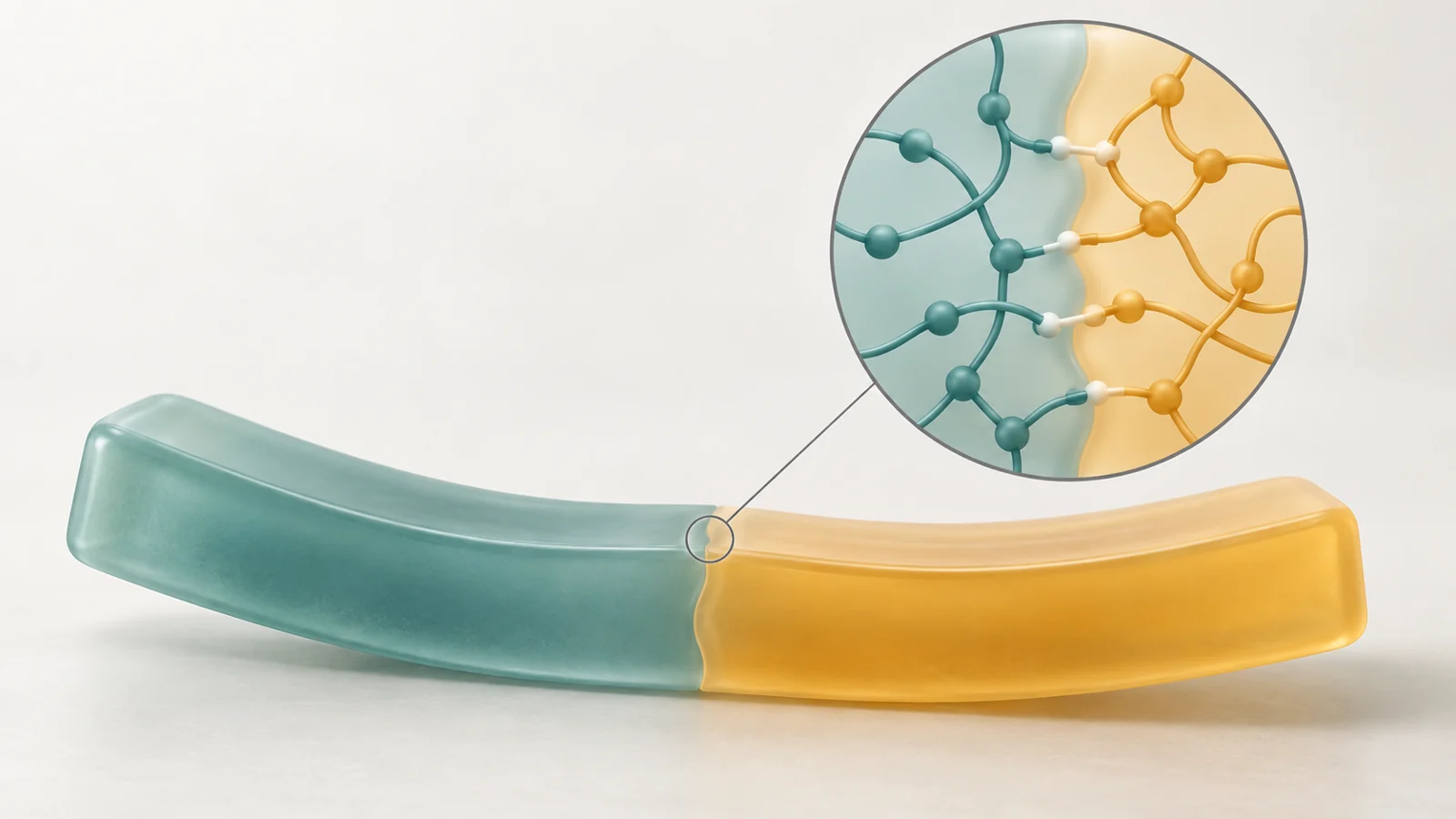
A polymer network contains cross-links—connections between its constituent chains. The review focuses on reversible covalent links and other physical or chemical interactions. Covalent links involve chemical bonds; other connections depend on different interactions within the material. Their shared importance here is reversibility, the capacity for connections to change and form again.
That capacity helps explain why healing chemistry also matters during fabrication. Connections that can re-form may help damaged material reconnect, while also supporting the joining or reshaping of material during manufacturing. The authors treat these properties as closely related design considerations.
The abstract also identifies recyclability and stress relaxation among the opportunities. Stress relaxation means that internal stress can ease over time. These features broaden the manufacturing question beyond whether a cut can close, although the supplied evidence does not establish how much any particular material benefits.
Making a shape and making a join
The review groups processing techniques into formative methods, additive manufacturing and a category it calls “(re)assembly binding.” Each addresses a different part of turning a polymer into a useful structure.
Formative processing gives material its shape. Additive manufacturing builds a structure by adding material. Both offer routes toward the complex geometries needed for soft robotic components. At this level, the distinction concerns how a part is formed; the abstract does not supply fabrication recipes or establish which route produces the best part.
Assembly and reassembly binding bring the interface between pieces into focus. Instead of considering only the geometry of an individual piece, developers must also consider how separate sections connect. A component made from more than one material needs a robust join if those materials are to function together.
Robust multi-material parts are a specific objective highlighted by the authors. This makes joining a manufacturing problem in its own right. Producing two well-shaped sections is only part of the task; their connection also belongs in the choice of material and processing method. The review aims to guide that choice according to the polymer and intended robotic application.
What complete recovery tells us here
The authors report that self-healing soft robots can recover completely from macroscopic damage—damage at the scale of the component rather than individual molecular connections—and associate this with longer lifetimes. That is a substantial claim, but its scope matters.
The available abstract does not identify the healing conditions, the measurements used to define complete recovery or the number of repair cycles involved. It therefore does not establish that every self-healing polymer repairs itself without assistance, or that every required robotic function returns after damage. “Complete” needs the context of what was tested and measured.
The authors also describe comparing and validating processing techniques against defined requirements for soft robots. The supplied abstract does not expose those requirements in detail, the validation procedures or the variation among the underlying studies. Readers cannot use it to rank manufacturing methods or estimate throughput and component lifetime.
The useful contribution available here is a processing-focused synthesis connecting material chemistry, shaping and joining. It provides a basis for thinking about fabrication choices, while leaving device-level performance and reliability to evidence with those details.
What this could change
If suitable processing can produce complex shapes while preserving useful healing behavior and robust joins, developers could build soft robotic components that can be repaired and kept in service longer. Users could then have more opportunities to retain a damaged component instead of replacing it.
The causal link runs through the whole part. A material’s healing ability becomes useful when fabrication turns it into a functioning component whose connections also meet the application’s needs. Potentially fewer replacements are a downstream inference from that possibility, rather than a measured saving or environmental benefit reported in the supplied evidence.
Key Sources
- Primary source: Processing of Self-Healing Polymers for Soft Robotics.
DOI or Journal Page · Review or Meta-Analysis · 2022-01-01