
Research Signal – Source date 2021-05-12
When researchers propose treating aging by targeting senescent cells—body cells associated with aging that can release inflammatory substances—what would a treatment actually change? A review published on May 12, 2021, brings together two approaches aimed at these cells and their secretions. It describes a therapeutic research direction, including a few agents already in clinical trials. This account draws on the review’s abstract; its full text was not available for assessment.
The central idea is that senescent cells can contribute to conditions around them. Their accumulation and the substances they release may reinforce a cycle of chronic inflammation, giving researchers more than one possible point of intervention.
How accumulation can feed inflammation
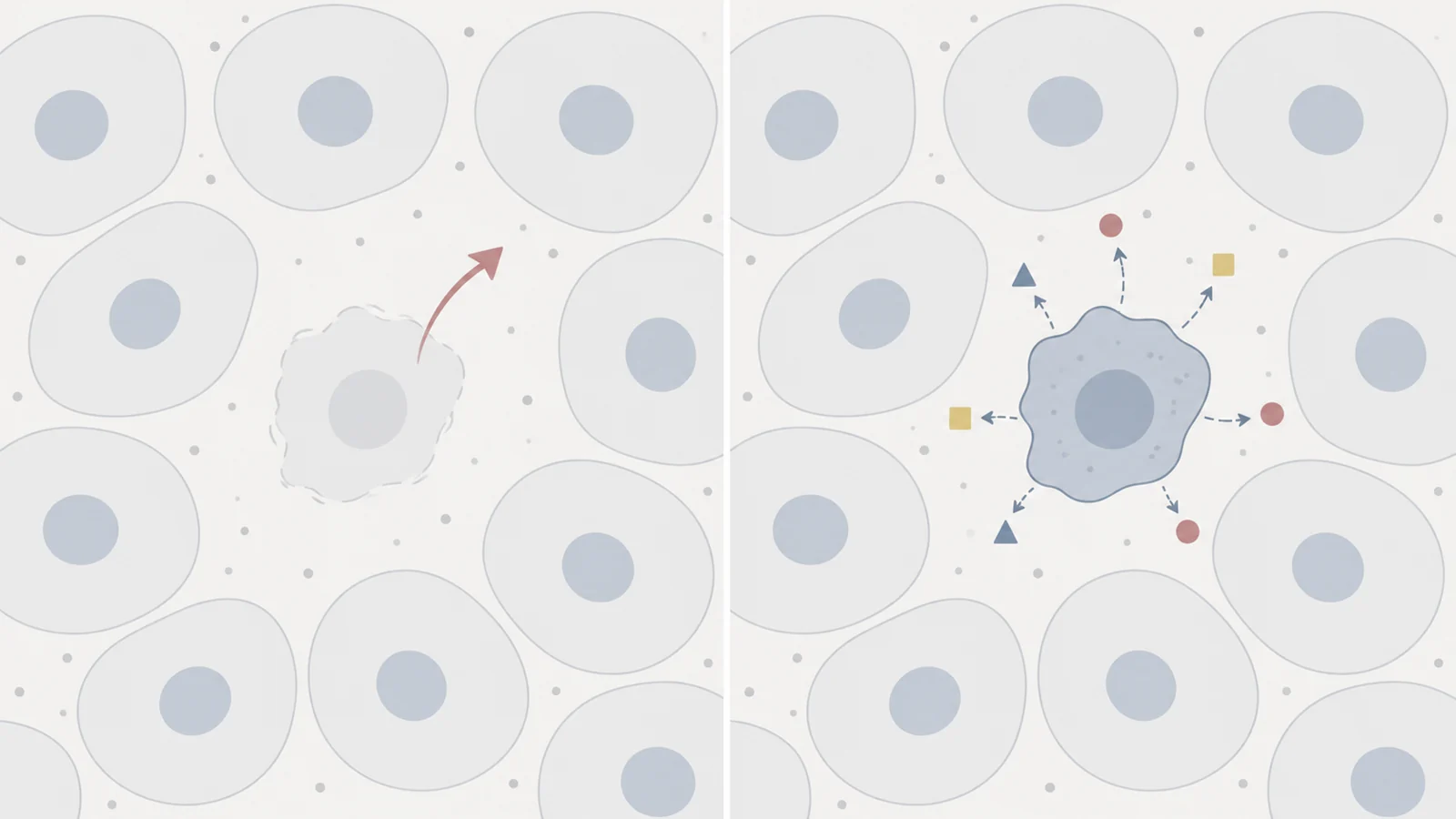
The review describes senescent cells as producing a senescence-associated secretory phenotype, or SASP. In ordinary language, this means a pattern of substances released by the cells. These include molecules that promote inflammation and others that break down the matrix, the material surrounding and supporting cells in tissue.
As senescent cells accumulate, the authors describe persistent, low-grade inflammation throughout the body, often called “inflammaging.” The proposed sequence does not end with inflammation. Chronic activation of the immune system can reduce the clearance of senescent cells. With fewer cells cleared away, accumulation continues, sustaining the conditions that helped it develop.
This feedback helps explain the therapeutic interest. A process that both contributes to inflammation and becomes harder to resolve under inflammatory conditions offers a possible target for interrupting ongoing tissue stress.
Removing cells or changing their secretions
The two approaches fall under the umbrella of senotherapeutics. Their names describe different intended actions.
Senolytics aim to selectively kill senescent cells. The target is the cell itself. Selectivity matters because the proposed intervention depends on distinguishing the cells researchers want to eliminate from other cells in the tissue.
Senomorphics aim to selectively suppress the SASP. Here, the intended change concerns what senescent cells release. A cell could remain present while its secretion pattern changes. Evidence of reduced secretion would therefore not, by itself, demonstrate that senescent cells had been removed.
That distinction changes how a treatment’s biological activity should be interpreted. A decrease in cell numbers and a decrease in inflammatory secretions answer different questions, even when both approaches arise from the same disease hypothesis.
The review includes both natural and synthetic compounds. Those terms describe origin, a separate distinction from therapeutic action. Calling a compound natural does not identify whether it acts as a senolytic or a senomorphic, and origin alone does not establish effectiveness or safety.
A shared target does not mean a shared response
Cellular senescence is heterogeneous. The review describes influences from genetics, epigenetics—the regulation of gene activity—and environmental factors across different types of body cells. The label “senescent” therefore does not establish that all such cells will respond alike to an intervention.
This makes selective treatment a central unresolved problem. An approach intended to act on senescent cells must work in the relevant cell population and disease setting. The fact that several age-related conditions are discussed together does not establish that one intervention would be suitable for all of them. The abstract cannot tell readers which approach is more effective or safer for any particular disease.
The report that a few agents had entered clinical trials marks a step toward testing in people. Trial entry is a statement about research activity, however, and the abstract supplies no trial results. It provides no patient outcome data or quantitative effects from which to judge clinical benefit. It also notes adverse effects among the issues considered, without giving the details needed to assess their frequency or severity here.
The evidence available for this account consequently does not establish improved health in patients, longer human lifespan, or reversal of aging. Nor does it support ranking individual compounds. The authors’ interest in redox-sensitive properties points to a focus of the full review, but the abstract does not support a detailed explanation of those molecular pathways.
What this could change
If selective intervention proves safe and produces meaningful benefits in patients, it could offer a way to limit tissue damage associated with senescent-cell activity. Reducing the inflammatory and matrix-degrading activity described in the review could lessen one source of continuing stress on affected tissues.
For people living with an age-related condition such as osteoarthritis, which the authors identify as a possible application, the potential payoff would be better preservation of tissue and its function. Establishing that benefit would require validation in the disease itself. From the May 2021 perspective, the therapeutic possibility is a more specific way to address a contributor to chronic disease, with everyday patient benefit as the goal.
Key Sources
- Primary source: Senolytics and senomorphics: Natural and synthetic therapeutics in the treatment of aging and chronic diseases.
DOI or Journal Page · Review or Meta-Analysis · 2021-05-12
Keep exploring