
Nanoparticle T-Cell Engagers
Can modular nanoparticle T-cell engagers reliably direct T cells to attack tumors?
Following this cluster shows whether modular designs are advancing beyond a platform concept toward reproducible evidence of tumor-directed activity. It also helps readers track what remains to be demonstrated as the designs evolve.
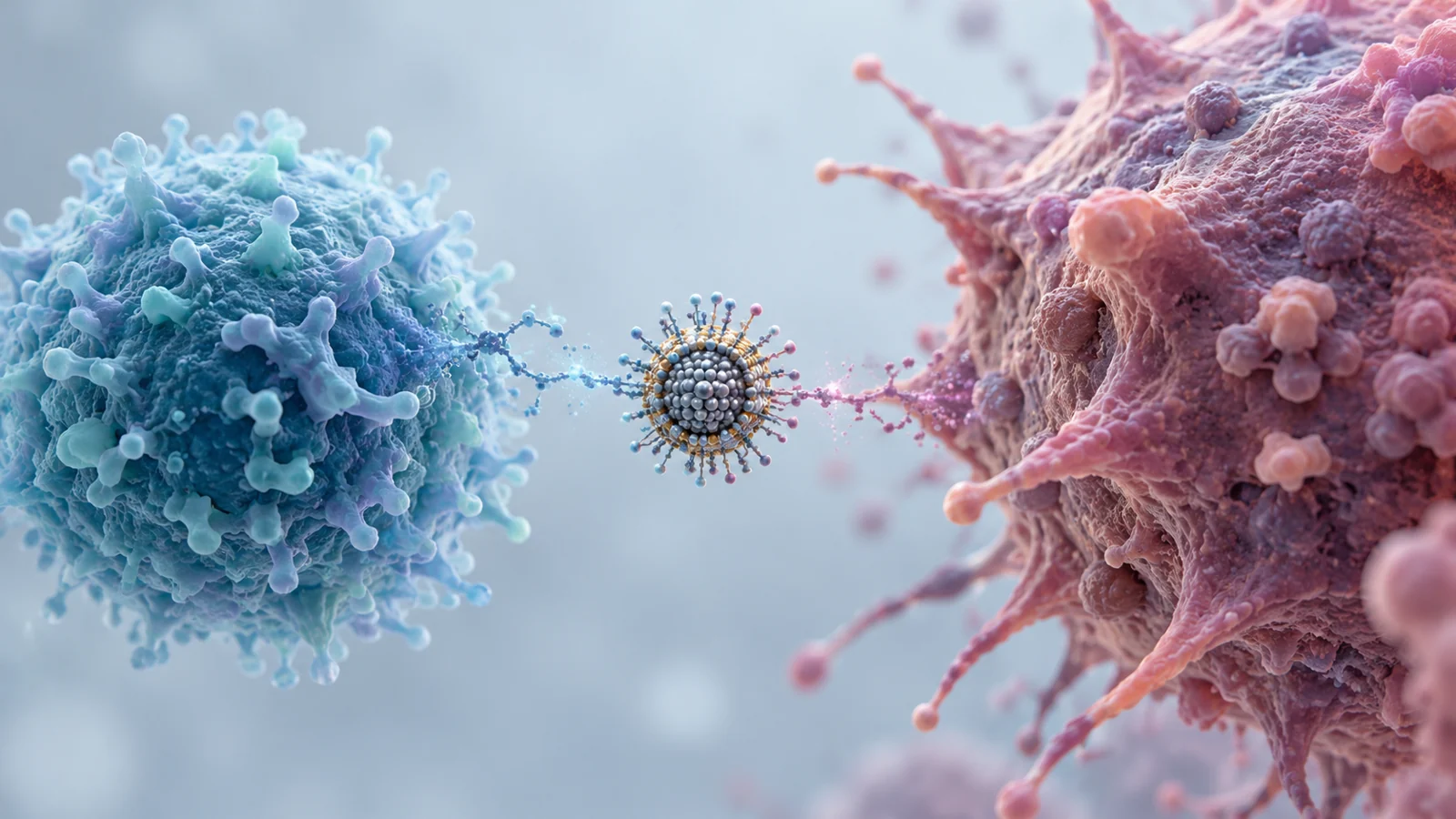
Where it stands now
Main bottleneck
Current evidence shows a modular platform and a later engineered design, but does not establish whether the approach produces reproducible antitumor effects or overcomes the challenges of applying it to cancer treatment.
Watch next
Watch for primary research that tests a nanoparticle T-cell engager in tumor models and reports verifiable antitumor activity alongside safety evidence.
Progress timeline
How the evidence has changed over time.
2026 · 1 update
- Why have T-cell engagers advanced further in blood cancers than solid tumors?Research note 3 of 3 · Source date 2026-06-03
Since the previous research note · Earlier expectation not tested
Track continuity
Since the previous research note: How does one lipid particle link a T cell to a tumor cell?
Previous expectation: A reusable lipid-particle engager might combine tumor targeting with immune-regulating binders if it proved safe and effective beyond the reported models.
What this study adds: The June 2026 review brings clinical uses and design barriers across the broader T-cell-engager field into view. The cataloged evidence does not test that lipid-particle design.
Current research note
2025 · 1 update
- How does one lipid particle link a T cell to a tumor cell?Changed directionResearch note 2 of 3 · Source date 2025-04-21
Since the previous research note · Changed direction
Track continuity
Since the previous research note: One T-cell bridge can carry three ways to recognize myeloma
Previous expectation: A particle with several tumor-recognition routes might help T cells find variable myeloma cells and, if circulation allowed, ease dosing.
What this study adds: The 2025 source reports a CD3–HER2 lipid-particle bridge with enhanced cytotoxicity in HER2-positive tumor models and describes a third, PD-L1-directed binder aimed at T-cell exhaustion.
Current research note
2021 · 1 update
- One T-cell bridge can carry three ways to recognize myelomaResearch note 1 of 3 · Source date 2021-01-21
How this Track works
This page changes as new evidence arrives. Open any update to see what researchers found at that point in the story.