
Evidence date · 2026-06-03 · Research note 3 of 3
1 2 3
See current Track status →
Since the previous research note · Earlier expectation not tested
Track continuity
Since the previous research note: How does one lipid particle link a T cell to a tumor cell?
Previous expectation: A reusable lipid-particle engager might combine tumor targeting with immune-regulating binders if it proved safe and effective beyond the reported models.
What this study adds: The June 2026 review brings clinical uses and design barriers across the broader T-cell-engager field into view. The cataloged evidence does not test that lipid-particle design.
What changed in this study
T-cell engagers have produced clinical results in blood cancers, while their progress in solid tumors has been more limited. The difference is not that solid tumors cannot be treated by redirecting T cells: the review describes a meaningful survival result in uveal melanoma. Rather, solid tumors add barriers to reaching cancer cells and finding a target that is both present on the tumor and scarce on healthy tissue.
The treatments work by bringing an immune cell and a cancer cell into close contact. That straightforward idea has yielded several drug designs, but the clinical examples are specific to their cancers, targets and patient groups. They show both the promise of ready-made immune therapies and why success in one setting does not automatically travel to another.
A molecular bridge redirects T cells
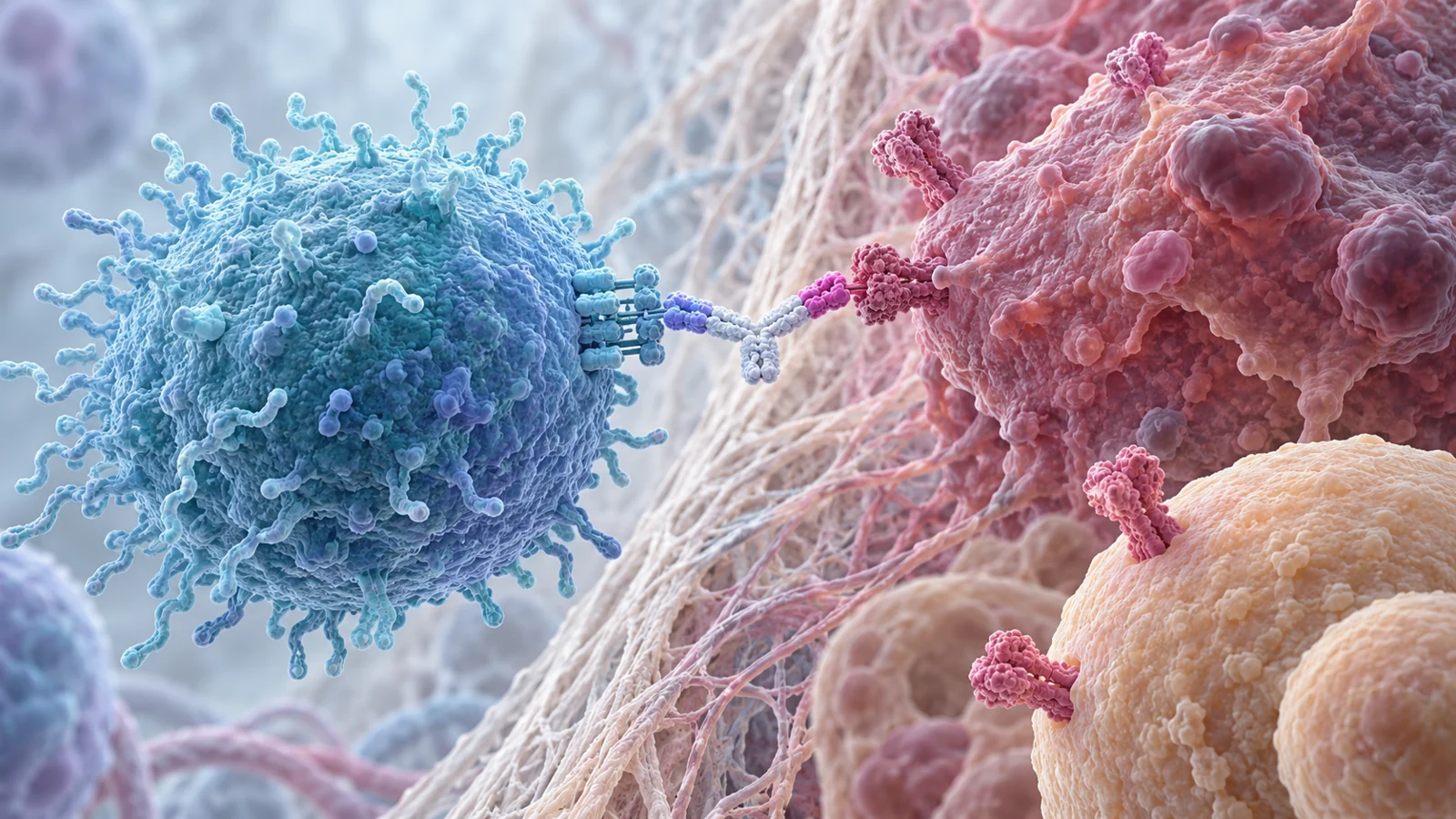
A conventional antibody-based T-cell engager has two binding ends. One attaches to CD3, a part of the signaling machinery on a T cell; the other binds a marker on a cancer cell. When both ends bind, the drug helps form a contact between the cells and activates the T cell to release cell-killing molecules.
In ordinary T-cell recognition, a T-cell receptor identifies a small piece of protein displayed by a cell on a major histocompatibility complex, or MHC. Conventional antibody engagers can route around that recognition step: their CD3-binding end activates the T cell while the other end identifies a surface marker on the tumor. This makes the approach independent of the usual MHC presentation route. It does not make the target irrelevant. If cancer cells lack or alter the marker, the bridge may not work as intended.
The formats differ in how those binding ends are built and how long a drug remains in the body. Blinatumomab is a small molecule made from two linked antibody fragments. Teclistamab uses a larger, IgG-like antibody format with changes meant to reduce unintended immune activation. Some small engagers clear quickly: the review gives blinatumomab a serum half-life of about two hours. Other designs add features intended to extend circulation and allow less frequent dosing. Longer persistence can improve convenience, but it also makes control of immune activity and off-target binding important design questions.
Blood cancers offer reachable targets
The strongest clinical examples in the review come from blood cancers, where malignant cells circulate in blood or occupy immune-cell-rich tissues. Blinatumomab, which links CD3 to CD19 on B cells, was tested in adults with relapsed or refractory B-cell precursor acute lymphoblastic leukemia. In the TOWER trial, the review reports median overall survival of 7.7 months with blinatumomab, compared with 4.0 months with standard chemotherapy. Complete remission occurred in 34% and 16% of patients, respectively. These figures describe that trial population and comparison; they are not a general estimate for every cancer or every engager.
Teclistamab provides a separate example in heavily treated multiple myeloma. It links CD3 to BCMA, a marker on malignant plasma cells. In the phase I/II MajesTEC-1 trial, the review reports an overall response rate of 63% among patients whose disease was resistant to three major classes of treatment. A response means the cancer burden decreased by the trial’s measure; it does not mean every patient benefited or that the response was permanent. The review also reports that 39.4% achieved a complete response or better, and median progression-free survival—the time before disease progression or death—was 11.3 months.
These results illustrate how a shared immune-cell target can be paired with different cancer markers. They also come from different diseases, treatments and study populations, so the numbers should not be compared as though the drugs were tested head-to-head.
Ready-made treatment changes the logistics
A T-cell engager is manufactured as a drug and can recruit a patient’s own T cells after it is given. CAR-T therapy instead starts with the patient’s T cells, which are collected, genetically modified and expanded outside the body before being returned. The review notes that CAR-T treatment can also involve chemotherapy before infusion to support the modified cells. Personalized manufacturing adds time, coordination and upfront cost; an off-the-shelf engager avoids that production process.
Convenience does not settle which approach works better. In a comparison cited by the review among patients with relapsed or refractory multiple myeloma previously treated with a BCMA-directed therapy, BCMA-targeted CAR-T therapy was associated with a higher response rate than a BCMA engager, 79% versus 51%, and longer median progression-free survival, 6 versus 2 months. The groups and treatments in that comparison define what those figures mean; they do not establish a universal advantage for CAR-T or for engagers. A separate BCMA engager study reported comparatively low rates of cytokine release syndrome, an inflammatory reaction caused by immune activation. Efficacy, durability, toxicity and treatment logistics all matter, and they can point in different directions.
Solid tumors make the bridge harder to use
A solid tumor is a physical and biological environment, not just a collection of target cells. T cells may have difficulty entering the tumor, and local immune-suppressing conditions can blunt their activity. Cancer cells within one tumor may also differ in which markers they display. A drug that binds a useful target can therefore face both an access problem and a patchwork of cells that do not all present the same target.
The review describes tebentafusp as an important solid-tumor example, but its design is distinct from conventional antibody engagers. It uses an affinity-enhanced T-cell receptor fused to an anti-CD3 antibody fragment. The receptor recognizes a piece of the gp100 protein displayed on uveal melanoma cells by HLA-A*02:01, a specific form of MHC. In the phase III IMCgp100–202 trial, median overall survival was 21.7 months with tebentafusp and 16.0 months with the comparison treatment. The survival benefit was reported regardless of objective radiological response, meaning scans did not capture the full pattern associated with longer survival in the trial.
This example shows that T-cell redirection can have a role in a solid cancer, while also showing a constraint: tebentafusp can target only patients whose cells carry HLA-A*02:01. The review estimates that this applies to about 45% of people in the US and Europe. It is a specific route to a specific target, not evidence that the same design works across solid tumors.
A shared target can put healthy tissue at risk
The target on a cancer cell may also appear on normal cells. When an engager activates T cells against that shared marker, the immune attack can injure healthy tissue even if the drug binds exactly as designed. The review describes solitomab, an EpCAM-targeting engager, as an example: EpCAM occurs on some tumors and normal gastrointestinal tissue, and early trials were terminated because of dose-limiting toxicity, including liver-enzyme elevations and diarrhea. A tumor marker is useful only if the treatment can distinguish enough cancer from the healthy tissue that carries it too.
This on-target, off-tumor harm is different from cytokine release syndrome. The first comes from T cells attacking healthy cells that display the intended target; the second is an inflammatory response to broad immune activation. Both matter to safety, but solving one does not necessarily solve the other.
One proposed design response is to keep an engager masked while it circulates and let enzymes found in a tumor environment remove the mask. The review discusses protease-activated XPAT constructs, including EGFR- and HER2-targeting candidates. In laboratory studies summarized there, the masked forms reduced off-target killing substantially, while the activated forms retained T-cell-mediated killing. Those experiments support a design strategy; they do not show that masked engagers have already delivered broadly safe clinical benefit across solid tumors. Each target and tumor environment may require its own engineering.
Cancer can change the target after treatment
Even when a target is initially present, a tumor can become harder to recognize. Some cancer cells may already display less of it, or treatment may favor cells that lose or alter the target. The review describes mutations in BCMA, the target of some myeloma engagers, that can impair drug binding despite detectable BCMA at the cell surface. A routine test that detects the marker may therefore miss a change that matters to a particular drug’s ability to attach.
The review reports TNFRSF17 mutations in 42.8% of patients who relapsed after anti-BCMA T-cell engager therapy, compared with 6% after CAR-T therapy in the cited analysis. That comparison concerns those treated groups and does not imply the same pattern for every target or product. It does underline that resistance can involve the quality of the binding site, not simply whether a marker is present or absent. T-cell exhaustion and immune-suppressing conditions can also weaken the response over time.
What safer T-cell engagers could mean for solid tumors
If safer targeting and better persistence can be achieved without sacrificing control of immune activation, ready-made T-cell engagers could give more patients access to treatments that enlist their own immune cells without personalized cell manufacturing. In blood cancers, the clinical examples already show what that capability can look like. For solid tumors, approaches that reach tumor cells, work within their local environment and spare healthy tissue could extend it to cancers that have so far been harder to treat. The review describes candidate designs and barriers, while the breadth of that future use remains conditional on clinical results.
Key Sources
- Primary source: T-cell engagers in cancer immunotherapy: mechanisms, challenges, and future perspectives.
DOI or Journal Page · Review or Meta-Analysis · 2026-06-03