
Evidence date · 2023-01-20 · Research note 3 of 3
1 2 3
See current Track status →
Since the previous research note · Earlier expectation not tested
Track continuity
Since the previous research note: Why is EA5181 testing durvalumab earlier in treatment?
Previous expectation: Randomized survival results and acceptable late heart and lung safety might support starting durvalumab during chemoradiation for eligible patients.
What this study adds: The January 2023 DEDALUS design addresses patients judged ineligible for concurrent chemotherapy and radiation, proposing earlier chemo-immunotherapy, radiation with durvalumab, and maintenance durvalumab. It specifies planned safety and survival measures rather than reporting outcomes.
What changed in this study
For some people with stage III lung cancer, chemotherapy and chest radiation cannot be given at the same time. The DEDALUS trial design proposes a different overlap: chemotherapy comes first with an immune-targeting drug, then radiation is given alongside that drug. The plan is intended for people whose cancer cannot be removed with surgery and whose care team judges them unsuitable for concurrent chemotherapy and radiation.
Published in January 2023, DEDALUS is a proposed single-arm, multicenter phase 2 study. Its publication describes the treatment sequence and what researchers plan to measure; it does not report results from participants.
A different way to combine the treatments
The study plans to enroll 45 people with unresectable stage III non-small-cell lung cancer. “Unresectable” means surgery is not considered an option for removing the cancer. A thoracic oncology team must judge each person ineligible for concurrent chemoradiation, meaning chemotherapy and radiation delivered together, while considering them candidates for a sequential approach followed by durvalumab.
The plan allows any PD-L1 status. PD-L1 is a marker whose status is assessed in the cancer; the design does not restrict enrollment to one status. The key distinction is the treatment team’s judgment about whether chemotherapy and radiation can be combined at the same time.
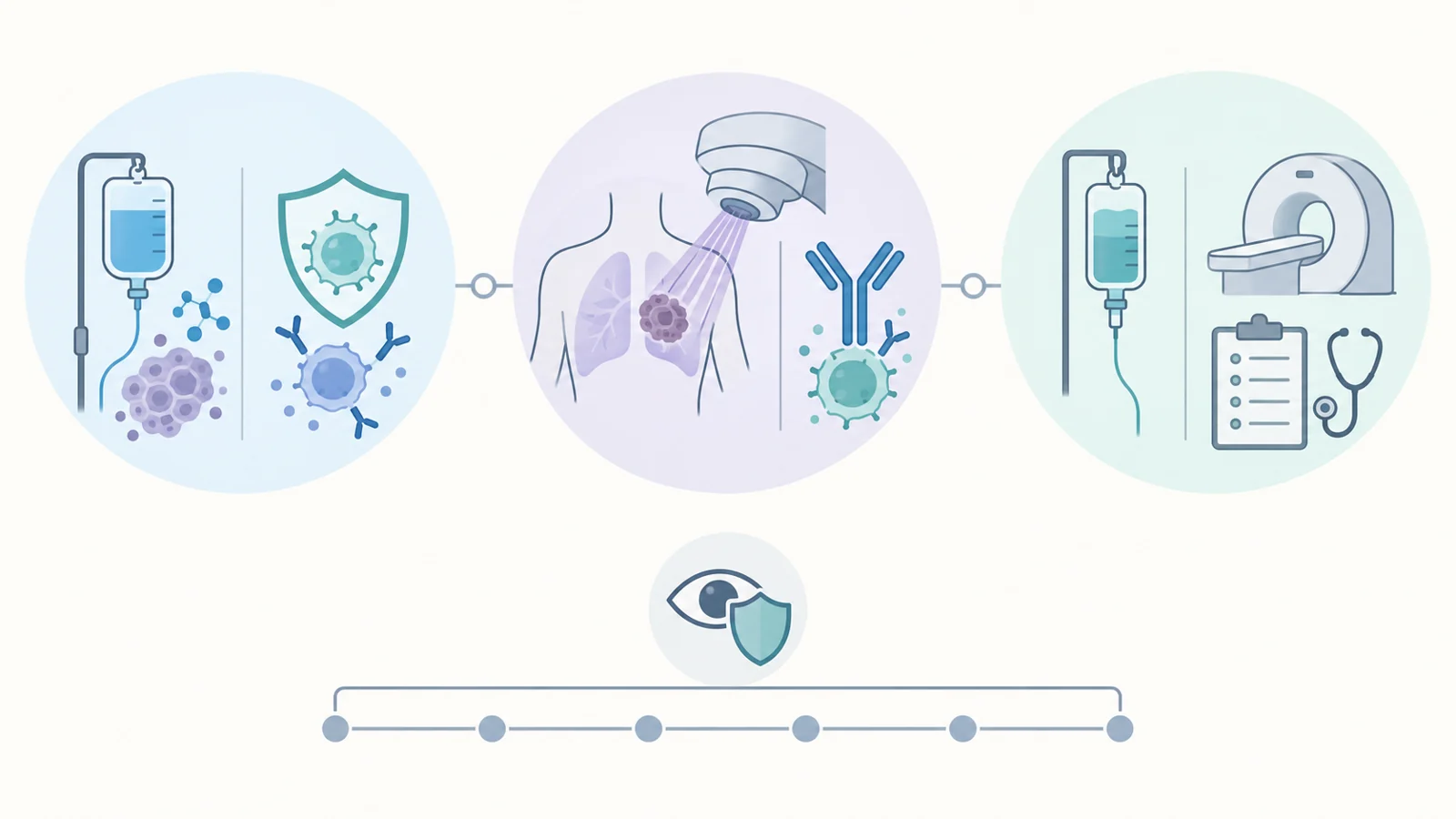
DEDALUS proposes three phases. First comes induction chemo-immunotherapy: chemotherapy together with immunotherapy, a treatment that uses an immune-targeting drug. Next, participants would receive de-intensified, hypofractionated radiation to the chest at the same time as durvalumab, an immune-targeting medicine. Hypofractionated radiation delivers treatment in larger portions over fewer sessions than a more spread-out schedule; the abstract does not specify a dose or number of sessions. Finally, participants would receive maintenance durvalumab, meaning continued treatment after the radiation phase.
So chemotherapy is not the treatment paired with radiation in this sequence. The proposed overlap is between radiation and durvalumab, after chemotherapy has already been given with immunotherapy.
Safety is the first planned test
The primary endpoint—the main measure the study is designed to assess—is the incidence of grade 3 or 4 adverse events considered possibly related to treatment during the first six months after treatment begins. This gives the study a defined early safety question for the proposed sequence.
The design also lists progression-free survival and overall survival as secondary measures. Progression-free survival tracks the time until cancer worsens or another defined event occurs; overall survival tracks survival from any cause. The researchers plan to report median values and outcomes at 12 months. These measures address different questions from the primary safety endpoint: how long participants remain without progression and how long they live.
The six-month safety window cannot settle whether later heart or lung harms occur. And because this is a single-arm study, with no comparison group described in the design, its planned measures cannot show whether the sequence is safer or more effective than concurrent or sequential alternatives. If outcomes change, the study also cannot isolate whether chemotherapy, durvalumab, radiation, or their combination produced the effect.
Blood and scans may add clues
Alongside the clinical measures, the study plans to analyze cell-free DNA, small fragments of DNA circulating in the blood. Samples are planned at baseline, after chemo-immunotherapy and radiation, and at progression. The researchers can examine how these molecular measurements relate to the treatment course, but the design does not make them a validated guide for choosing treatment.
The plan also includes radiomics analysis of computed tomography (CT) scans at baseline and before maintenance treatment. Radiomics uses quantitative features extracted from medical images. Together, the blood and scan analyses could help describe molecular and imaging changes at specified points in the sequence. They are ancillary analyses, not reported findings or established tools for directing care.
What this sequence could offer patients who cannot combine chemotherapy and radiation
If the study and later evidence support the approach, people judged unsuitable for concurrent chemotherapy and radiation could have an evidence-supported sequence that still includes an immune-targeting drug during radiation and afterward. That would offer a treatment option shaped around the timing they can receive, while retaining immunotherapy in the plan. Acceptable safety and evidence of patient benefit would need to support such an option; the January 2023 DEDALUS design establishes neither.
Key Sources
- Primary source: Rationale and Design of a Single-Arm, Phase 2, Multi-Center Study of Chemo-Immunotherapy Followed by Hypo-Fractionated RT and Maintenance Immunotherapy in Patients With Unresectable Stage III NSCLC: The DEDALUS Trial.
DOI or Journal Page · Clinical Trial · 2023-01-20