
Evidence date · 2021-03-01 · Research note 1 of 3
1 2 3
See current Track status →
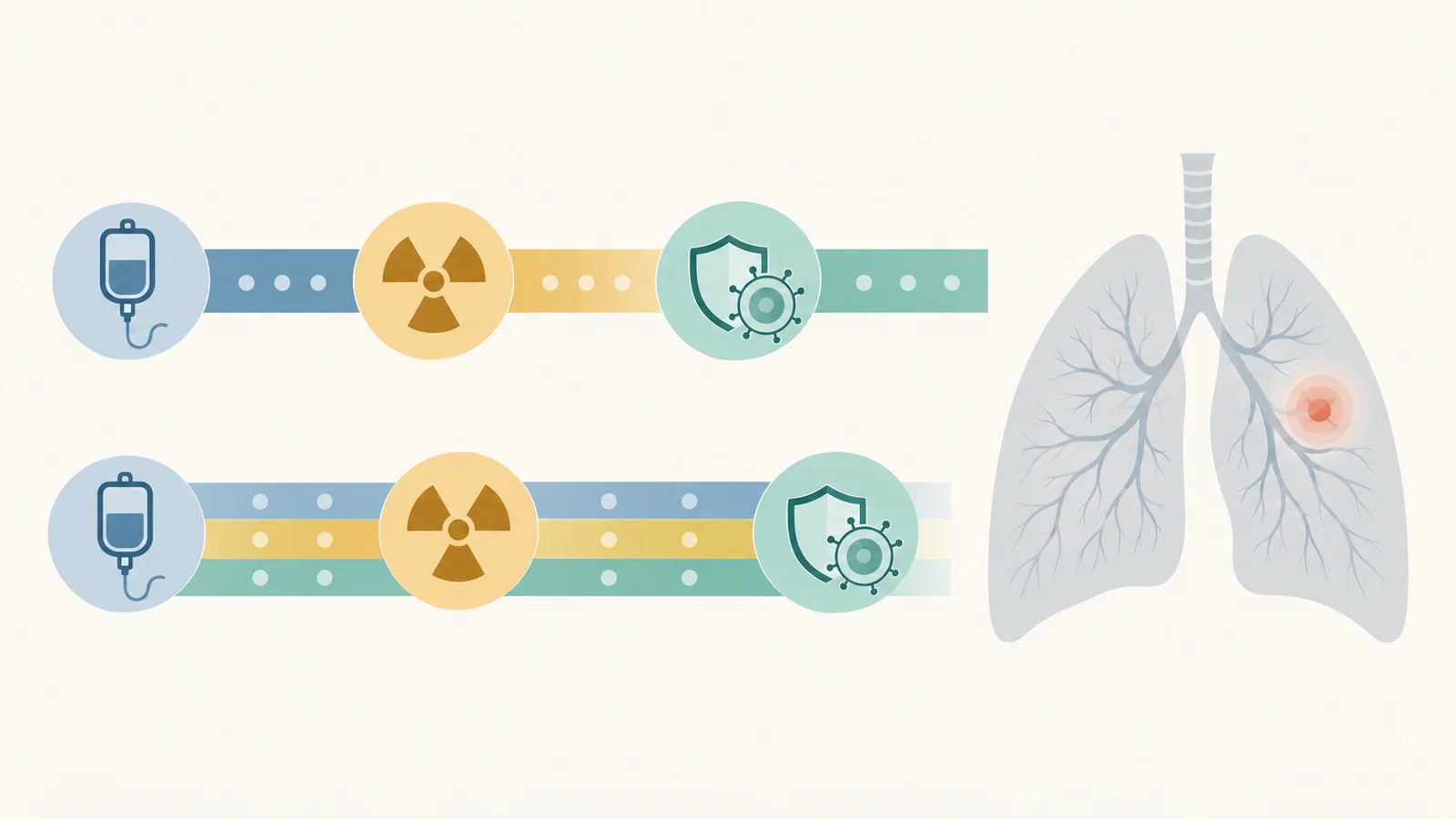
A review of 13 studies found different rates of lung inflammation depending on when immune therapy was given, which immune target it acted on, and whether results came from clinical trials or routine care. In clinical trials, grade 2 pneumonitis—a category of lung inflammation—was reported more often when immune checkpoint therapy was given during chemoradiation than when it followed chemoradiation. Other comparisons showed that the difference between trial and real-world results could matter too.
These are pooled rates across groups of patients in different studies. They offer a way to compare patterns in the published evidence, but they do not show that changing a particular person’s treatment would change that person’s risk.
Trials reported more grade 2 lung inflammation with concurrent immune therapy
The clinical trials in the review reported grade 2 pneumonitis in 23.0% of patients receiving immune checkpoint therapy concurrently with chemoradiation. The pooled rate was 11.0% when immune therapy was given sequentially, after chemoradiation. In everyday terms, the first schedule overlaps the immune treatment with chemotherapy and radiation; the second starts immune treatment after that combined treatment is complete.
The comparison is about a particular category of pneumonitis severity. It does not mean that every person receiving concurrent treatment developed lung inflammation, or that the same difference would apply in every treatment setting. The reported figures summarize results across the clinical-trial groups included in the review.
Chemoradiation is used to treat stage III non-small-cell lung cancer, and immune checkpoint inhibitors were being studied alongside it, either during treatment or afterward. The review’s timing comparison describes how often grade 2 pneumonitis was reported in studies using those different schedules. Because patients were grouped by the treatment approaches used in the component studies, the figures alone cannot show that timing caused the difference.
The drug target comparison showed another difference
Immune checkpoint therapies can act on different proteins. The studies compared anti-PD-1 therapies with inhibitors of PD-L1, two distinct targets. Among clinical trials, the pooled rate of grade 3 or higher pneumonitis was 8.6% with anti-PD-1 therapy and 4.4% with PD-L1 inhibitors. Grade 3 or higher represents a more severe category than grade 2.
This is a separate comparison from the one about concurrent versus sequential timing. It does not show that the target alone explains the difference: the review compared pooled groups of studies, and the supplied results do not establish that switching targets would lower an individual patient’s risk. Nor do these safety rates show whether a treatment associated with less pneumonitis would maintain the same cancer control.
Severe pneumonitis was more frequent in real-world reports of sequential PD-L1 therapy
For sequential PD-L1 therapy, real-world reports had a pooled grade 3 or higher pneumonitis rate of 9.9%. The comparable clinical-trial rate was 4.4%. Across the review as a whole, the authors included seven real-world reports and six prospective clinical trials.
The difference matters when readers consider how trial findings might translate to routine care. Trial participants and the care settings represented in trials may differ from those in real-world reports. This review’s comparison identifies a difference in reported rates; it does not determine why the rates differed or predict what will happen to a person outside a trial.
What pooled percentages can tell us
The authors searched MEDLINE and EMBASE for studies of anti-PD-1 or anti-PD-L1 therapy given concurrently with or after definitive chemoradiation for stage III non-small-cell lung cancer. They identified 13 studies in total: six prospective clinical trials and seven real-world reports. For pneumonitis, they pooled study proportions using a random-effects model, which accounts for the possibility that results differ across studies rather than treating every study as if it measured one identical group.
A pooled proportion combines reported pneumonitis rates across studies using statistical weights. It is not a personalized forecast. The review also compared groups statistically, but these pooled comparisons do not establish that changing treatment timing or drug target would cause a patient’s risk to fall. The reported safety results also do not establish whether a strategy with a lower pneumonitis rate would preserve cancer outcomes.
What lower lung risk could mean for treatment
For people receiving chemoradiation for stage III lung cancer, a treatment sequence or immune therapy choice that produces less serious lung inflammation could make combined treatment safer. That benefit would matter only if comparative evidence confirmed the safety difference and showed that cancer control was maintained. The 2021 review describes patterns in the available safety results; it does not settle which treatment approach offers that balance.
Key Sources
- Primary source: Immune Checkpoint Inhibition With Chemoradiotherapy in Stage III Non-small-cell Lung Cancer: A Systematic Review and Meta-analysis of Safety Results.
DOI or Journal Page · Review or Meta-Analysis · 2021-03-01