
Evidence date · 2025-04-21 · Research note 2 of 3
1 2 3
See current Track status →
Since the previous research note · Changed direction
Track continuity
Since the previous research note: One T-cell bridge can carry three ways to recognize myeloma
Previous expectation: A particle with several tumor-recognition routes might help T cells find variable myeloma cells and, if circulation allowed, ease dosing.
What this study adds: The 2025 source reports a CD3–HER2 lipid-particle bridge with enhanced cytotoxicity in HER2-positive tumor models and describes a third, PD-L1-directed binder aimed at T-cell exhaustion.
What changed in this study
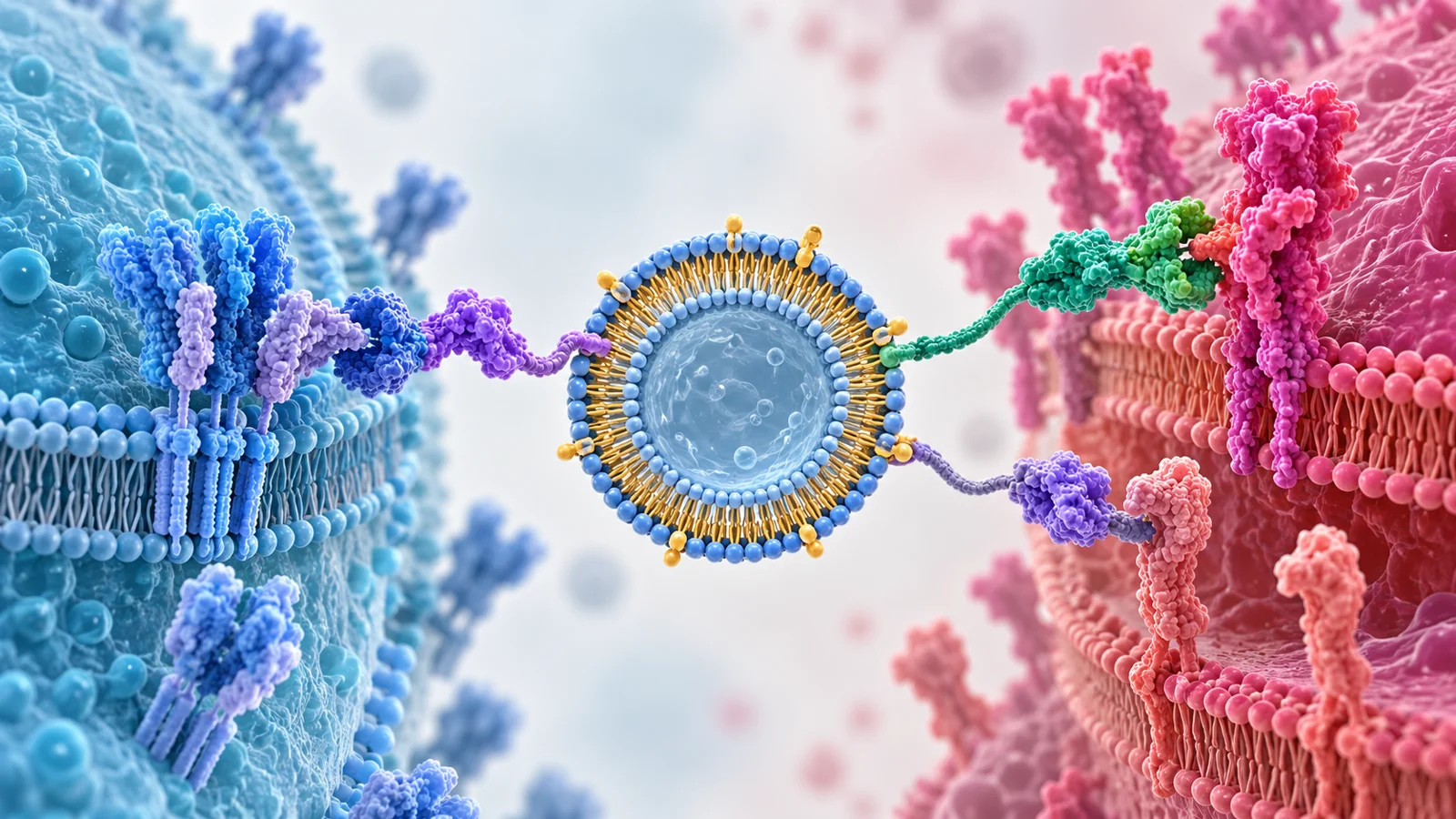
A lipid particle can carry thousands of antibody fragments, but its useful role depends on what those fragments bind. In a study published on April 21, 2025, researchers reported a two-target particle designed to bind T cells and HER2-positive tumor cells. The particle enhanced CD8-positive T-cell-mediated killing in HER2-positive tumor models. A third binder was added for a different purpose: to address T-cell exhaustion.
A lipid layer that can display antibody fragments
The researchers used genetically engineered lipoproteins fused to antibody fragments. These lipid-tagged fragments spontaneously inserted into the fatty outer layer of nanoparticles, placing their binding ends on the surface. The approach can display at least 0.102 single-chain variable fragments per square nanometer, or about 3,200 fragments on a particle.
That figure describes the platform’s reported display capacity. It makes the design tangible, but a high count alone does not explain how a particle connects cells or whether a particular arrangement works. The binding targets matter too.
Two binding jobs bring the cells together
The two-target version, called Lipo-BiTE, carried fragments aimed at CD3 and HER2. CD3 is a molecule on T cells; HER2 is a marker found on the targeted tumor cells. Binding both gives the particle a way to engage a T cell and a HER2-positive tumor cell at once.
For this two-target configuration, the researchers reported an optimized surface density of 1.28 × 10⁻³ fragments per square nanometer. This figure applies to the anti-CD3 and anti-HER2 arrangement, rather than describing the platform’s maximum display capacity. The two numbers refer to different claims and do not, by themselves, show that a sparser surface works better.
In HER2-positive tumor models, Lipo-BiTE was associated with enhanced CD8-positive T-cell-mediated cytotoxicity—the T cells’ ability to kill the targeted tumor cells. That is the reported activity at the tumor-model stage. The supplied evidence does not specify the model subtype or effect size, so it cannot establish how large or broadly applicable the effect is.
A third binder takes aim at exhaustion
The researchers also designed Lipo-TriTE by adding nanobodies, small antibody-derived binders, that bind PD-L1. They intended this addition to address T-cell exhaustion, a weakening of T-cell activity, rather than to recognize another tumor marker.
The supplied evidence describes that design aim, but does not quantify an exhaustion outcome or an added cytotoxic benefit from the third binder. Its intended role should therefore be kept separate from the enhanced killing reported for the two-target particle.
What modular T-cell engagers could change
If these configurations prove effective and safe beyond the reported tumor models, a reusable lipid-particle design could let researchers combine tumor targeting with immune-regulating binders in different ways. That could broaden the set of T-cell engager designs available for cancer immunotherapy. Whether the approach can work in people, how it behaves in circulation, and what safety or dosing profile it might have remain open questions on the evidence available here.
Key Sources
- Primary source: Modular Design of T Cell Nanoengagers for Tumor Immunotherapy via Genetically Engineered Lipid-Tagged Antibody Fragments.
DOI or Journal Page · Peer-Reviewed Paper · 2025-04-21