
Evidence date · 2021-01-21 · Research note 1 of 3
1 2 3
See current Track status →
A myeloma cell may display a marker that helps immune cells recognize it—or display too little of that marker for a treatment to connect reliably. In a 2021 preclinical study, researchers tested whether one liposome, a tiny fat-based particle, could carry antibodies that attach T cells to cancer cells through several possible markers at once.
The study focused on multiple myeloma, a cancer of plasma cells, and three markers found on myeloma cells: BCMA, CS1 and CD38. The researchers built particles with one cancer-targeting antibody at a time, then compared them with particles carrying antibodies to all three markers. Their experiments asked whether those multiple connections could improve T-cell activity when one marker was unavailable.
Myeloma markers varied across the samples
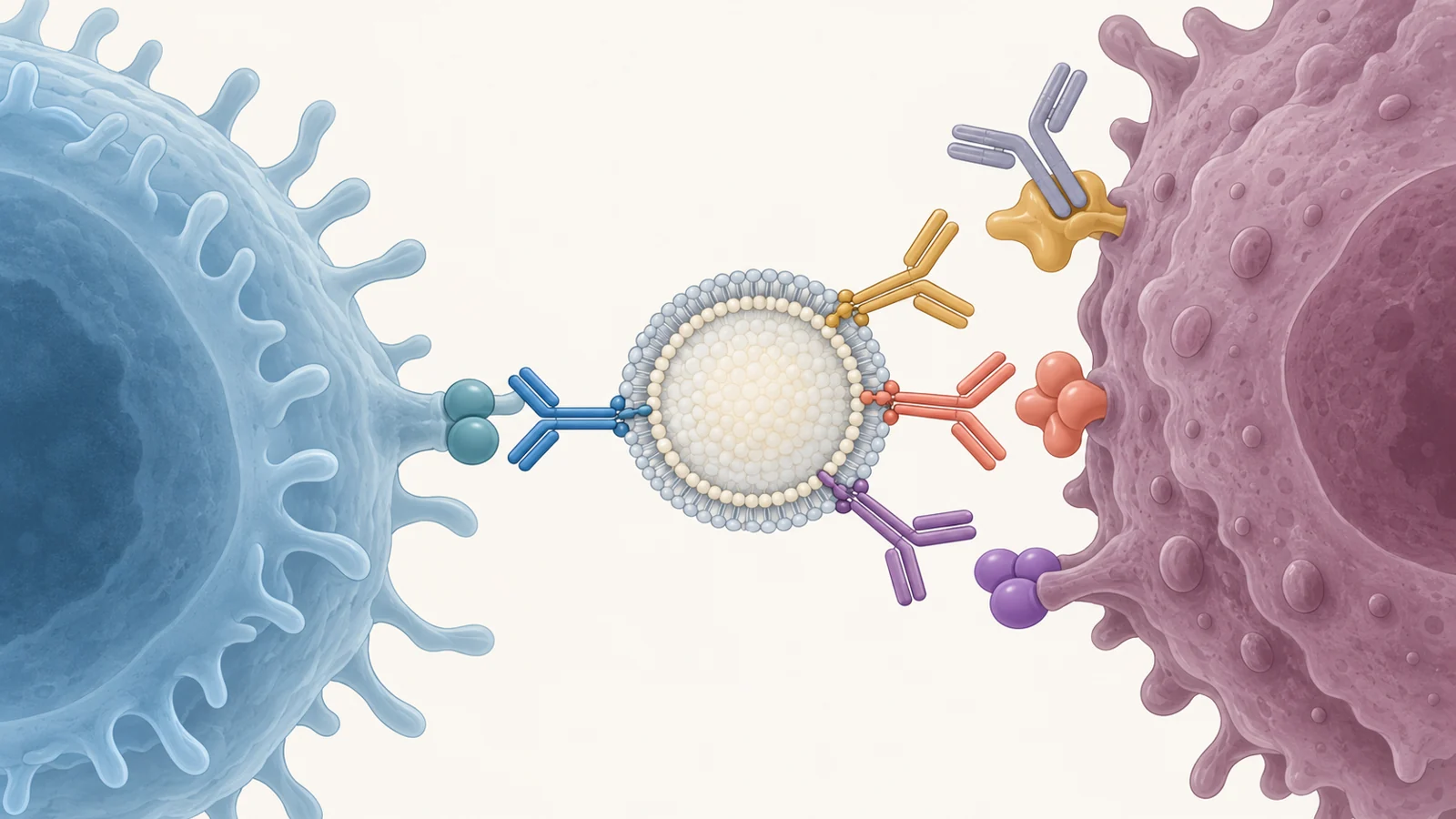
A treatment that directs T cells toward a cancer cell needs a way to recognize that cell. In this study, each liposome carried antibodies on its surface: one kind recognized CD3, a marker on T cells, while other antibodies recognized one or more markers on cancer cells. The particle could therefore bring a T cell close to a cell bearing a chosen cancer marker and help the T cell engage it.
The one-target particles were called nanoBiTEs. The three-target version, carrying antibodies for BCMA, CS1 and CD38 alongside the T-cell connection, was called a nanoMuTE. These names describe the study’s designs; the central difference was whether a particle could connect through one myeloma marker or through three.
The choice of three markers reflected variation in the material the researchers examined. They analyzed gene-expression data from 600 newly diagnosed myeloma patients, drawn from previously published data, and found that BCMA, CS1 and CD38 expression varied across patients. They also measured surface proteins in myeloma cell lines and three patient-derived samples, again finding variable expression. Gene expression and surface protein measurements are different kinds of evidence, but both pointed to a practical challenge: a single marker was not equally present across the myeloma material studied.
More connections produced more activity in marrow-like cultures
To compare the designs, the researchers placed myeloma cells and T cells in a three-dimensional culture made with bone-marrow material. In this setting, each single-target particle increased myeloma-cell killing compared with a control particle. The three-target particle produced more killing than each of the single-target versions.
They also measured T-cell activation. The single-target particles increased activation compared with the control, and the three-target formulation produced greater activation than each single-target particle. This matters because the result was not just that the multi-target particle attached to more cancer cells: in these cultures, the researchers measured both cancer-cell killing and an immune-cell response. The experiments were performed in laboratory cultures, including tests with patient-derived marrow material outside the body; they do not show how a person would respond to treatment.
Blocking one marker left other routes available
The clearest test of the three-target design came when the researchers made one marker unavailable. They treated myeloma cells with an antibody that blocked BCMA, CS1 or CD38, then measured how well the particles bound. Blocking the marker targeted by a single-target particle reduced that particle’s binding. The three-target particle, by contrast, showed no significant binding decrease when only one of the three markers was blocked. Its binding fell when all three were blocked together.
The researchers also examined the myeloma cells that remained after treatment. After exposure to a single-target particle, the targeted marker’s expression was lower in the remaining cell population. That pattern could arise because cells with more of the marker were preferentially killed, because surviving cells reduced the marker, or through some combination of these possibilities. The experiment did not separate those explanations. The blocking test offers a related, short-term observation: the three-target particle could still bind when one route was blocked, while the single-target particle depended on its matching marker.
These tests show how multiple targets may preserve binding under a specific laboratory condition. They do not establish that the design prevents lasting antigen loss or relapse in a person.
A longer measured circulation time enabled weekly mouse dosing
The researchers also measured how long the particles remained detectable in mice. Across the tested formulations, the reported half-life was roughly 50–60 hours. A half-life is the time for a measured amount in the body to fall by about half; it is not the same as the time a treatment remains effective. The authors contrasted this circulation time with the short-lived conventional T-cell engager discussed in their paper, which can require continuous infusion.
In the animal experiments, the particles were given by intravenous injection once a week. A longer circulation time could make less frequent dosing possible, but a weekly schedule for patients is only a clinical inference from these mouse measurements. Human dosing, safety and effectiveness would need to be established separately.
The mouse results differed between two blood cancers
For the myeloma experiment, mice were given human myeloma cells and human T cells, then treated with the particles. The single-target formulations delayed tumor progression and prolonged survival compared with the control. The three-target formulation delayed progression further and the entire treated cohort remained alive through the study’s reported 55-day observation point. This was a comparison in a mouse xenograft model, not evidence of durable control in people.
A separate experiment in Waldenström macroglobulinemia (WM), another blood cancer, helps show why the three-target result should not be read as a universal rule. In that model, a single-target particle directed at CD20 produced a much stronger result: the researchers reported tumor eradication, with the cohort surviving without signs of disease for as long as two months, when the experiment ended. They noted that CD20 was prevalent and much more intensely expressed on WM cells than the myeloma targets BCMA, CS1 and CD38 were on the tested myeloma cells. A strong, commonly displayed target may be enough in one model; the myeloma comparison addressed a different pattern of marker expression.
The evidence remains preclinical. Patient-derived cells were tested outside the body, and treatment efficacy was tested in mouse xenografts with human T cells. The animal groups were small and unblinded. Short-term binding and marker measurements cannot establish lasting prevention of tumor escape, safety in patients or clinical benefit. Nor can the particularly strong CD20 result in the separate WM model predict what would happen in myeloma or in people.
What multi-target T-cell engagers could change
If the approach holds up in further research, a particle that can connect through several cancer markers could give T cells more than one way to recognize tumors whose cells vary in what they display. That flexibility could support off-the-shelf treatments designed around a cancer’s marker pattern, while the measured circulation time suggests a possible route to less frequent dosing than continuous infusion. Both possibilities depend on showing that the particles can be made safe and effective for people; these experiments establish an early proof of concept in cultures and mice, not a patient treatment.
Key Sources
- Primary source: Nanoparticle T-cell engagers as a modular platform for cancer immunotherapy.
DOI or Journal Page · Peer-Reviewed Paper · 2021-01-21