
Research Signal – Source date 2023-04-09
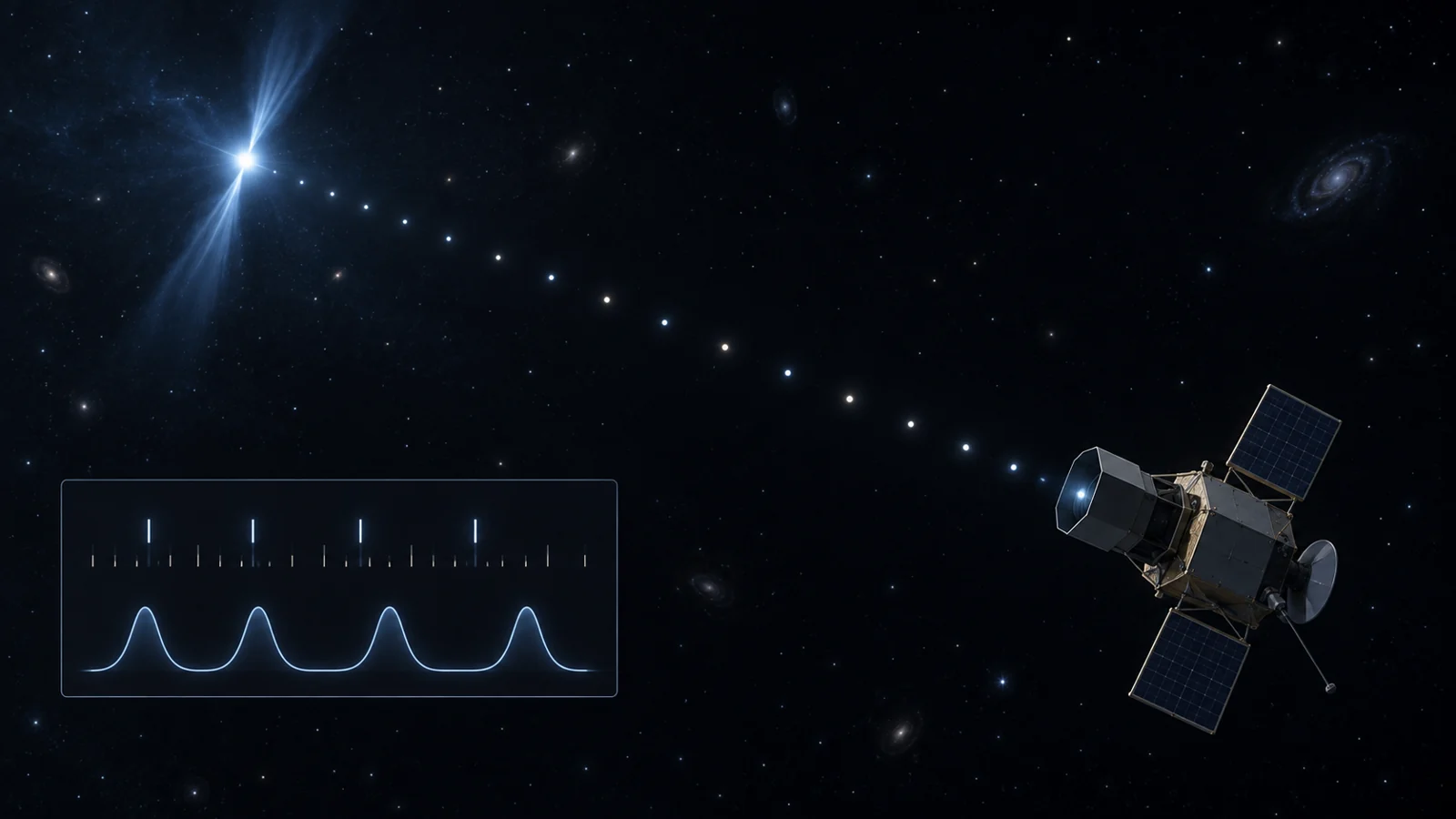
A spacecraft could use distant stars to help work out where it is. Pulsars—stars whose signals arrive in regular pulses—offer timing references that can be compared with predictions stored onboard. The appeal is a spacecraft able to calculate more of its own navigation state from observations of the sky.
The April 9, 2023 arXiv version of Review of X-ray pulsar spacecraft autonomous navigation brings together the missions, detectors and calculation methods behind this idea. Its useful contribution is the connection between those subjects. Flight experiments show what has been attempted with actual instruments; pulse estimation explains how their measurements are formed; navigation methods reveal what those measurements must support.
Read from that 2023 perspective, the technology has meaningful flight evidence and a demanding measurement problem. Understanding both starts with what a stellar pulse can tell a spacecraft.
A shared reference for arrival times
Pulsars are useful because their positions can be determined in advance and their pulse frequencies can be highly stable. The review describes the long-term stability of millisecond pulsars as comparable to that of high-precision timing instruments. That makes their repeating signals useful for predicting when particular parts of a pulse pattern should arrive.
The calculation needs a common reference location. The review uses the Solar System barycenter, the Solar System’s center of mass. A timing model describes how the pulsar’s pulse phase—the point reached within its repeating cycle—evolves at that reference location. A spacecraft measures arrival times at its own location and relates those observations to the model.
Position enters through the travel time of the signal. For a distant pulsar in a known direction, a change in the spacecraft’s position along that direction changes when the signal reaches it relative to the reference location. Comparing measured and predicted timing therefore supplies information about position. Observations from different directions and a navigation calculation can turn that information into an estimate of the spacecraft’s whereabouts.
This gives each part of the system a distinct job. The pulsar database supplies celestial positions and timing information. The detector records X-ray events. Pulse estimation extracts timing from those events, and navigation processing interprets the timing in terms of spacecraft motion. The stellar reference is the starting point of that calculation, rather than a transmitted set of spacecraft coordinates.
What the flight examples establish
The review’s mission examples describe different kinds of progress. One concerns an explicit goal for onboard navigation; others report orbit estimates derived from collected X-ray data. Their accuracy figures only make sense alongside those objectives and observing conditions.
SEXTANT, the Station Experiment for X-ray Timing and Navigation Technology, is described as a real-time flight experiment. Its objective was onboard orbit determination using X-ray pulsar observations alone, targeting 10 kilometers of accuracy in the worst direction with up to two weeks of dedicated observations of millisecond pulsars. That figure describes the experiment’s target. It should be read as an objective, not as an achieved result established by that passage.
The review also reports rough orbit determination by XPNAV-1 with an average accuracy of about 38.4 kilometers. For POLAR, it describes an orbit study of the Tiangong-2 space laboratory with accuracy of about 10 kilometers, using 31 days of hard X-ray observations of the Crab pulsar. The latter study supported the feasibility of pulsar navigation in principle.
These accounts answer different questions. An onboard, real-time objective concerns where and when navigation processing happens. An orbit study using a long observation record tests what can be recovered from those data. Average accuracy and accuracy in the worst direction are also different descriptions of error. Putting all three numbers in a ranked list would erase the conditions that give them meaning.
The practical accomplishment is that X-ray observations have supported orbit determination in flight studies. Those results give the field something concrete to build on, while the mission-specific durations and metrics prevent a single number from becoming a general promise about how quickly or accurately a spacecraft could navigate.
A pulse timestamp has to be estimated
An X-ray detector records individual events. The repeating pulse profile describes how the rate of arriving events varies over a cycle: brightness over time. A useful pulse arrival time must be estimated from that pattern, amid events that do not contribute to the desired pulsed signal.
The review gives a striking example from the pulsars selected for SEXTANT. In the table it discusses, background count rates are at least ten times the pulsed count rates for every listed pulsar. Those numbers describe that selection and instrument context, but they make the measurement task tangible. The navigation information is carried by a repeating component within a much larger stream of detected events.
Researchers therefore have to recover the pattern statistically. Events accumulated across repeated cycles reveal where the pulse profile rises and falls. Estimating its phase locates the observed pattern within the expected cycle and provides the timing information needed downstream. A single detected X-ray is not equivalent to a clean timestamp for the whole pulse.
Finding the repetition rate can itself be part of the task. The review surveys methods that search for periodicity in different ways, including approaches that work with frequencies and others that work directly with the sequence over time. Despite their different mathematical starting points, their performance depends on the quality of the measured brightness record.
This is where the regularity of the star meets the limitations of observation. A stable repeating source can still yield an uncertain pulse arrival estimate when useful events are sparse and background is substantial. Detector capability, the available observations and the estimation method jointly determine how much timing information reaches the navigation calculation.
When a navigation calculation assumes too much
The review identifies a consequential weakness in many proposed navigation methods. Much of their testing uses simulated data and assumes that precise pulse arrival times can already be obtained. It also notes assumptions of X-ray detector areas around one square meter, an area that its survey of instruments indicates is difficult to achieve.
That matters because a navigation algorithm can perform well with its assigned inputs while leaving the hardest measurement problem upstream. If simulated arrival times are more precise than a practical detector and estimator can deliver, the resulting position estimate describes performance under those assumptions. Its accuracy does not transfer automatically to a spacecraft carrying an achievable instrument.
The authors consequently call for navigation methods to be tested with real X-ray pulsar data. Such tests connect the calculation to the quality of the observations it must actually consume. They can expose whether an apparent improvement in navigation survives the uncertainty introduced while estimating pulse timing.
The review also points to a different use of information from other measurements. Several approaches combine pulse phase or arrival-time estimates with other navigation inputs after the pulse estimate has been made. The authors suggest using those other measurements to assist pulse estimation itself. That moves their contribution earlier in the process, where the X-ray timing measurement is still being formed.
This is a proposed direction for addressing an unresolved problem in the review’s 2023 account. It links instrument observations and navigation processing more closely, rather than treating pulse timing as a finished input whose quality can simply be assumed.
What this could change
If achievable X-ray instruments and reliable pulse estimation can support navigation under real observing conditions, future deep-space spacecraft could determine more of their position and motion onboard. The causal path is specific: collect stellar X-rays, recover useful pulse timing, compare it with celestial timing models, and use the differences to update the spacecraft’s navigation estimate.
For spacecraft and their operators, that could reduce reliance on externally supplied navigation updates. A mission could obtain part of its navigation information from observations it makes itself, giving onboard systems a greater role in maintaining knowledge of where the vehicle is during deep-space travel.
The review presents CubeX as a planned pathfinder for autonomous precision deep-space navigation using X-ray pulsars, alongside its proposed lunar science work. From the source’s April 2023 perspective, that is an intended application of the technology. The larger prospect is an onboard navigation capability built around celestial timing references, with its usefulness determined by instruments and pulse measurements that a spacecraft can sustain in practice.
Key Sources
- Primary source: Review of X-ray pulsar spacecraft autonomous navigation
arXiv · Preprint · 2023-04-09
Keep exploring