
Research Signal – Source date 2021-03-15
A tumor can carry many DNA mutations and still offer the immune system few targets it can use. Some cancer mutations create neoantigens—tumor-specific protein fragments that immune cells may recognize—but a mutation count is only an indirect clue. It can miss fragments made in other ways, and it cannot tell by itself whether a fragment reaches a cell’s surface, whether a patient’s T cells recognize it, or whether the cancer will keep displaying it.
A 2021 review in Cancer Discovery describes a search that has to reach beyond counting mutations. It also has to follow how tumor cells display fragments, how T cells respond, and how both can change as cancer evolves. The review draws on genomic and proteomic analyses, laboratory assays, animal studies, and early human research, whose results answer different questions and carry different weight.
A target has to be displayed before a T cell can see it
Cells continually break down proteins into short fragments. Molecules called major histocompatibility complexes, or MHC, carry some of those fragments to the cell surface. In humans, these molecules are also called human leukocyte antigens, or HLA. A T cell can respond when its receptor recognizes a particular fragment presented by a compatible MHC molecule. A DNA change matters to this process only if it contributes to a fragment that is made, displayed, and recognized.
This chain helps explain why tumor mutation burden—the number of mutations, often estimated from protein-coding DNA—is an imperfect guide. Across several cancer types, higher burden has been associated with response to immune checkpoint inhibitors, treatments that help release restraints on immune activity. Yet the review also notes that some cancers with low mutation counts can respond, while some high-burden cancers acquire resistance. The count may point toward immune activity without showing which targets are usable or whether a response will last.
The search also depends on a patient’s HLA variants. Different versions of these molecules bind different sets of protein fragments. A peptide predicted to bind one person’s HLA may not be displayed by another’s. Even within one patient, cancer cells can differ in which HLA versions and other presentation machinery they retain.
Some tumor targets fall outside a standard DNA search
Many prediction methods begin with single-letter changes in protein-coding DNA, called single-nucleotide variants. But tumors can make potentially recognizable fragments through other routes.
A frameshift occurs when DNA insertions or deletions alter how a gene’s instructions are read, creating a new sequence of protein building blocks. The review describes analyses suggesting that frameshift mutations may yield more predicted neoantigens per mutation than single-letter changes, even though they occur less often. Some can also lead to premature termination of the message used to make a protein. Cancer cells may then lose the resulting fragment as the message is broken down, one way a potential target can disappear.
Gene fusions join parts of genes that are normally separate. They can create new protein sequences, including in some cancers with relatively few single-letter mutations. Because some fusions are shared across tumors, researchers have considered whether they could support treatments made for more than one person. Early studies discussed in the review had modest results, and a single-target approach can leave room for cancer cells to evade recognition.
RNA processing adds another layer. A cell can edit RNA or splice it in different ways, changing the instructions used to make proteins without a matching change in the DNA sequence. These routes may produce fragments that a coding-DNA search would overlook. The review describes evidence that RNA-edited peptides can bind MHC and stimulate T cells in laboratory work, while the amount and pattern of editing varies among cancer types. Tumors can also produce different splice patterns from normal cells, creating new joins between sections of a gene.
These examples widen the candidate pool; they do not make every newly predicted fragment a treatment target. A candidate must still be present in the tumor and visible to the immune system.
Prediction, detection, and recognition answer different questions
Computational tools can estimate whether a fragment might bind a patient’s MHC. That is a useful first filter, but binding is not the same as presentation. The review estimates that of hundreds or thousands of peptides predicted to bind MHC, only about 1 to 3 percent are displayed and can trigger an active T-cell response in the body.
Physical detection asks whether a fragment is actually displayed. One approach isolates MHC-bound peptides from tumor samples and uses mass spectrometry to identify them. The review reports that conventional protein databases could not confidently identify more than 70 percent of the peptides detected in some such analyses, pointing to a large set of fragments that standard annotations may miss. This finding supports looking beyond familiar coding mutations, but it does not identify every unknown fragment as a cancer-specific target.
A third question is whether a patient’s T cells respond to a candidate. Researchers can test this with immune-cell assays, including methods that measure T-cell activation or detect cells carrying receptors for particular peptide–MHC pairs. Such work is difficult when relevant T cells are rare or suppressed. Growing cells with a peptide can reveal a response, but may also produce new responses in the laboratory that were not already present in the patient. The tests therefore complement one another: prediction estimates a possible fit, mass spectrometry checks what the tumor displays, and cell assays probe recognition.
Cancer can shed targets as it branches
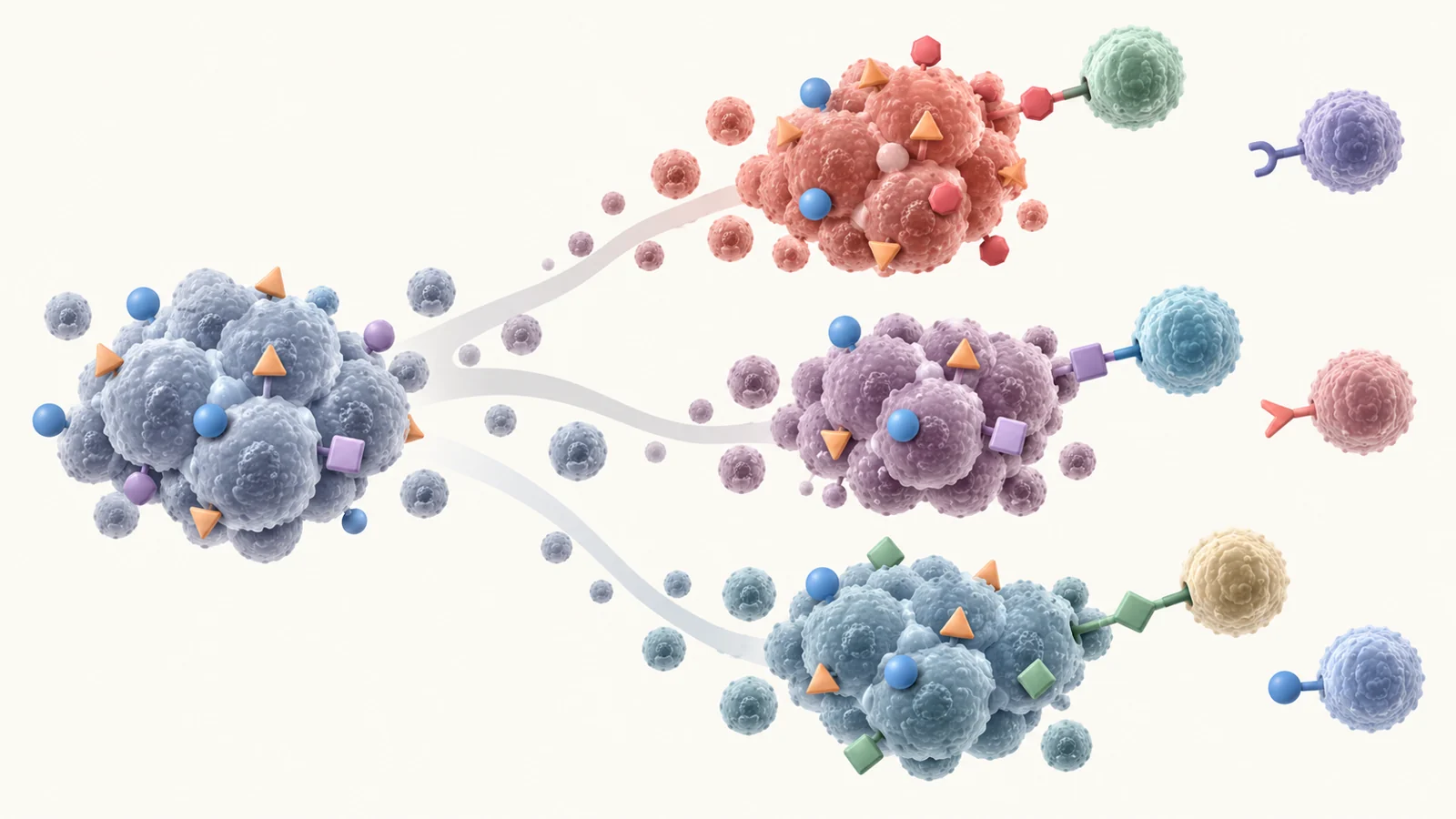
Tumors evolve as cell populations acquire and lose changes. A mutation present in an early ancestor may be shared by many cancer cells; a later mutation may belong to only one branch. Targets tied to shared early mutations could give an immune treatment broader reach than targets found in just a small subpopulation. But shared targets are not guaranteed to remain available.
The review describes evidence that tumors can lose neoantigens as they progress, including through changes in DNA copy number that remove mutation-bearing material. They can also reduce production of a target’s RNA, or lose an HLA version that would have displayed it. In one analysis of 90 lung cancers discussed by the review, 40 percent had lost one of their HLA versions, with evidence that this loss became more common as cancer spread to distant sites. Such findings are examples of immune pressure shaping which cancer-cell populations persist; they do not mean every tumor follows the same path.
This makes the target choice time-sensitive. A fragment found in one sample may not represent every region of a tumor, and a target displayed before treatment may be lost in a later branch. The review points to multi-region and repeated tumor sampling as ways to study those changes. It also describes the idea of updating personalized vaccines as a tumor evolves, while treating that as a potential strategy rather than an established way to keep pace with cancer.
Recognition can fail when T cells cannot do the work
Even a displayed fragment may meet too few effective T cells. The review describes neoantigen-reactive cells as uncommon in many patients, with studies finding that only a small fraction of tumor-infiltrating T cells recognize tumor targets. Some patients may lack a useful pre-existing T-cell population; others may have cells whose activity is weakened by prolonged exposure or immune suppression.
Tumors can also shape their surroundings to make immune attack harder. Some conditions limit T-cell entry into the tumor, while others interfere with the priming process that activates new T cells. Changes in cancer-cell signaling can affect antigen presentation or the movement and activity of immune cells. These barriers help explain why adding a target does not automatically create an effective response: the immune system has to generate or supply suitable cells and those cells must reach cancer cells that still display the target.
Vaccines and engineered receptors take different routes
Personalized multi-target vaccines aim to teach or expand a patient’s own immune response against several selected tumor fragments. Early human studies discussed in the review used approaches including synthetic long peptides and RNA. They reported sustained neoantigen-specific T-cell responses in blood, many of them newly generated. A clinical study also combined a multi-peptide vaccine with the checkpoint inhibitor nivolumab and reported immune responses and clinical activity. Because the study was not randomized and these cancer types can respond to checkpoint treatment on its own, it cannot isolate how much the vaccine contributed.
A multi-target design may make it harder for a tumor to escape by losing one fragment, especially if targets are shared across many cancer cells. But selecting targets, producing a patient-specific product, and priming a strong response remain difficult. A vaccine also depends on the patient’s immune system to produce T cells that can enter the tumor and function there.
Engineered T-cell receptor therapy takes a more direct route: T cells are given a receptor chosen to recognize a particular peptide displayed by MHC. Unlike CAR T cells, which recognize molecules on the outside of cells, T-cell receptors can target fragments of proteins that were made inside a cancer cell and then displayed at its surface. The review describes early work to obtain neoantigen-specific receptors from donor T cells, potentially avoiding some problems with a patient’s exhausted or limited T-cell supply.
That approach brings its own demands. The receptor must recognize the intended tumor fragment without also reacting to similar fragments in healthy tissue. Earlier receptor therapies aimed at other kinds of targets had caused severe cross-reactions, a safety concern that makes careful testing essential. Finding and engineering suitable cells also remained costly and time-intensive in the review’s account. Vaccines and engineered cells therefore address different parts of the problem, and combining them with other treatments was an area for further study rather than a settled recipe.
What an adaptable cancer vaccine could change
A better ability to identify fragments that tumors actually display, and to track which ones remain shared as cancer evolves, could make immune treatments more precisely matched to a patient’s cancer. If researchers can also help effective T cells reach tumors and withstand local immune suppression, multi-target vaccines or engineered receptors might eventually extend immune recognition to cancers that respond poorly to existing approaches. The 2021 review presents that as a possible path, dependent on solving target selection, immune escape, safety, and manufacturing challenges—not as a demonstrated durable benefit across cancer types.
Key Sources
- Primary source: Exploiting Tumor Neoantigens to Target Cancer Evolution: Current Challenges and Promising Therapeutic Approaches.
DOI or Journal Page · Review or Meta-Analysis · 2021-03-15
Keep exploring