
Research Signal – Source date 2022-08-30
A tumor can carry many mutations and still offer few dependable targets for immune treatment. A mutation count tells researchers how often the tumor’s DNA differs from normal DNA. It does not show which changes produce a protein fragment that immune cells can recognize, whether that fragment appears across the tumor, or whether a patient’s T cells will respond to it.
The 2022 review “Neoantigen vaccine and neoantigen-specific cell adoptive transfer therapy in solid tumors: Challenges and future directions” examines two ways of acting on these targets. A therapeutic vaccine aims to prompt the patient’s own immune system to respond. Adoptive cell transfer instead collects reactive T cells, grows or modifies them outside the body, and returns them to the patient. Both approaches depend on choosing targets that cancer cells display and on overcoming obstacles within solid tumors.
From a DNA change to an immune-visible target
A neoantigen is a cancer-specific target created when a tumor mutation changes a protein. This differs from a tumor-associated antigen, which may be present at higher levels in cancer but can also occur in healthy tissue. Because neoantigens arise from tumor-specific changes, they may help direct immune responses toward cancer cells while avoiding some of the tolerance that limits responses to shared self-proteins. Tumor specificity alone, however, does not establish that treatment will be harmless.
For a T cell to recognize a neoantigen, the altered protein must be broken into short pieces and displayed on a cell’s surface. Those pieces bind to molecules called MHC; in humans, the corresponding gene system is called HLA. A T cell’s receptor can then recognize the displayed peptide-MHC combination. Different patients have different HLA types, so the same mutation may yield a visible target in one person but not another.
Finding candidates therefore takes more than counting mutations. Researchers can compare DNA from a tumor biopsy with DNA from nonmalignant tissue, often blood, to identify changes specific to the tumor. RNA sequencing can help check whether the altered gene is being expressed. Prediction methods then estimate whether the resulting peptide can be processed and presented by that patient’s HLA molecules, and whether it may be recognized by T cells.
These are linked filters, not interchangeable measurements. A mutation may be present in DNA but not expressed; a resulting peptide may not be presented; and presentation does not by itself show that a useful T-cell response will follow. The review describes mass spectrometry as one laboratory approach for detecting peptides presented by tumor cells. It may complement sequencing and prediction, although the review notes practical demands including complex sample processing and the need for substantial tumor tissue.
This helps explain why a high tumor mutational burden (TMB)—the number of mutations per amount of sequenced DNA—does not equal a long list of usable immune targets. Only some mutations change proteins, and only some resulting peptides are processed, displayed, and recognized. The review discusses tumor neoantigen burden (TNB), which counts detected neoantigens per genomic area, as a potentially more direct measure. Studies it cites link higher TNB with immune-cell presence and better outcomes in some immunotherapy settings. Those associations do not make either measure a guarantee of benefit for an individual patient.
Why shared targets matter across a tumor
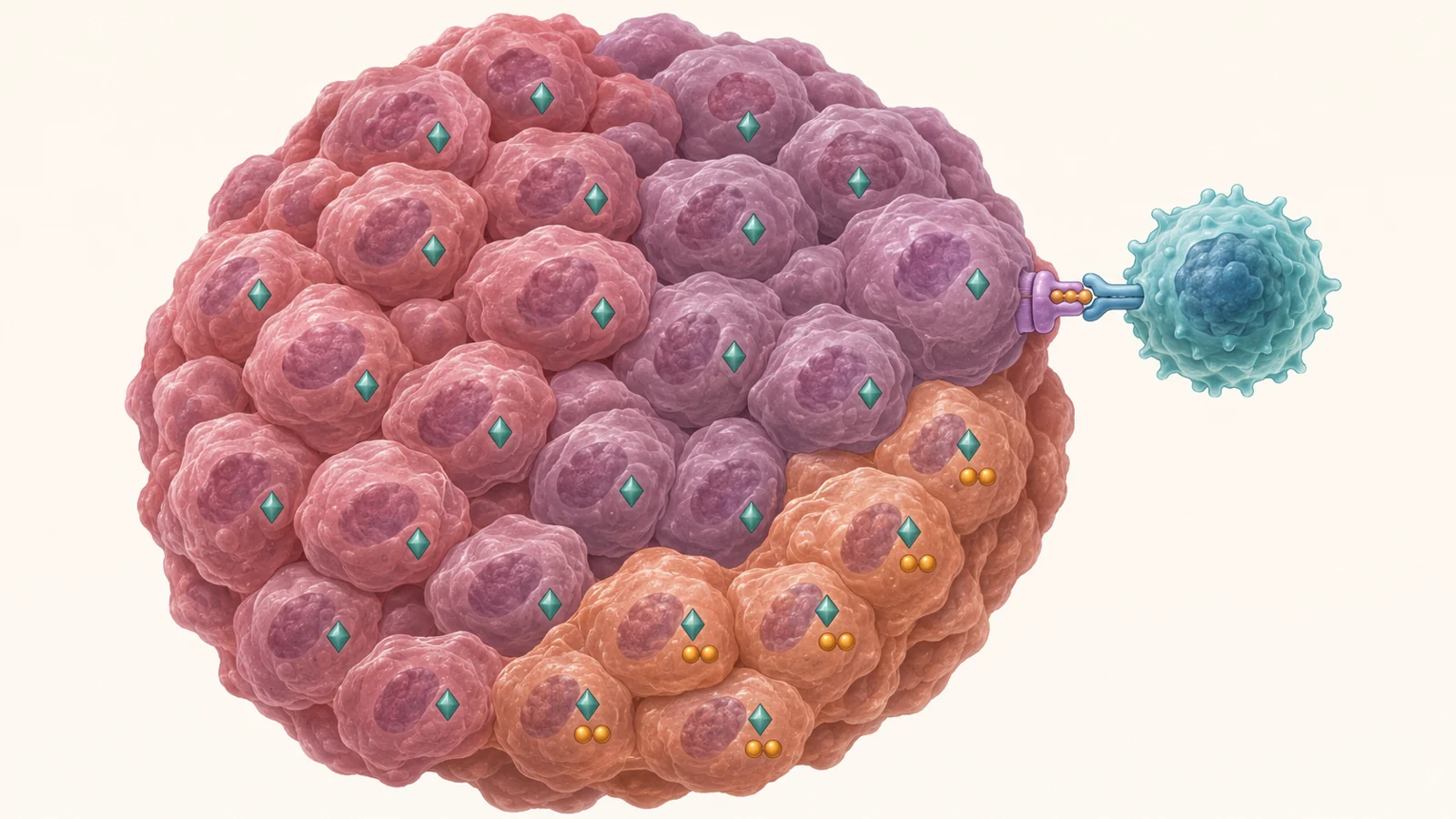
A biopsy samples a piece of a tumor, while a cancer can contain cell populations with different mutations. Some differences occur between regions or metastases; others emerge over time. If a target is present only in one branch of the tumor, a vaccine or transferred T cells directed at it may leave other cancer cells untouched.
The review distinguishes clonal neoantigens, shared by tumor cells, from subclonal neoantigens, found only in some populations. It cites research associating higher clonal neoantigen burden with longer survival in lung adenocarcinoma and describes T cells recognizing clonal targets in patients with durable clinical benefit. It also notes that chemotherapy-associated subclonal neoantigens appeared among some poor responders in the cited work. These findings support the importance of tumor composition, but they do not establish a dependable way to control diverse solid tumors over time.
Targets shared broadly across cancer cells are attractive because they could give immune treatment more of the disease to recognize. Selecting them is difficult: a promising mutation in one biopsy may not be present, expressed, or displayed in every relevant region. Tumor diversity can also change under treatment, leaving the makeup of a tumor different from the sample used to choose targets.
Two routes to mobilizing T cells
A therapeutic neoantigen vaccine is intended to stimulate or expand the patient’s own T cells against selected cancer-specific targets. Vaccine formats discussed in the review include peptides and approaches using cells that present antigens. The goal is to generate a new or stronger T-cell response against the selected targets. The review also notes the possibility that vaccine-boosted cells could persist as immune memory.
Adoptive cell transfer follows a different route. Reactive cells can be isolated from a patient’s tumor, expanded and stimulated in the laboratory, then returned. Other approaches modify lymphocytes to carry a selected T-cell receptor that recognizes a target. This supplies selected cells directly, rather than relying on a vaccine alone to generate enough reactive cells inside the patient. The procedures are complex, and the review describes both approaches as under development for solid tumors.
The strategies could be considered together because they address different steps: a vaccine may encourage the body to build a target-specific response, while transfer can provide expanded or engineered reactive cells. The review raises combination approaches with checkpoint inhibitors as a research direction. Its discussion does not show that one route is superior or that combining them improves outcomes broadly. Solid tumors can also contain suppressive immune environments, which can limit the activity of T cells even when a target has been identified.
Evidence ranges from mouse experiments to early trials
The review brings together examples with different evidentiary weight. In mouse models, peptide and mRNA vaccines targeting neoantigens stimulated immune responses and were associated with tumor rejection in melanoma, colon cancer, and a chemical-induced sarcoma model. These experiments show that selected targets can support antitumor activity in those models; they do not establish clinical effectiveness in people with solid tumors.
For cell transfer, the review describes a reported individual patient with cholangiocarcinoma whose tumor regressed after receiving neoepitope-specific CD4 T cells. This is a human proof of concept for the possibility that transferred cells recognizing a neoantigen can have anticancer activity. An individual observation cannot establish how often the approach works, which patients might benefit, or how durable the effect would be across cancers.
The review also summarizes early-phase vaccine trials. Examples include personalized vaccines designed around up to 20 patient- and tumor-specific neoantigens, and shared-neoantigen vaccines tested with checkpoint inhibitors in several cancer types. The cited table identifies these as Phase I/II programs and gives trial-status information from 2020 and 2021. Their inclusion shows clinical investigation was underway; it is not a pooled efficacy result or proof that these approaches improve outcomes.
How this could shape the future
For someone with a solid tumor, treatment could eventually be matched to immune-visible targets shared across more of that tumor. If researchers can identify those targets reliably, a vaccine-trained response or transferred T cells could have a more dependable set of cancer cells to recognize as the disease changes. That possibility follows from the review’s two central challenges: selecting peptides a patient’s immune system can see and accounting for the tumor’s diversity.
Sequencing, expression checks, HLA-based prediction, laboratory peptide detection, personalized vaccines, and cell-transfer approaches are all part of the research landscape described in the review. The unproven step is turning them into a reliable way to select targets that are displayed broadly and sustain effective T-cell activity in the suppressive environment of solid tumors.
A nearer milestone would be a prospective human study showing that selected clonal targets are displayed across sampled tumor regions and recognized by vaccine-induced or transferred T cells. Such evidence would strengthen the bridge from target prediction to actual tumor recognition. A patient-level benefit would still require further clinical evidence, including evidence that immune responses can remain effective against the disease over time.
Key Sources
- Primary source: Neoantigen vaccine and neoantigen-specific cell adoptive transfer therapy in solid tumors: Challenges and future directions.
DOI or Journal Page · Review or Meta-Analysis · 2022-08-30
Keep exploring