
Research Signal – Source date 2021-02-25
Some nanofilled dental composites have resisted wear better than conventional composites in laboratory studies. Yet clinical trials discussed in a 2021 literature review found no significant difference in wear rates between conventional and nanofilled fillings in back teeth. Both findings can be true: a filling’s behavior depends on how it is built, what it contacts, and how wear is measured.
Wear is the gradual loss or deformation of a material’s surface as it interacts with another surface in motion. In the mouth, chewing, brushing, food, beverages, bacteria and saliva all contribute to conditions that are difficult to reproduce together in a laboratory. The review compares several kinds of composite and testing approaches, but it does not offer one clinical ranking of them all.
Chewing wears a surface in more than one way
Abrasive wear happens when a surface is scraped. Brushing can abrade any exposed part of a composite filling; contact during chewing concentrates abrasion on surfaces that meet opposing teeth. Sometimes those two surfaces scrape directly against each other. At other times, food particles caught between them do the scraping.
Repeated contact can also stress a material. The review describes how small cracks can grow with repeated loading and eventually join, releasing tiny particles from the surface. Those particles may then contribute to further abrasion. In other words, wear can build through repeated small changes rather than one dramatic break.
The mouth’s chemistry can influence the process as well. Food, drinks, bacteria and other substances can affect a composite’s surface hardness and roughness, potentially making it more susceptible to abrasion. Saliva can buffer acidity and reduce microbial activity, so the oral environment includes protective influences alongside wear-promoting ones.
The filler and resin have to work together
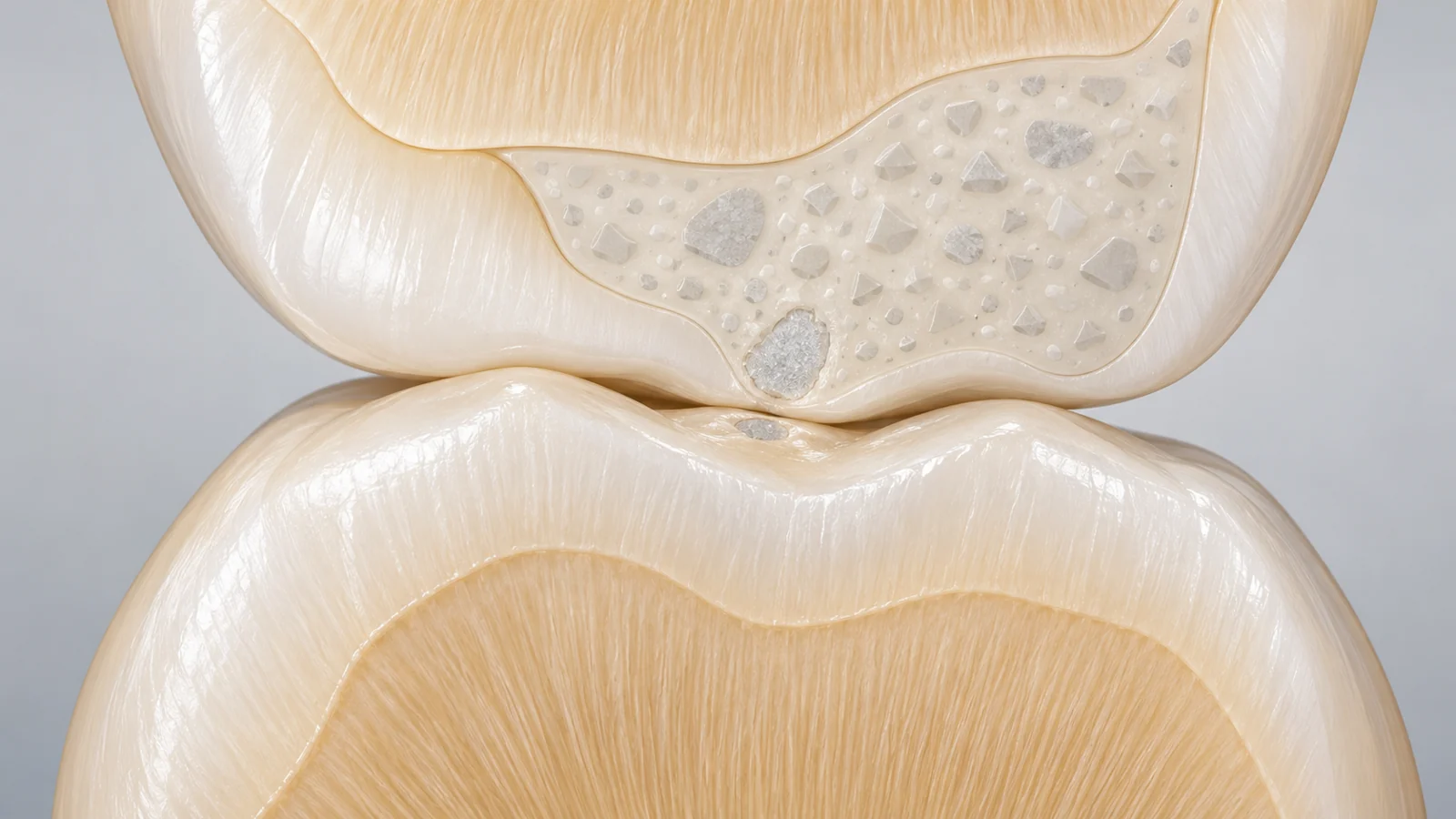
A dental composite combines hard reinforcing particles, called fillers, with a surrounding organic resin. A coupling agent helps bond the two. These parts form a working system: during chewing, rigid fillers pass forces into the more elastic resin. That transfer can put stress on the boundary between them. If the bond is weak, particles can detach, leaving more of the vulnerable resin exposed at the surface.
Filler size and spacing matter because smaller particles and shorter distances between them have been associated with less abrasive wear. The review also describes better wear resistance when the resin is more fully polymerized—the process that hardens it—and when the filler-to-resin bond is stronger. The shape, amount and distribution of the particles, the resin’s composition and the forces applied all affect the result.
This helps explain why a laboratory advantage may not translate into a clear clinical difference. Some nanofilled composites showed greater wear resistance in laboratory studies, while the posterior-tooth trials cited by the review found no significant difference in wear rate from conventional composites. The material is only one part of a system that includes contact, loading and the conditions in a person’s mouth.
Flowable composites changed as their formulations changed
Early flowable composites were made with relatively little filler—about 25–30 percent by volume—which made them less viscous. The review describes disadvantages associated with those early formulations, including greater polymerization shrinkage and less favorable physical and mechanical properties. Later formulations changed the resin composition and increased filler content to about 45–65 percent by volume, alongside changes in particle size. These developments improved their physical and mechanical properties.
A clinical comparison cited in the review found similar behavior for conventional and flowable composites after two years in cavities on the chewing surface. In those cavities, the narrow middle section was less than half the distance between the tooth’s cusps (raised points on the chewing surface). A separate laboratory comparison found similar wear resistance for a flowable and a nanofilled composite. The clinical result applies to that cavity size and follow-up period; it does not settle how flowable materials perform in broader situations.
Direct placement and laboratory fabrication involve different tradeoffs
A dentist can place a direct composite filling in one visit. An indirect composite restoration is made outside the mouth, commonly in a laboratory, and then bonded to the tooth in a later visit. Controlled light, temperature, humidity, pressure and processing time can produce a more fully polymerized indirect restoration with improved mechanical properties in laboratory testing.
Direct placement has a different processing challenge. As the resin hardens, it shrinks by around 2–4 percent, creating stresses within the restoration and at its contact with the cavity walls. The review reports that these internal stresses may be substantially greater for direct than indirect restorations. Still, it cites similar survival rates for direct and indirect composite restorations in posterior teeth, and one laboratory comparison found no significant wear-resistance difference among the composite types it examined.
Those findings measure different things. Processing can change material properties and shrinkage stresses, but a lab comparison of wear is not itself a measure of how long a restoration survives in a patient. The review’s clinical comparisons do not support treating lower shrinkage or improved laboratory properties alone as a guarantee of longer-lasting fillings.
Milled composites add another comparison
Computer-aided design and manufacturing, or CAD/CAM, can produce an indirect composite restoration from a digital design using a milling machine. The review describes these composites as being polymerized under high pressure and temperature. It reports that CAD/CAM composites had less wear than ceramic materials in cited comparisons and caused less abrasion of opposing enamel than ceramics. The review also reports lower wear for CAD/CAM composites than for direct composites.
Wear of the restoration and abrasion of the opposing tooth are separate outcomes. A material can lose less of its own surface while also causing a different amount of wear on the tooth it contacts. The cited comparisons do not show that every CAD/CAM composite has the same effects. The technology also requires equipment and training, which add practical costs.
Patient observations and laboratory simulations answer different questions
Researchers can assess wear by examining restorations in patients, either directly or through impressions and casts. They can also simulate chewing in the laboratory and measure changes such as surface shape or material loss. Each approach captures different parts of the problem: observations in the mouth include the combined conditions of use, while laboratory tests allow wear to be measured under simulated conditions.
The review cautions that oral wear is complex and difficult to reproduce in the laboratory. That makes laboratory results useful for comparing materials under test conditions, but not a substitute for clinical evidence. The nanofilled comparison illustrates the distinction: some materials performed better in certain lab studies, while cited clinical trials found no significant difference in posterior wear rates from conventional composites. The review synthesizes those findings; it reports no new comparative trial or pooled estimate.
What better wear resistance could mean for teeth
If researchers can improve the wear resistance of composites while keeping their properties closer to those of tooth tissues, restorations could maintain their shape for longer. The review points to more durable resin ingredients, better-distributed fillers and stronger bonds between filler and resin as possible routes toward that capability. Whether those changes deliver a lasting clinical benefit depends on how the materials perform under the varied conditions of real use.
Key Sources
- Primary source: Wear of contemporary dental composite resin restorations: a literature review.
DOI or Journal Page · Review or Meta-Analysis · 2021-02-25
Keep exploring