
Research Signal – Source date 2021-03-29
A T cell found inside a tumor is not necessarily attacking it. In examples from melanoma, ovarian, and colorectal cancers, only about 10% of the tumor-infiltrating CD8-positive T cells recognized nearby tumor tissue; many of the others were bystanders. The estimate applies to those cited examples, not to every solid cancer or every cell therapy. But it captures a central challenge: collecting immune cells from a tumor does not guarantee that the cells selected for treatment can recognize the cancer.
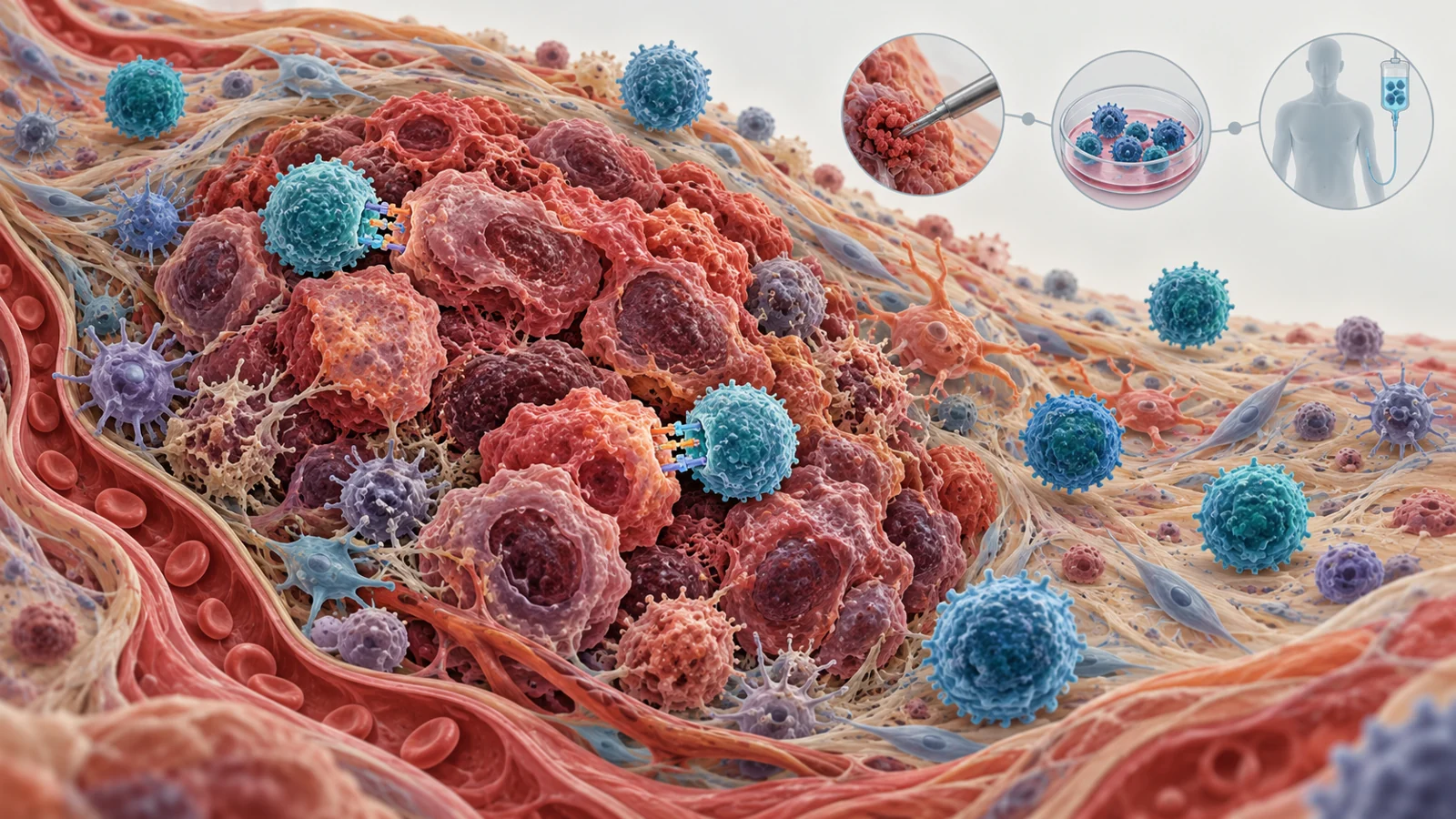
Tumor-infiltrating lymphocytes, or TILs, are immune cells collected from tumor tissue. In one approach called adoptive cell transfer, researchers grow a patient’s TILs outside the body and return them by infusion. A T cell receptor, or TCR, recognizes a particular target presented by a cell. Some treatments instead engineer T cells with selected receptors; chimeric antigen receptors, or CARs, can recognize cell-surface targets in a different way. These approaches share the aim of directing immune cells against cancer, but the review’s discussion of tumor-derived cells makes clear that being present in a tumor is not the same as being tumor-reactive.
A review published on March 29, 2021, synthesized discussions from a 2020 expert meeting on cancer genomics, tumor–immune interactions, and cell manufacturing. It described an active area of research, including durable responses in some patients, alongside major obstacles to extending cell therapies across solid cancers. Its mutation-directed examples were limited to case reports in particular tumor types, rather than evidence of benefit across solid cancers.
A mutation can be present without being a useful target
A tumor is not always one uniform mass of genetically identical cells. As cancer develops, early mutations may be shared across much of the tumor, while later changes can appear only in particular subgroups. A treatment directed at a shared mutation has a chance of addressing more cancer cells than one aimed at a change confined to a small branch of the tumor’s evolution.
That makes the timing and distribution of a mutation important. The review describes early, or clonal, mutations as potential targets because they may be present in many cancer cells. Later, subclonal mutations may be restricted to only some cells. Identifying which mutations are shared is difficult: a tissue sample contains non-cancer cells too, and tumor diversity and changes in chromosome copy number can complicate estimates of how prevalent a mutation is.
Even a well-chosen mutation is only a candidate. Researchers must predict whether it can produce a peptide—a small piece of a protein—that the patient’s immune system can recognize. Then they must test whether T cells actually respond to it. The review notes that different research teams often disagreed about which predicted mutation-derived targets ranked highest, and that not every predicted target provokes an immune response. A computer prediction can narrow the search; it cannot by itself show that a patient’s T cells will recognize the target.
For TIL treatment, this creates a selection problem. If tumor-reactive cells are rare among the cells collected, simply expanding the whole population can leave the final product with too few cells directed at cancer. The review describes research into preferentially expanding particular T-cell groups, including tissue-resident memory cells, which can home to tissue and are associated with better survival outcomes in several solid tumors. These are strategies under investigation, not evidence that a reliable selection method is already available for every patient.
Reaching the tumor is part of the challenge
Recognition matters only if the treatment cells can reach and function inside tumor tissue. Some solid tumors have few infiltrating T cells, while others contain immune cells in different patterns across separate tumor sites in the same patient. A biopsy from one location may therefore not capture the full variation in either cancer cells or the local immune environment.
Once T cells enter a tumor, they meet conditions that can suppress their activity. The review describes research aimed at increasing infiltration and making tumors more receptive to immune cells. One approach under study is radiotherapy, which can expose tumor material that immune cells may recognize. Other strategies seek to alter the tumor environment before or during cell treatment. Because several pathways in a tumor can suppress immune activity, blocking many at once may increase toxicity; researchers must weigh possible gains in T-cell activity against that risk.
Cells can lose strength as they grow or persist
T cells that have been exposed to cancer for a long time can become exhausted: they remain recognizable as immune cells, but respond less effectively. Persistent exposure to tumor targets and suppressive conditions can reduce their ability to expand and attack. During the growth of a TIL product, cancer-reactive cells may also be diluted by bystander cells, further reducing the share of cells that can act on the tumor.
The review describes a biological tradeoff in choosing which cells to grow. Less-differentiated T cells, such as naive or central-memory cells, have shown stronger persistence in TIL treatment approaches. Yet cells at earlier stages may be less equipped to home to tissue, while TILs collected from tumors are often already functionally worn down. Some exhausted T cells retain features associated with long-term renewal, so selecting for the right cell state may matter as much as selecting for recognition. The goal is not simply to grow the largest possible number of cells, but to produce cells that can reach the tumor and sustain activity there.
A personalized treatment needs a dependable production system
Each patient-specific product starts with that patient’s cells, which must be collected, grown, and prepared for infusion under reliable manufacturing conditions. That requires facilities, trained staff, consistent procedures, quality controls, and reliable handling of the material along the way. The review argues that the time, space, labor, consumables, and waste involved are substantial challenges to making these treatments available at scale.
Automation and closed manufacturing systems could reduce some labor and facility demands, while allowing multiple patient batches to be processed in parallel. The review presents these as ways to expand manufacturing capacity. They do not, by themselves, settle the questions of cost or access. The authors also identify financial and geographic access as concerns, especially for mutation-reactive T-cell approaches that may cost several times as much as CAR-T treatment. A treatment that can be made for one patient in a specialized setting is not automatically a treatment that many health systems can provide.
The prospect of tailored T cells for more solid cancers
The 2021 review describes a conditional future: more patients with different solid cancers could receive T-cell treatments tailored to their tumors if researchers can identify targets shared by enough cancer cells, select immune cells that truly recognize those targets, and keep those cells active after infusion. Making that possible at meaningful scale would also require dependable production and wider financial and geographic access. Each step remains part of the scientific and practical challenge; progress in one alone cannot deliver the full promise.
Key Sources
- Primary source: Promises and challenges of adoptive T-cell therapies for solid tumours.
DOI or Journal Page · Review or Meta-Analysis · 2021-03-29
Keep exploring