
Research Signal – Source date 2021-04-26
A corn-starch material reinforced with sugarcane fibre reached a tensile strength of 35 megapascals in one formulation discussed in a 2021 review. But in moisture tests covered by the same review, increasing glycerol beyond a reported level raised the material’s moisture absorption. The ingredients and their proportions could make a starch film easier to shape or stronger in a pull test, while changing how it responds to humid surroundings.
The result is one example assembled from earlier studies, not a specification for a finished package. The review, published April 26, 2021, compares thermoplastic starch materials and blends made with different ingredients and tested in different ways. Its examples help explain why “starch-based” alone does not predict whether a material will be flexible, strong, moisture resistant or suitable for a particular use.
Heat and a plasticizer make starch easier to shape
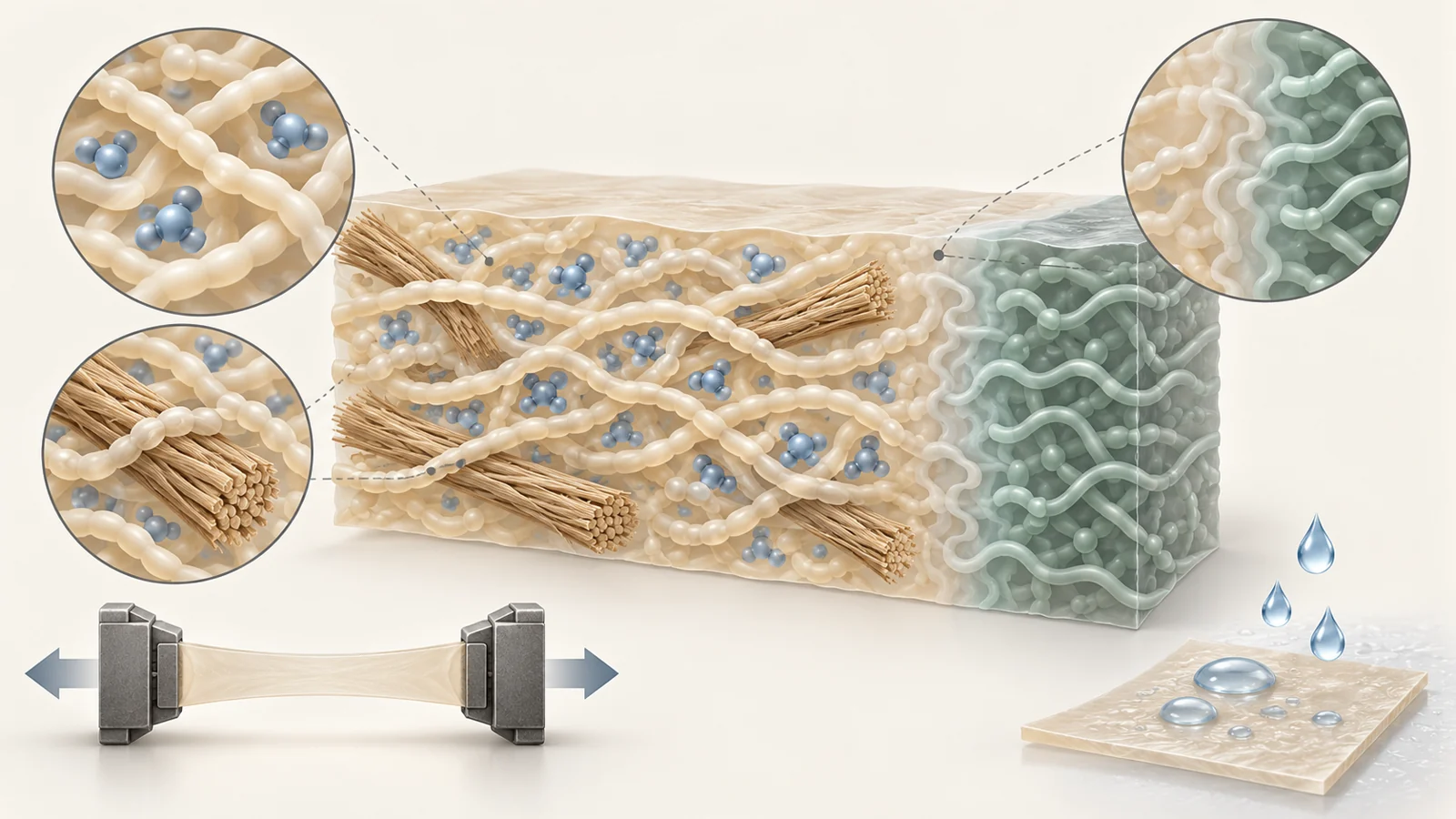
Starch in its natural form can be brittle and difficult to process like a conventional plastic. To make thermoplastic starch, researchers apply heat and mechanical work while adding a plasticizer, such as glycerol. The plasticizer reduces some of the attraction between starch’s molecular chains, giving them more room to move. That change can make the material more flexible and easier to process.
The same molecular attraction helps explain why the recipe matters. Hydrogen bonds are attractions between parts of the starch molecules. A plasticizer can loosen some of those bonds and increase flexibility, but changing the amount also changes the material’s structure and how it interacts with water. Fibres or a second polymer can alter the result again. There is no single ingredient setting in these examples that guarantees every desired property at once.
A strong pull test does not answer the moisture question
The 35 MPa result came from a cited study of corn starch reinforced with acetylated sugarcane fibre. For scale, that value falls within the tensile-strength ranges the review cites for polystyrene and polypropylene; it does not establish comparable performance in finished packaging. The review describes formulations with glycerol content between 20% and 30% and fibre content between 0% and 20%. The highest tensile value was reported for a composition with 24–28% glycerol and 10–15% fibre. In that study, fibre loading above 12% was also associated with declining strength, which the authors attributed to poor fibre distribution.
Tensile strength measures how much pulling force a sample can withstand before breaking. It does not measure how much moisture the material takes up from the air. In the moisture tests discussed by the review, samples were held in environments at 53% and 100% relative humidity until their weight stopped changing. Moisture absorption was lowest at glycerol levels below 25% across the tested fibre range, then increased considerably when glycerol exceeded 25%. The review describes a similar trend in a water-solubility test.
So the 35 MPa figure and the moisture finding answer different questions. A blend can perform well under a particular pull test and still take up more moisture under humid conditions. The review also notes that other cited studies reported different moisture responses as glycerol and fibre levels changed. These findings vary with the materials and formulations being tested; the review does not identify one recipe as a universal solution.
Starch and PLA need help to mix well
The review also considers blends of thermoplastic starch and polylactic acid, or PLA, a plastic made from renewable resources. Combining them may bring useful properties together, but the ingredients do not naturally mix well: starch attracts water, while PLA resists it. The review describes low miscibility between the two and says successful melt blending requires suitable techniques and compatibilizers—added materials intended to help the components interact.
This is a different challenge from reinforcing starch with plant fibre. A fibre can change the behavior of the starch material as a composite; a second polymer introduces an interface between two materials with different affinities for water. The review lists several compatibilizers used in starch–PLA blends, but its examples do not establish that every blend will achieve the same degree of compatibility or performance.
Renewable ingredients do not determine disposal conditions
A material’s origin and what happens to it after use are separate questions. PLA is produced from renewable resources, but the review says it requires a proper composting facility, with heating at 60 °C and special microbes, to decompose. Being bio-based or containing starch therefore does not by itself mean that a finished blend will break down in any environment or ordinary waste-disposal setting.
The review also describes a cited PLA example in which degradation time varied with formulation. That reinforces how much the material’s composition and the conditions around it matter. The packaging examples discussed in the review are not one tested product with a single, guaranteed disposal outcome, and the review does not establish a measured net environmental benefit for all starch blends.
Different studies leave a product-level question
The review brings together prior work on different starch sources, plasticizers, fibres and polymer blends. The corn-starch and sugarcane-fibre example, the humidity tests and the PLA disposal discussion concern different formulations and measurements. A tensile value from one sample cannot stand in for moisture performance, and a moisture result cannot by itself establish how a finished package would perform through use and disposal.
That matters because packaging has to suit its intended conditions. A film that bends easily may still be unsuitable if it takes up too much moisture for its use; a strong laboratory sample may not tell a manufacturer how a complete package will behave. The review provides examples of material properties and possible applications, while leaving product suitability dependent on the specific formulation and use.
What better starch packaging could change
As of the review’s 2021 publication, starch-based materials offered a possible route to packaging for selected uses now served by petroleum-derived plastics. If makers can formulate blends that retain the strength and moisture performance a use requires, and if disposal conditions match the material, those ingredients could support a workable packaging option. The examples show why that possibility depends on the formulation and its destination after use, rather than on renewable ingredients alone.
Key Sources
- Primary source: Physical Properties of Thermoplastic Starch Derived from Natural Resources and Its Blends: A Review.
DOI or Journal Page · Review or Meta-Analysis · 2021-04-26
Keep exploring