
Research Signal – Source date 2021-04-01
Corn and potato starch can yield fibers thinner than a micrometer in one reported process, yet another study found that glutinous rice starch did not form nanofibers under its electrospinning conditions. The contrast points to a central challenge in making fibers from plants: starch is not one uniform material, and the way its molecules are arranged can affect how it behaves during spinning.
A 2021 review brings together research on spinning fibers from native starch and from starch blended with other polymers. It describes conventional routes such as melt, wet and dry spinning, alongside newer approaches including electrospinning and centrifugal spinning. The examples show that fine fibers are possible, but making a fiber is only one step toward a material that can be manufactured reliably and used in textiles.
Why the shape of starch molecules matters
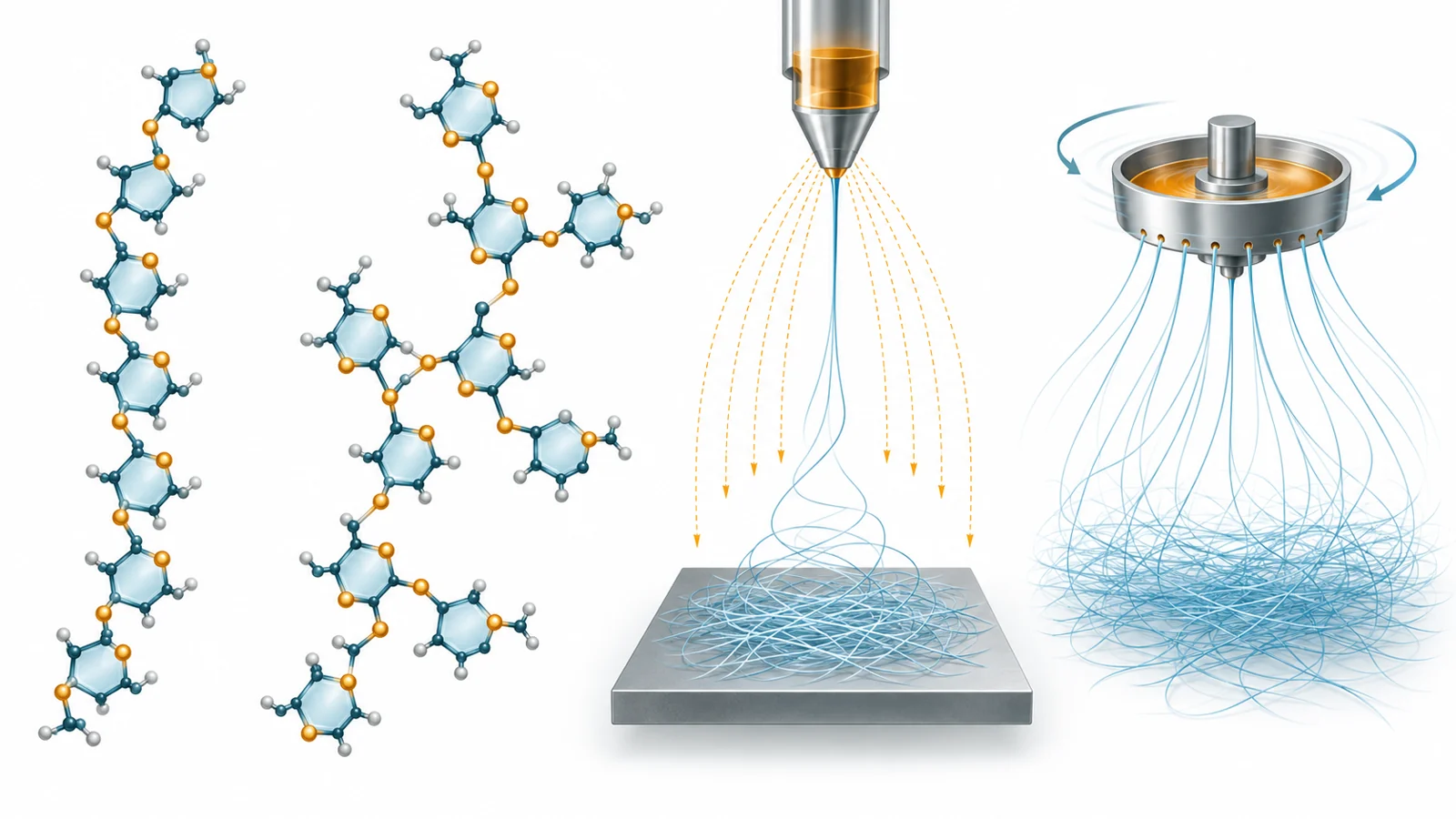
Starch is made mainly of two carbohydrate components. Amylose is mostly linear, while amylopectin has a branched structure. In the review’s account, amylose chains can line up and associate with one another more readily. Branching makes that alignment and association harder for amylopectin, a difference that can affect whether a spinning mixture forms fibers and how strong those fibers are.
The review describes one electrospinning study in which tapioca starch produced nanofibers, while glutinous rice starch did not produce nanofibers under those reported conditions. In that work, both starch dispersions were prepared using water and heated before spinning. The contrasting result illustrates that the label “starch” alone does not predict how a material will behave in a particular process. It does not establish a universal ranking of starch types: these were separate material examples, not a controlled comparison across all starches and spinning conditions.
From a starch mixture to a flowing thread
Conventional melt spinning works by pushing a polymer melt through small openings, then drawing and cooling the emerging strands. Native starch cannot simply be treated like a conventional melt-spun plastic. The review explains that starch can be made to flow when combined with plasticizers such as water, glycerol or sorbitol and exposed to heat above 90 °C and the shear created during processing. This treated material is called thermoplastic starch.
The sequence matters: plasticizer, heat and mechanical force change the starch so it can flow through an extruder. But the resulting fiber still depends on the formulation and how it is processed. The review notes that thermoplastic starch can be mechanically weak, absorb moisture and change over time, making it difficult to use alone in fiber applications.
A starch-and-water mixture that is not thermoplastic follows a different route. The review describes these non-thermoplastic compositions as unsuitable for melt spinning because starch can degrade before it reaches a melting temperature. Wet or dry spinning can instead form fibers from a flowing mixture, which is then set as it loses water. The processing route therefore depends on how the particular starch composition responds to heat, water and force.
Fine fibers by electric force and rotation
Electrospinning uses a high-voltage electric field to draw fibers from a polymer mixture. The review describes this method as capable of producing fibers from micrometer down to nanometer scales. A related approach, electro-wet spinning, adds a coagulation bath to help solidify fibers when a solvent is difficult to evaporate.
One cited electro-wet-spinning study made a web from pure starch, without another polymer acting as a binder or matrix. The researchers used an amylose-rich starch and a solvent mixture, then collected the fibers in an ethanol bath. The reported average fiber diameter was 2.60 micrometers. The web was heat-treated to make its starch structure more ordered; the review also reports that crosslinking improved a starch braid’s stability in water. These are findings about that particular web and its treatment, not evidence that every pure-starch fiber has the same properties.
Centrifugal spinning offers a separate example. In this method, rotation helps drive a material outward to form fibers. A study summarized in the review produced submicron fibers from amylopectin-rich native corn and potato starches. The corn-starch fibers had a smooth surface, while those made from potato starch had a rough one. The study also reported structural changes during processing, including loss of order in starch regions and rearrangement of chains.
The electrospinning and centrifugal-spinning examples are not a head-to-head test. They use different starches and processes, so their reported fiber sizes do not show which method works best overall. Instead, they show that composition and processing can combine in different ways to produce fine fibers.
What goes into the finished fiber
Some approaches aim to make fibers from starch alone; others blend starch with another polymer. Blending can help address starch’s limited strength, moisture sensitivity and processing difficulties. In the examples discussed by the review, starch has been combined with other materials, including in multicomponent fibers where thermoplastic starch formed the core and another thermoplastic polymer formed the outer sheath.
That construction matters when interpreting what a fiber can do. A starch-containing fiber is not necessarily made entirely of starch, and a pure-starch web is not interchangeable with a blend. Solvents and coagulation baths can help fibers form or solidify; plasticizers can make starch flow; and a second polymer can alter the material’s properties. The ingredient and process choices shape the finished material, so a fiber’s diameter by itself cannot tell us whether it will hold up in a textile.
The distance between a fine fiber and a useful textile
Small-scale demonstrations are not the same as a dependable manufacturing process. The review notes that conventional spinning methods remain attractive for production because they can offer higher output and economic advantages. Melt spinning, in particular, has potential for continuous fiber extrusion, but starch compounds would need to avoid shear-related damage and fiber breaks. The review points to alternative, more environmentally friendly plasticizers and control of drawing and cooling as areas relevant to improving the resulting fibers.
Material performance also matters after a fiber has been made. The review identifies mechanical strength, thermal stability, moisture sensitivity and processability as continuing obstacles to wider industrial use. Those constraints help explain why a strikingly small fiber diameter is only one measure of progress. The reviewed demonstrations do not establish durable textile performance or commercial-scale production, and the finished blends and fibers would need to be assessed in their own right.
What starch fibers could change in textiles
Reliable production of durable starch-based fibers that meet the needs of a particular textile use could give manufacturers another option based on an abundant plant-derived feedstock. Corn, potato and other starch sources might then substitute for some fibers made from oil-based materials. The practical value would depend on whether the finished fibers can be made at useful scale and perform well enough for their intended use.
The review presents this possibility as a research direction, not a measured environmental outcome. Whether a starch fiber or blend reduces pollution or has a lifecycle advantage depends on how it is made, what else it contains, how it performs and how it is disposed of. Fine fibers demonstrate a route worth investigating; they do not, by themselves, establish those broader benefits.
Key Sources
- Primary source: Review on Spinning of Biopolymer Fibers from Starch.
DOI or Journal Page · Review or Meta-Analysis · 2021-04-01
Keep exploring