
Research Signal – Source date 2025-06-10
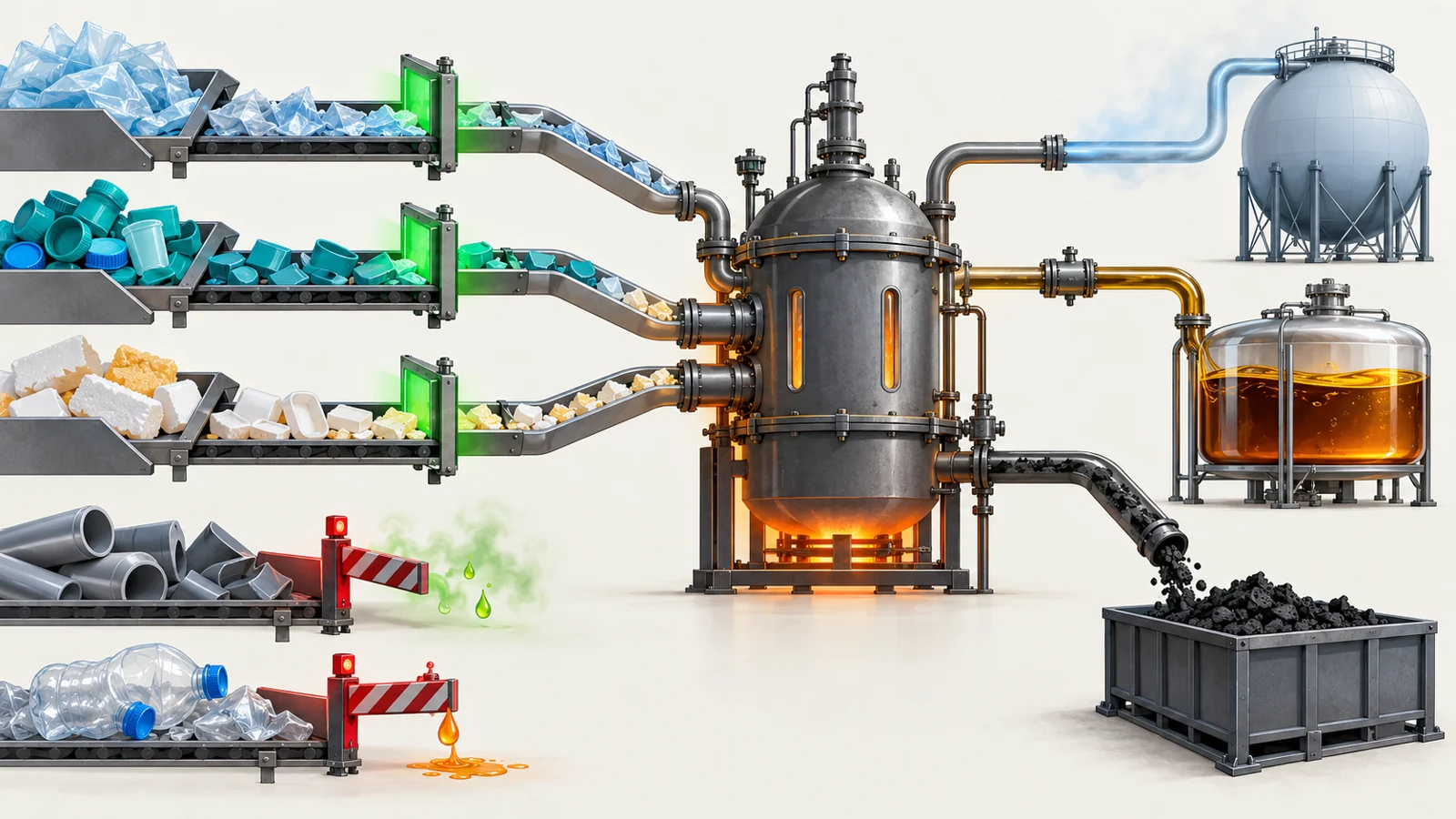
A plastic can break down in a laboratory reactor and still be a poor fit for a plant that needs a steady stream of usable chemical raw material. A review published online on June 10, 2025, surveys decades of pyrolysis research and industrial projects. It finds that laboratory studies have explored a broader range of plastics—including vinyl plastic and drink-bottle polyester—than operating plants commonly accept, which tend to favor familiar plastics such as polyethylene, polypropylene and polystyrene.
The gap is not simply about whether heat can decompose a material. A plant must also manage what comes out, keep its process running, and have enough suitable plastic arriving. The review synthesizes earlier experiments and project reports; it does not present a new plant trial that shows a broad mix of difficult plastics can be processed continuously.
Heat breaks chains, but it does not make one product
Pyrolysis heats plastic so that its long molecular chains break apart. The resulting mixture can include gas, liquid oil and solid residue. Depending on the starting plastic and the operating conditions, those products may contain chemical feedstocks, fuel fractions or substances that need further treatment. The oil is not automatically a ready-made replacement for new plastic.
A laboratory comparison in the review shows how strongly temperature can change the outcome. In one study, polyethylene yielded 50.3 percent oil by mass at 530 °C, much of it wax. At 760 °C, the reported gas yield was 55.8 percent by mass. Polystyrene, tested at 580 °C, yielded a reported 64.9 percent styrene monomer by mass. These are results from particular experiments, not expected yields for every plastic or plant. They illustrate why “plastic pyrolysis” does not describe a single output: the material and conditions shape what is recovered.
For a chemical maker, the useful question is therefore not only whether the plastic decomposes. It is whether the resulting mixture contains the desired raw materials, in a form the next facility can accept. Some existing chemical processes can take oil made from plastic waste, but that oil may need to meet demanding specifications before it can be used as feedstock.
PVC and PET bring different chemistry problems
Vinyl plastic, commonly called PVC, contains chlorine. When PVC is heated, chlorine can end up in the oil or other process streams. That matters because chlorine levels acceptable to a receiving process may be very low. The review cites a reported limit of 3 parts per million for feedstock entering a fossil-based steam cracker, while Japanese rules for pyrolysis oil specify less than 100 parts per million. These figures refer to different contexts; they show why a product that is technically recoverable may still need substantial contaminant control to find a use.
Researchers have investigated alkaline additives and metal oxides to capture or remove chlorine. In one laboratory study of mixed waste plastics, a nickel-containing catalyst reduced chlorine in the pyrolysis oil. The reported concentration fell from 4,364 to 228 parts per million in that experiment. That is evidence that dechlorination can be pursued, not evidence that a commercial plant can reliably meet a receiving facility’s limit while processing variable waste over time.
PET, the polyester used in many drink bottles, poses a different challenge. Pyrolysis can produce terephthalic acid, a high-boiling acidic compound that can corrode equipment and contribute to pipe blockages. The review describes laboratory investigations that tried to redirect PET-derived products. For example, iron oxyhydroxide was studied as a way to suppress terephthalic acid formation and produce compounds including acetophenone and benzene. In another study, a titanium dioxide and silica catalyst was tested with a mixture of PET and polypropylene; the reported oil yield was about 70 percent, and the catalyst was regenerated and reused in repeated laboratory runs.
Those examples point to possible routes, each with its own product mixture and operating demands. They do not mean that PVC and PET can simply be added to the same plant feed, or that either route has been established as a dependable industrial solution. For operators, the challenge is to control the unwanted chemistry while producing an output that has a practical destination.
Catalysts can steer the mixture, then must keep working
A catalyst is a material that helps steer chemical reactions. In the experiments surveyed, catalysts were used to change which products formed, sometimes lowering the share of heavier oil and increasing lighter hydrocarbons or aromatic compounds such as benzene, toluene and xylene. Different catalyst families favored different outcomes: some helped recover aliphatic hydrocarbons from polyethylene- and polypropylene-rich plastics, while more acidic zeolite catalysts could promote shorter-chain and aromatic products.
That control is useful only if the catalyst remains effective and affordable in the process. The review finds that most industrial-scale operations it surveyed focused on common plastics and generally ran without catalysts; only a few had commercialized catalytic processes. Catalyst durability and reuse matter because frequent replacement or loss of performance can undermine stable operation and increase operating costs. A small experiment showing a promising product shift does not by itself answer how a catalyst will behave through long-running plant operation with real feedstock.
The review’s comparison makes catalyst reliability a concrete part of the laboratory-to-plant gap. The chemistry may be tunable in a controlled test, while a plant needs a process design that can sustain the desired output over time, handle its feed, and keep the catalyst useful.
A plant also needs plastic to arrive
Feedstock supply can decide whether a technically workable facility stays open. The review describes earlier Japanese packaging-plastic liquefaction plants in Niigata and Sapporo, with reported capacities of 6,000 and 15,000 tonnes per year. They began commercial operation in 1999 and 2000 and operated for about a decade with support from Japan’s Containers and Packaging Recycling Law. They later closed when policy priorities favored mechanical recycling and the plants faced insufficient waste collection.
The history illustrates a practical dependency: a facility built to process plastic needs enough collected material, year after year. A plant’s nameplate capacity or a project description does not show how much it actually processed over time. The review reports project capacities and product descriptions, which should be read as project details rather than independently verified operating results.
The same supply question becomes harder as plants try to accept more kinds of waste. A broad feed mix may include plastics with different compositions and contaminants, while a receiving chemical facility expects a consistent input. Collection, sorting, processing and product quality all have to align for the recovered material to move through the chain.
Recovered oil and recycled content are not the same measure
Pyrolysis is often discussed as a way to return waste plastic to chemical production, but making fuel and making raw material for new chemicals are not interchangeable outcomes. The review distinguishes chemical recycling from energy recovery: chemical recycling changes plastic into monomers or other raw materials, while burning material for energy does not count as recycling under the definition it cites.
Many processes send plastic-derived oil into existing facilities, such as steam crackers, that also process much larger amounts of virgin oil. This can make use of established chemical infrastructure, but it complicates the question of how much recycled material ends up in a particular product. When recycled-derived and fossil-derived inputs are blended, product accounting may use a mass-balance method to allocate recycled content across outputs. The review notes that such accounting raises questions about accuracy and third-party certification.
So the amount of plastic-derived oil entering a facility is not automatically the same as the recycled share of every product leaving it. The pathway can supply chemical raw material, but claims about product content depend on how inputs and outputs are tracked and verified.
Where this research could lead
A chemical plant that already uses oil from relatively easy-to-process plastic waste could one day receive dependable raw material from a broader collected mix, including streams that pyrolysis plants now tend to avoid. If contaminant removal, durable processing, reliable supply and conversion in the receiving facility all work together, more kinds of discarded plastic could enter a route back to chemical production. That possibility follows from the review’s contrast between laboratory studies that have tested a wider range of plastics and industrial projects that largely focus on common feedstocks; it is a future capability, not a result the review has demonstrated.
A meaningful nearer milestone would be a sustained plant-scale run using a documented difficult-plastic feed, with the resulting oil composition reported against the acceptance limits of the facility meant to use it. That would connect the laboratory evidence to a specific operating requirement—and show whether a wider feed mix can produce a dependable chemical input.
Key Sources
- Primary source: Chemical Feedstock Recovery Through Plastic Pyrolysis: Challenges and Perspectives Toward a Circular Economy.
DOI or Journal Page · Review or Meta-Analysis · 2025-06-10
Keep exploring