
Research Signal – Source date 2021-12-23
Natural killer cells can attack abnormal cells without first being primed to recognize a specific target. That rapid response makes them appealing for cancer therapy. Yet the conditions described in a 2021 review differ sharply between blood cancers and solid tumors: inside solid tumors, there may be too few effective natural killer cells, and those that arrive can have trouble recognizing or attacking cancer cells.
The review, published on December 23, 2021, brings together mechanistic research, preclinical experiments and cited clinical observations. It does not test one treatment or establish a pooled clinical effect. Its central lesson is that “getting more immune cells there” is only one part of a difficult problem. Proposed therapies address different steps, and success at one step does not guarantee tumor control.
Getting to the tumor is a separate challenge
Natural killer (NK) cells are immune cells that can kill abnormal cells without the prior priming described in the review. They help detect emerging cancers and may limit metastasis or clear small amounts of remaining disease. But the review describes low NK-cell numbers in several solid cancers, including lung, liver, stomach and colorectal tumors.
Part of the difficulty is navigation. Tumors and surrounding tissue may provide too few of the chemical signals that attract NK cells. Signals in the tumor environment can also alter which NK-cell types are recruited. In some settings, less cytotoxic CD56-bright cells are preferentially drawn in, while highly cytotoxic CD56-dim cells are less able to migrate into the tumor. Pressure associated with hyaluronan buildup may also collapse blood vessels and make entry harder.
One proposed fix is to adjust the receptors NK cells use to follow chemical trails. In studies summarized by the review, CXCR1 engineering increased NK-cell accumulation in an ovarian cancer xenograft, CXCR4 engineering increased accumulation in glioma, and CXCR2 engineering improved homing and adhesion in patients receiving adoptive NK transfer for renal cell carcinoma. These findings support a possible way to improve delivery, but the results vary by receptor and cancer context. A cell’s presence near a tumor does not by itself show that it can find, attack or control the cancer.
Inside the tumor, the signals change
Arrival does not guarantee that NK cells remain active. Tumor cells, regulatory immune cells and other parts of the local environment can produce suppressive signals. The review highlights transforming growth factor beta (TGF-β), which can reduce the display of NK-cell receptors involved in recognizing abnormal cells. Other substances in the tumor environment can dampen NK-cell metabolism and effector functions, or shift cells toward a less active state.
This helps explain why solid tumors pose a different challenge from cancers in the blood. An NK cell may need to reach the right tissue, keep its ability to recognize a target and retain the capacity to attack despite local suppression. Approaches that address one of these problems may leave the others untouched.
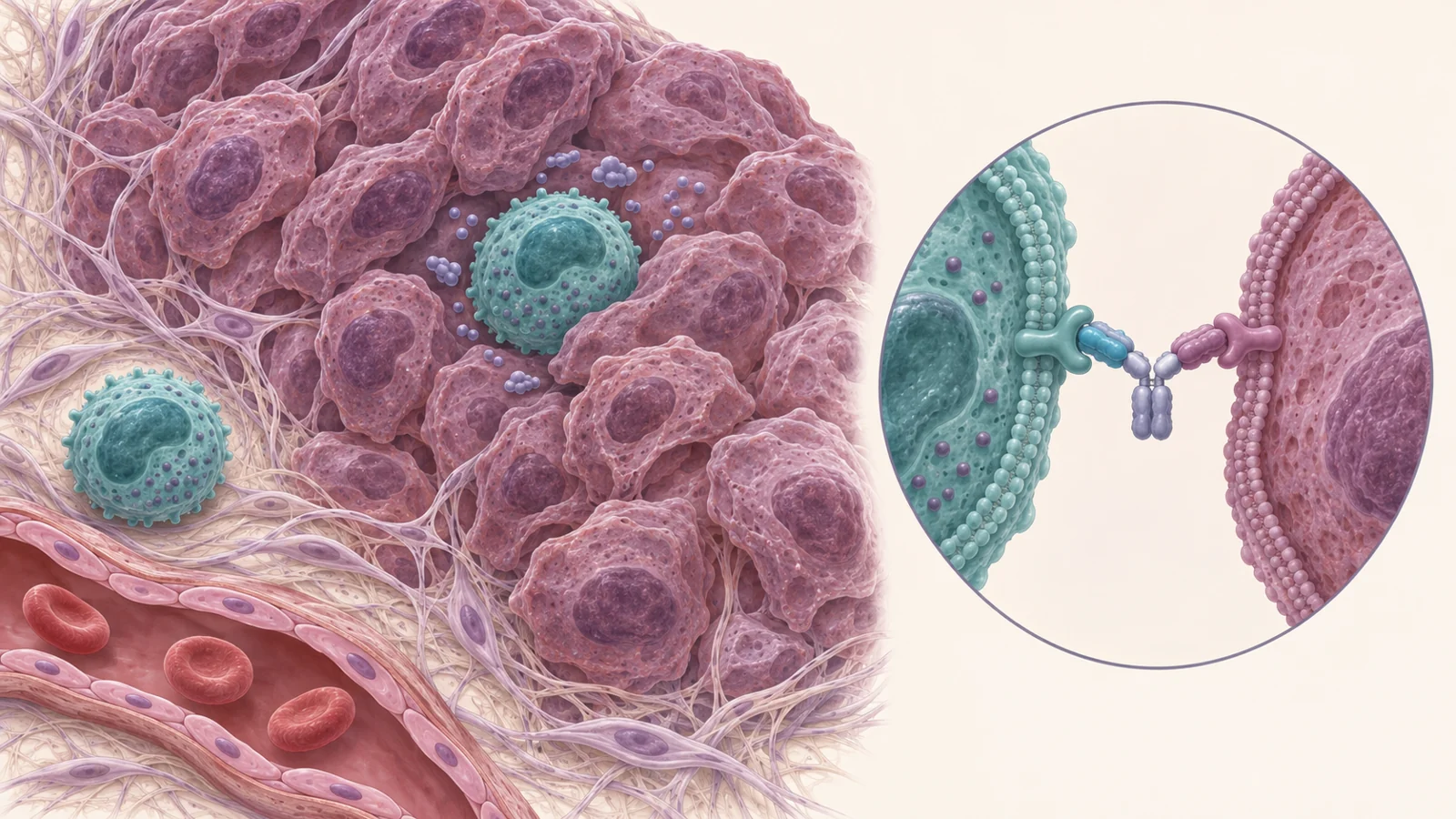
Some strategies try to restore activity by blocking inhibitory signals or changing the immune environment. Others aim to make contact with cancer cells more direct. NK-cell engagers, for example, are designed to bind an activating receptor on an NK cell and an antigen on a tumor cell, bringing the two into closer contact. BiKEs and TriKEs are examples of these linking molecules; some designs also include a component intended to boost NK-cell activity. The review describes preclinical solid-tumor results for engagers targeting antigens such as HER2, EGFR and EpCAM. It also reports that an EGFR–CD16A engager, AFM24, was entering early clinical testing in advanced solid cancers at the time of publication.
Engineered NK cells take another route. CAR-NK cells are modified to carry a synthetic receptor that recognizes a chosen tumor antigen and sends an activation signal into the cell. The review describes promising preclinical results and several phase 1 or phase 2 trials in solid tumors. These approaches seek to improve recognition, while chemokine-receptor engineering seeks to improve tumor entry. They solve different problems; neither category’s early findings establish a general benefit across solid cancers.
More immune activity can bring its own problems
Boosting a signal is not automatically helpful. Chemokines can attract NK cells, but they can also draw in cells that suppress immune responses or support tumor growth. The review notes that CCL5 may recruit regulatory T cells and that CCL2 can attract tumor-associated macrophages. A recruitment strategy therefore depends on which cells respond to the signal in a particular tumor environment.
The same tradeoff appears with cytokines. Interleukin-2 (IL-2) can increase NK-cell activity, but the review describes evidence that high-dose IL-2 can also expand regulatory T cells. It also notes serious potential adverse effects, including vascular leakage, cardiovascular problems and neurological toxicity. A modified IL-2 agonist called NKTR-214 was described as a strategy intended to stimulate NK and CD8 T cells without increasing regulatory T cells, but the review’s account does not establish that this resolves the broader challenge in solid tumors.
Blocking inhibitory receptors can also produce unintended effects. The review describes IPH2101, an antibody that blocks KIR receptors. Early studies in blood cancers indicated increased NK-cell cytotoxicity, but another cited finding suggested the treatment could cause NK cells to lose the KIR2D receptors it targets. That change was associated with reduced NK-mediated immune response and no clinical benefit in multiple myeloma. A result from one blockade strategy cannot predict every inhibitor, but it shows why the biological response must be checked rather than assumed from the treatment’s design.
What the evidence had reached by 2021
The evidence summarized in the review spans different stages. Some proposed methods—such as engineered homing receptors and tumor-targeting engagers—had encouraging results in preclinical models. Some solid-tumor approaches, including AFM24 and CAR-NK therapies, were entering early clinical trials. The review also cites human observations from NK-cell transfer studies, but these do not show that the reviewed approaches as a group control solid tumors.
One example makes the gap between cell delivery and tumor response clear: patients who received their own NK cells had cells that persisted in circulation for weeks or months, yet the treatment did not control melanoma or renal cell carcinoma progression. By contrast, the review describes promising human results for donor NK-cell therapies in certain blood cancers. Those observations provide context for NK-cell therapy, but they do not establish that the same approach works in solid tumors, where cells must reach and function within a different environment.
The review therefore offers a set of distinct research directions, not a clinical ranking. Its cited studies differ in cancer type, intervention and stage, and the review itself does not demonstrate improved outcomes for people with solid tumors. Neither circulating NK cells nor cells detected in tumor tissue alone would be enough to show that a treatment is working.
How this could shape the future
A person with a solid tumor could eventually have an additional, clinically tested NK-directed option whose cells reliably enter the tumor and remain able to recognize and attack cancer cells. The review helps explain the steps that would have to connect: overcoming barriers to entry, addressing local suppression and improving recognition of tumor cells. Reaching that future would depend on independent therapeutic development and clinical testing; the approaches under investigation in 2021 were not yet proof of dependable patient benefit.
A useful nearer milestone would be a prospective solid-tumor study that shows NK cells inside treated tumors are functionally active while also reporting patient outcomes and harms. That combination would help distinguish successful delivery from a meaningful clinical effect.
Key Sources
- Primary source: Challenges and Recent Advances in NK Cell-Targeted Immunotherapies in Solid Tumors.
DOI or Journal Page · Review or Meta-Analysis · 2021-12-23
Keep exploring