
Research Signal – Source date 2021-03-09
Radiation may accompany surgery, serve as the main treatment, or help ease symptoms. The purpose changes the conversation: a team considering radiation alongside surgery is weighing it as part of a broader treatment approach, while definitive radiation is intended to treat the cancer itself. When the aim is palliation, attention also turns to easing the patient’s symptoms.
A 2021 review for thoracic surgeons surveys radiation technologies, their history, and landmark trials that established their use. It offers orientation on how radiation fits into lung cancer care, rather than a new comparison of which approach works best.
Treatment plans put the balance in view
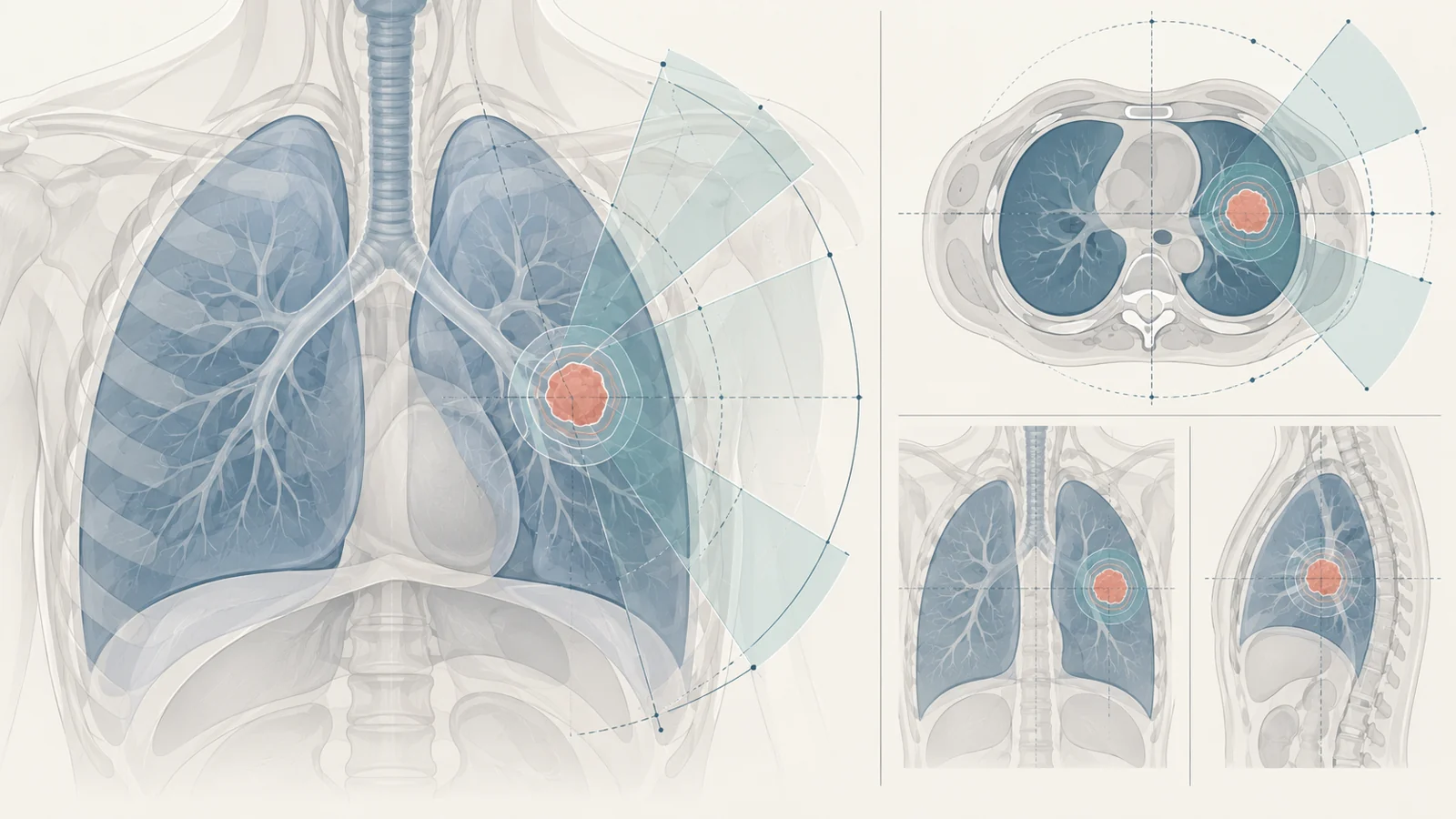
The review organizes four fundamental means of external-beam radiation and includes visual examples of plans for comparison. The examples illustrate radiation planning; they are not evidence that one delivery approach works best. The central planning challenge is to pursue tumor control while minimizing harm to healthy tissue in the chest.
The review also stresses that radiation can cause side effects in the chest, both soon after treatment and over a longer period. Those risks matter alongside the aim of controlling the tumor.
The clinical setting shapes the question
The review emphasizes early-stage lung cancer when surgery is not possible, as well as locally advanced disease. These are settings where radiation has an important role in management, though the review does not turn them into a single treatment rule for every patient. Its focus is to help thoracic surgeons understand radiation’s technology and delivery as they discuss why it is being considered.
The authors also flag proton therapy and radiation in the era of immunotherapy as developments that could change practice. Those topics point to evolving questions in the field; the review’s summary does not establish that either has improved patient outcomes.
What better radiation choices could mean for lung cancer patients
If future comparisons show that a radiation approach controls lung tumors with fewer chest side effects, patients could receive treatment that causes less harm without giving up tumor control. The review’s abstract explains why that trade-off matters but does not establish that any delivery approach achieves it.
Key Sources
- Primary source: Radiation Modalities Used in Lung Cancer: An Overview for Thoracic Surgeons.
DOI or Journal Page · Review or Meta-Analysis · 2021-03-09
Keep exploring