
Research Signal – Source date 2021-04-01
A cancer treatment may work by releasing a brake on immune cells. An allergy treatment may repeatedly introduce the very substance that triggers symptoms. These approaches sound opposite, but both aim to steer immune activity toward a different response.
A 2021 review of human immunology and immunotherapy describes how researchers are learning to influence immune defenses in several ways. The cancer and allergy examples show why treatment is not simply a matter of turning immunity up or down: the desired change depends on what is going wrong and how immune cells respond in their surroundings.
Cancer can borrow the immune system’s brakes
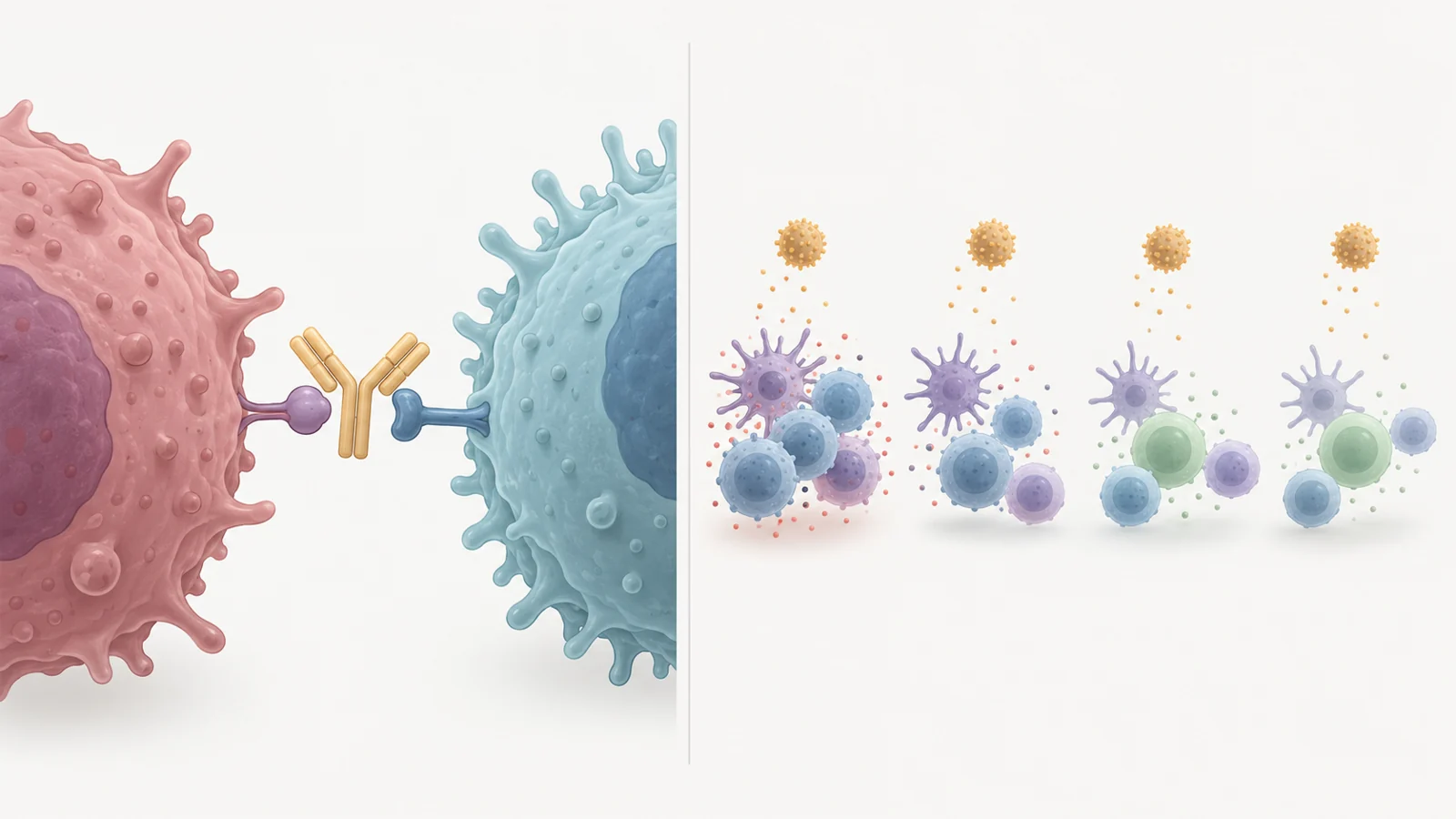
T cells help coordinate immune responses and can attack abnormal cells. Their activity is regulated by checkpoint molecules, which act as inhibitory controls. In ordinary immune responses, those controls help prevent activation from continuing unchecked. Tumor cells can exploit them: interactions involving PD-1 or CTLA-4 can suppress T-cell activity against the cancer.
Checkpoint inhibitor antibodies are designed to block some of those interactions. In effect, they can release an inhibitory signal that a tumor is using to restrain immune cells. This approach has produced striking results in some cancers and has expanded the ways clinicians can try to engage the immune system against tumors.
But removing one brake does not erase the other conditions that can limit an attack. Tumors exist in a local environment shaped by cancer cells and nearby noncancerous cells, including immune cells and fibroblasts. The review describes how this environment can weaken T cells that attack tumors and attract other T cells that limit immune activity. A tumor’s defenses therefore involve more than one checkpoint interaction.
Responses to checkpoint treatment vary. The review points to several reasons for that variation: the number of tumor-targeting immune cells, the inhibitory signals those cells encounter, and whether tumor cells display molecules that help T cells recognize them. These factors help explain why blocking a checkpoint is not a universal way to overcome cancer’s suppression of immunity.
Repeated allergen exposure has a different aim
Allergen-specific immunotherapy is intended to change how the immune system responds to an allergen over time. It uses repeated doses of allergen in a controlled schedule, with doses often increased before a maintenance phase. The aim is to develop longer-lasting tolerance; when that tolerance is acquired, treatment may be discontinued.
This goal differs from medicines such as antihistamines or corticosteroids, which the review describes as relieving allergic symptoms without changing the disease’s natural course. Allergen immunotherapy is presented as an approach intended to modify that course. The repeated exposure is not a general attempt to intensify immunity. It is a way of seeking a more tolerant response to a particular allergen.
The contrast with cancer treatment is useful: one approach tries to restore an antitumor response by blocking inhibitory signals, while the other seeks to reduce harmful reactivity through repeated, controlled exposure. They are distinct strategies for distinct problems, not competing settings on a single immune-control dial.
A cell’s surroundings can change its behavior
Immune cells do not act in isolation. Signals in tissues, interactions with other cells, and microbial surroundings can shape what they do. The review describes innate lymphoid cells as immune cells that respond early to infection and sense nearby tissue signals that help keep those tissues in balance. When those responses become dysregulated, they can also contribute to inflammation and disorders such as allergy or metabolic disease.
T-cell categories do not always predict what a cell will do in every setting. In studies of human T cells previously exposed to pathogens or vaccines, cells grouped under the same label still varied. Research on arthritis also proposed that a T-cell group could shift toward another state in response to signals in an inflamed joint. This ability to change complicates the assumption that a cell’s label alone determines its role.
Microbes add another layer. In mice raised without microbes, immune tissues and cells develop differently; some of those differences reverse when ordinary gut bacteria are introduced. Examples involving particular bacteria and T-cell development illustrate how microbial interactions can influence immunity. These animal findings help researchers study the relationship, but they do not by themselves show that a microbiome-based treatment will work safely in people.
Immune memory has more than one mechanism
The immune system can retain traces of earlier challenges in different ways. In adaptive immune memory, T and B cells undergo lasting changes, including expansion of groups of cells that respond to a familiar challenge. These changes support a faster, more pronounced response when the body encounters a familiar challenge again.
The review also describes trained innate immunity. After infection or vaccination, some fast-responding immune cells can retain changes in how they use energy and regulate genes, altering later responses. This is not the same process as adaptive memory, and the review describes its effects as less persistent. It also discusses studies suggesting that stem cells in the skin show greater wound-healing capacity after earlier inflammation, widening the kinds of cells being studied for lasting responses.
Researchers are interested in these different forms of memory because they may inform future vaccination strategies and treatment of conditions in which immune memory contributes to disease, including allergies and autoimmune illness. The mechanisms are an active area of research; their description does not establish a new vaccine benefit or treatment outcome for patients.
The examples sit at different stages
The review brings together many kinds of work: mechanisms of immune regulation, findings from animal models, therapies used in clinical care, and approaches still being investigated. Its discussion ranges from checkpoint antibodies and allergen-specific immunotherapy to therapeutic cancer vaccines and attempts to use microorganisms to treat inflammatory illnesses.
Those examples do not offer a direct comparison of effectiveness across diseases. A treatment aimed at tumor suppression and one aimed at allergen tolerance address different problems, and the review supplies no single measure that ranks them. Some interventions are established clinical approaches; others remain under investigation or have had limited effects in the examples described. Mechanistic findings and animal studies can suggest where to look, but they cannot alone establish that an intervention will be safe and effective in people.
What more precise immune treatments could change
A fuller understanding of immune cells, their changing roles, and the signals around them could help clinicians direct immune activity more selectively: encouraging it when a tumor is suppressing an antitumor response, or promoting tolerance when a specific immune reaction is harmful. If researchers can translate that understanding into reliable treatments, patients could benefit from approaches better matched to the disease and less likely to cause unwanted effects. That prospect depends on demonstrating safety and effectiveness across the different diseases and settings where these strategies might be used.
Key Sources
- Primary source: Human immunology and immunotherapy: main achievements and challenges.
DOI or Journal Page · Review or Meta-Analysis · 2021-04-01
Keep exploring