
Research Signal – Source date 2021-03-26
A little moisture can help one layered solid lubricant slide while making another work worse. In a 2021 review of two-dimensional materials and composites, graphite is described as lubricating well in humid conditions, while adsorbed water is reported to increase friction in some molybdenum disulfide films. The contrast matters for machines that need lubrication where liquid oil is inadequate, including some aerospace and industrial settings.
The review brings together theoretical explanations and previously reported experiments on materials, coatings and composites. Its examples come from different environments and contact scales, so they do not establish one material as the winner everywhere. They do show why a coating must be matched to its surroundings, and why low friction is only part of the job.
Sliding resistance begins at the interface
When two surfaces move against each other, atoms and molecules at their interface interact. Their contact can deform the thin layers, and overcoming that deformation takes energy. Some of that energy is released as heat. The review describes this process at the atomic scale as one contributor to friction, alongside other physical, mechanical and chemical interactions that are difficult to separate into a single universal account.
A friction coefficient is a measure of sliding resistance. It does not tell engineers by itself how long a film will last. A material can allow easy sliding but still wear away quickly; a coating that resists wear may have higher friction. For a useful lubricant, both outcomes matter: the surfaces should slide with limited resistance, and the film should remain intact enough to keep doing its job.
Why humidity has opposite effects
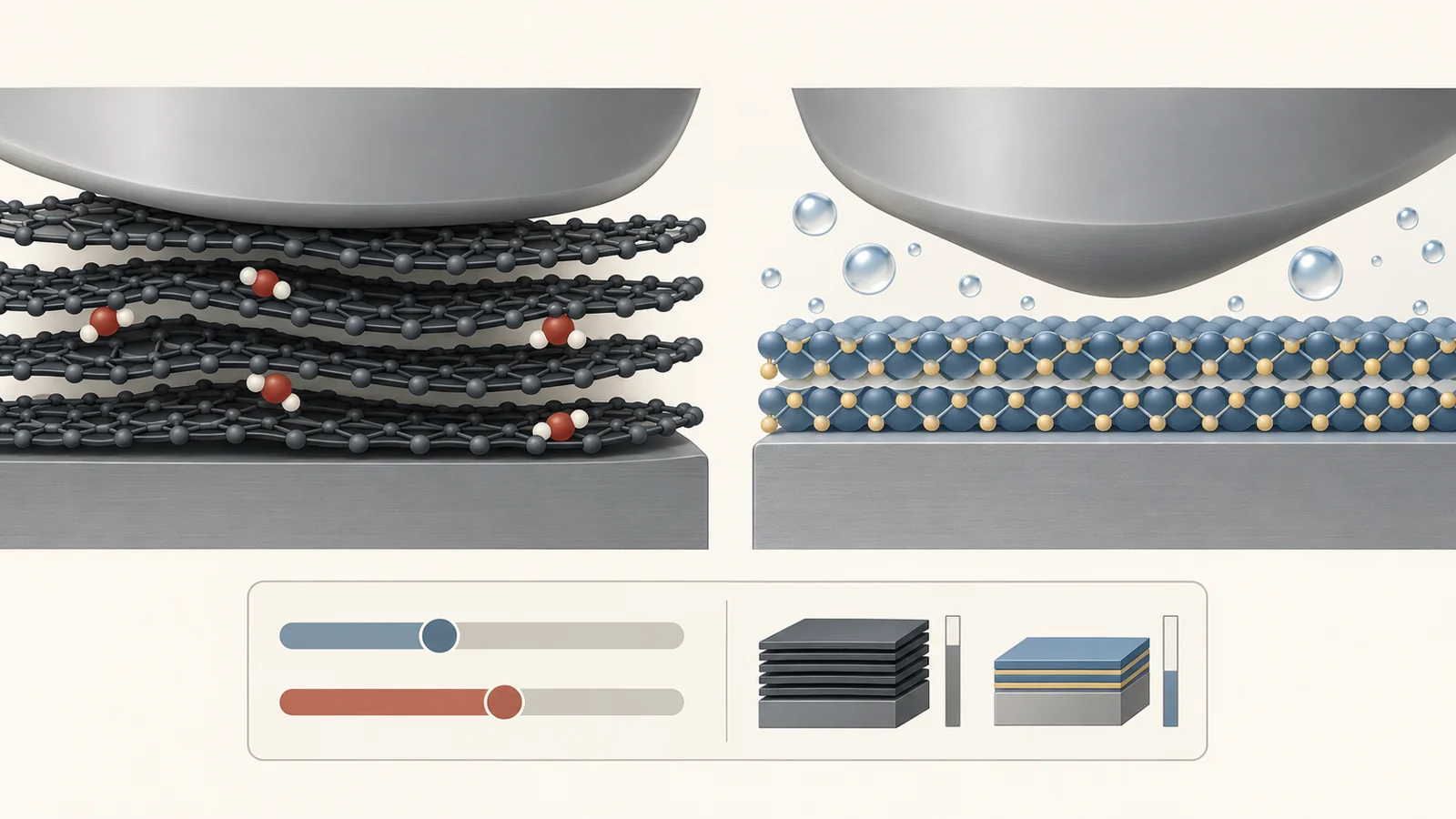
Graphite consists of stacked layers. In the review’s account, humidity can weaken interactions between those layers, helping them slip past one another. The paper describes water-related ions at the layers as contributing to this weakening. This helps explain why graphite has long been used as a solid lubricant or as an additive where the air is humid.
Molybdenum disulfide is also layered, but the review summarizes studies in which water adsorbed on its surface raised friction at room temperature. Those conditions also restricted the buildup of a thin lubricant layer on the opposing sliding surface. The review notes that oxygen and higher temperatures add further effects: oxidation can raise friction, but the resulting oxide layer may wear away and expose underlying unoxidized material. The balance depends on the film and its environment.
These findings describe different materials and reported conditions, not a controlled head-to-head contest across all operating environments. The practical point is that “layered” does not mean “responds to humidity in the same way.” A coating suited to a dry setting may perform poorly in humid air, while graphite’s advantage in humid conditions does not make it universally reliable.
Low friction can come with a short service life
Wear is physical damage to a film as surfaces slide. The review describes plastic deformation and fracture as routes to wear. A film that deforms without cracking may hold up better during sliding; a brittle film can crack and shed debris that adds to wear. As a surface becomes rougher, friction may also rise.
This is why a strikingly low friction measurement cannot stand in for durability. The review discusses a reported graphene and diamond-like carbon contact with a friction coefficient of about 0.004, associated with tiny graphene layers forming nanoscale rolls during sliding. It is an example of very low resistance in a particular contact arrangement. It does not establish how a coating would hold up across a full machine, with different loads, surroundings and service life.
Engineers can tune the film as well as the material
A lubricant’s behavior depends partly on how it is made and arranged. In studies of molybdenum disulfide and related films, researchers changed how coatings were deposited, which way their layers faced and what other materials they contained. Aligning the broad faces of the layers with the coated surface can leave their more reactive edges less exposed. Adding other materials or stacking different films can alter the coating’s structure and its behavior in humidity or heat.
One cited study examined sputtered multilayers combining molybdenum disulfide with other materials. A film whose two-layer pattern repeated every 20 nanometers showed better mechanical and friction-and-wear results than pure molybdenum disulfide in that study. The review attributes the improvement to the multilayer structure and notes that the structure changed as the bilayer period decreased. The result illustrates how layer spacing can matter; it is not a general performance guarantee for every coating or machine.
Composites offer another route. The review describes dispersing solid lubricants within metal, ceramic or polymer matrices. A harder material around the lubricant may help a coating last longer; processes such as powder metallurgy and sintering allow researchers to control the amount and distribution of lubricant within it. The design has to balance the lubricant’s contribution to easy sliding with the matrix’s role in supporting the film.
From small contacts to working machinery
Results from atomic-scale simulations, microscope contacts and laboratory films answer different questions from tests of complete equipment. Contact geometry, film design and surrounding conditions vary across the studies collected in the review. Even a coating that performs well in one experiment may face a different combination of loads, heat, oxygen or moisture in service.
The review is a synthesis of earlier theoretical and experimental work, rather than a new universal comparison of candidates. Its examples help explain what engineers can adjust, but they do not show that solid films can broadly replace liquid lubricants. The review identifies shorter wear life and the difficulty of recoating as continuing challenges. Those practical constraints matter alongside the friction measured in a test.
Where better solid coatings could keep machines moving
More durable solid films could help space hardware and demanding industrial machinery operate in conditions where liquid lubricants are inadequate. That benefit depends on coatings retaining low sliding resistance while resisting wear and remaining maintainable under real operating conditions. The review’s material and manufacturing examples point to possible ways to improve that balance, while leaving machine-wide performance to be established for each application.
Key Sources
- Primary source: Tribological Properties of 2D Materials and Composites-A Review of Recent Advances.
DOI or Journal Page · Review or Meta-Analysis · 2021-03-26
Keep exploring