
Research Signal – Source date 2021-02-22
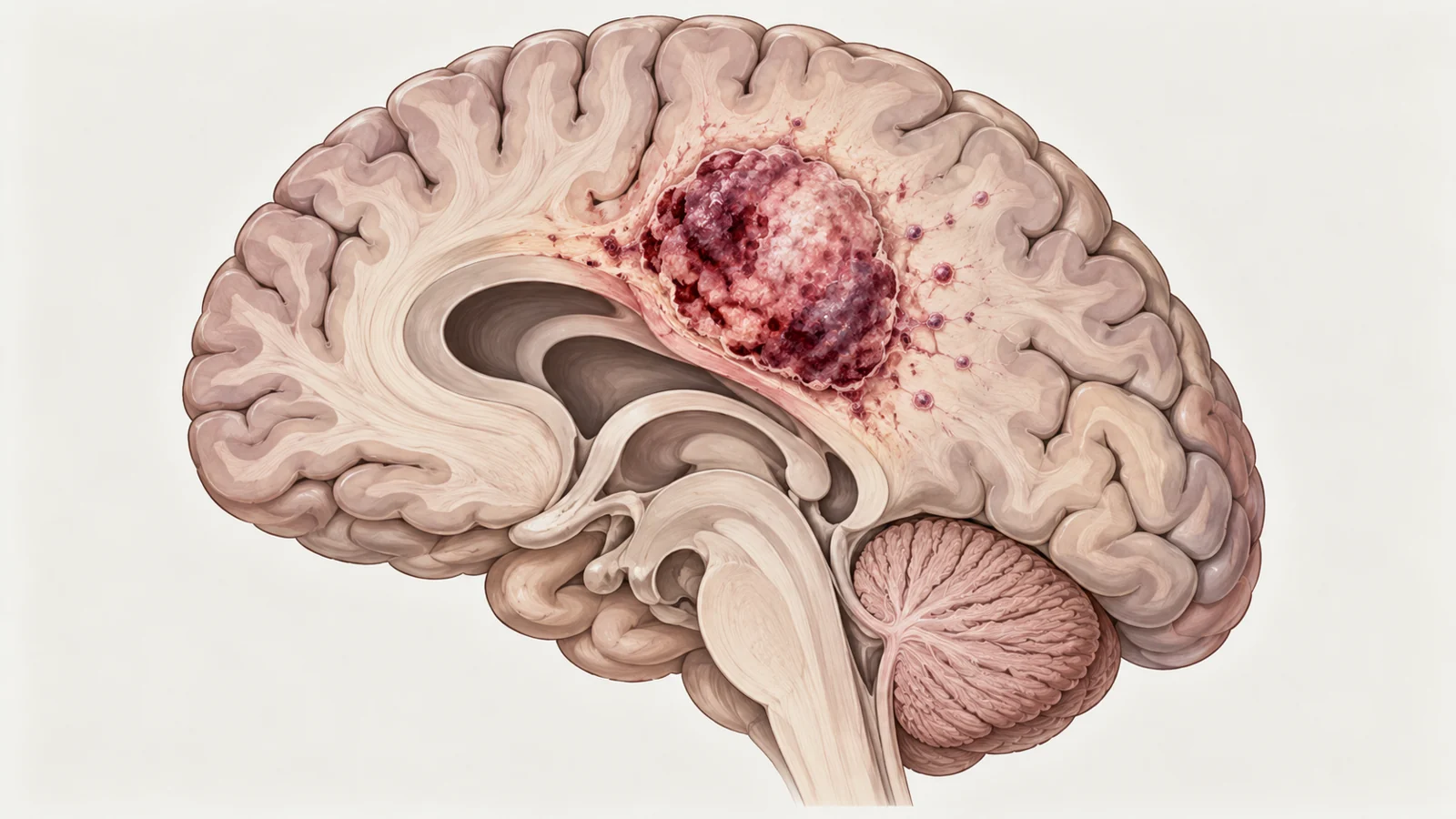
High-grade gliomas are aggressive tumors that arise in the brain. Glioblastoma is a particularly aggressive example. Surgery, radiation and chemotherapy can extend survival, yet the tumor may return. One reason is that treatment has to contend with two problems at once: tumor cells can reach beyond the visible mass, and the cells within a tumor do not all share the same features.
A 2021 review, Challenges and Perspectives of Standard Therapy and Drug Development in High-Grade Gliomas, surveys these limits and a range of proposed approaches. Its examples come from different kinds of research, including clinical trials and laboratory and animal studies. The review makes a case for combining approaches and tailoring choices to tumor biology, but it does not test one personalized combination as a single treatment strategy.
Standard treatment can extend survival, but it cannot remove every risk
For newly diagnosed glioblastoma, the review describes surgery followed by radiation with temozolomide, a chemotherapy drug, and then additional temozolomide. In the treatment study it cites, patients receiving radiation with daily temozolomide followed by six cycles of the drug had a median overall survival of 14.6 months, compared with 12.1 months in the control group. Median survival is the point at which half the people in a group have died and half are still alive; the difference shows a meaningful gain in that study, not a cure for every patient.
Surgery can reduce the tumor’s bulk, ease pressure inside the skull and provide tissue for diagnosis. But the surgeon must balance removing as much tumor as possible against avoiding injury to healthy brain tissue. The review describes a goal of removing up to 90% when feasible without causing neurological deficits. Even a substantial operation can leave tumor cells behind because glioblastoma cells can infiltrate surrounding tissue rather than remain neatly within a removable lump. Removing more tissue to chase those cells can itself cause serious harm.
That physical limit helps explain why recurrence can follow an apparently extensive operation. Radiation and chemotherapy then act on what remains, but they face a further challenge: surviving cells may differ in ways that affect how well treatment works.
Repair and variation can weaken a targeted attack
Temozolomide damages tumor-cell DNA. The review describes MGMT, a gene involved in DNA repair, as one factor that can blunt this drug’s effect. When the MGMT promoter is unmethylated, the gene can remain active and produce more of the repair protein, a pattern associated with temozolomide resistance. Promoter methylation can reduce MGMT expression, and the review reports that the treatment advantage is greatest in about half of patients whose tumors have this feature.
MGMT is only part of the explanation. The review estimates that it accounts for 8–10% of temozolomide resistance in glioblastoma and discusses other contributors as well. A single molecular marker therefore cannot explain every tumor’s response. The cells in one tumor may also vary in their genetic features, including whether they carry a particular treatment target.
A vaccine trial illustrates why a specific target can be promising without benefiting a broad group of patients. The vaccine rindopepimut was designed to target EGFRvIII, a variant found in only a portion of glioblastomas. In the ACT IV trial in newly diagnosed patients, adding the vaccine to temozolomide did not show a survival benefit. The review notes that a tumor can also lose the targeted variant as it evolves. A treatment aimed at one feature may therefore miss cells that lack it or no longer express it.
More treatments bring questions of timing and dose
The review proposes combining standard care with approaches such as immunotherapy, repurposed drugs and precision medicine. But adding a treatment does not automatically improve the whole regimen. The review warns that side effects of chemotherapy and radiation may hinder immunotherapy when the treatments are combined, so timing matters.
Dose presents another practical constraint for repurposed drugs. The review cites experimental work in which hydroxychloroquine, considered as an addition to glioblastoma treatment, was effective at about 20 micromolar, compared with an acceptable dose near 5 micromolar. A concentration that produces an effect in experiments may be too high for safe use in people. The review also describes a sequential temozolomide, hydroxychloroquine and AT101 approach that had greater effects on tumor growth and less toxicity to normal astrocytes than temozolomide alone in the reported experiments. That result offers a rationale to investigate sequence and dose; it does not settle what would be safe or effective in patients.
Better delivery is not yet a better outcome
Nanocarriers, including liposomes, are being studied as ways to transport drugs toward tumor tissue. The aim is to improve delivery while limiting exposure elsewhere. The review discusses early clinical development of liposome-based drugs, as well as the difficulty of getting treatments through the blood–brain barrier, the protective boundary between blood and brain. A delivery method that reaches or remains in tumor tissue still has to show that it helps patients.
In one phase II study described by the review, postoperative glioblastoma patients who had undergone chemoradiation received temozolomide combined with pegylated liposomal doxorubicin. The combination did not show a statistically significant benefit in overall survival or six-month progression-free survival. This clinical result cautions against treating improved transport as proof of improved outcomes: the drug, delivery method and tumor’s varied biology all matter.
Profiling could help match treatment to a tumor
The review proposes collecting samples from multiple parts of a tumor, including enhancing and non-enhancing regions, and profiling their genetic features. Researchers could then use those results to identify candidate drugs for the alterations found, while samples and blood measurements might support future work on less invasive biomarkers.
This is a proposed way to make treatment selection more responsive to tumor variation. A marker can also inform prognosis: the review, for example, describes molecular combinations associated with more favorable or poorer prognoses. Knowing that a patient’s tumor has a feature linked to prognosis is not the same as showing that a drug chosen because of that feature improves survival. The profiling approach and its treatment choices would need to demonstrate patient benefit on their own terms.
What tailored glioma treatment could change
If sampling across tumor regions can identify important differences, and if treatments matched to those differences prove safe and effective, clinicians could have a better chance of addressing more of the cells that survive initial therapy. That could make treatment more individually suited to a tumor while helping avoid unnecessary treatment intensity for some patients. The review presents this as a direction for research, not as an established result: no single combination it discusses has been shown here to cure high-grade glioma or reliably prevent recurrence.
Key Sources
- Primary source: Challenges and Perspectives of Standard Therapy and Drug Development in High-Grade Gliomas.
DOI or Journal Page · Review or Meta-Analysis · 2021-02-22
Keep exploring