
Research Signal – Source date 2022-04-29
A cancer-fighting T-cell treatment can call for hundreds of millions of altered immune cells—or, in one example, about a hundred billion. That difference changes the equipment, labor and handling a manufacturing process must accommodate. It also helps explain why a simple culture bag remained useful even as automated systems became available.
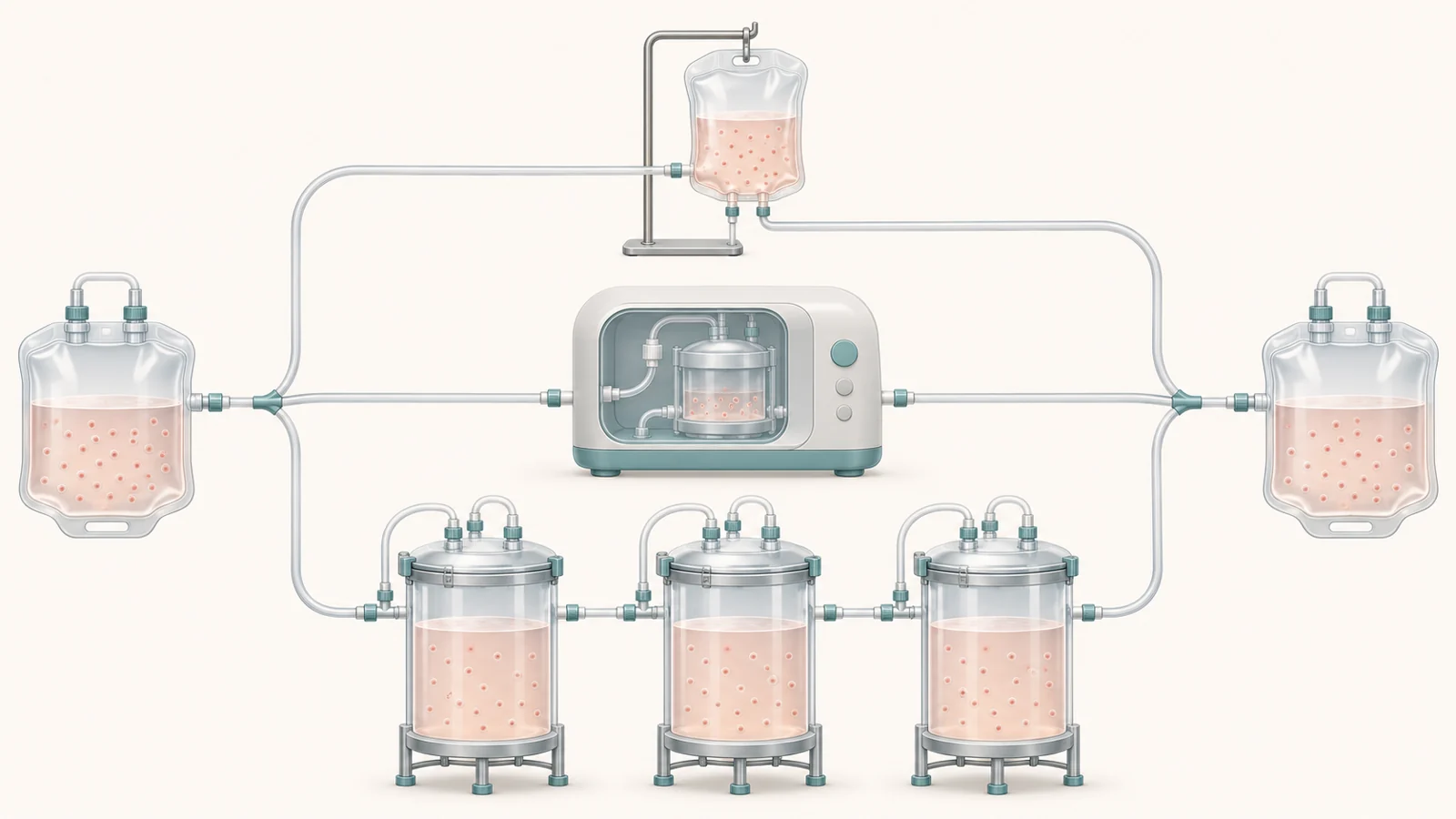
Engineered T cells are immune cells altered to recognize cancer. In a 2022 account of manufacturing work at the NIH Clinical Center, researchers describe three processes used in early-stage (phase I) trials: CD30 CAR-T cells for lymphoma, CD19/CD22 bispecific CAR-T cells for blood cancers, and E7 TCR T cells for HPV-related cancers. Each case illustrates a different production challenge. Together, they show why making these personalized treatments at scale requires choices about both how many cells one patient needs and how reliably the process can be repeated for many patients.
Each patient’s cells go through a production process
For an autologous treatment, a patient’s own cells are used to make that patient’s product. A manufacturing process therefore has to be run again for each person, while the target dose can vary sharply between therapies. Scaling out means repeating production across patients; scaling up means making a larger quantity in a production run. Both demands matter, but they are not the same problem.
The basic steps give the equipment examples their context. A starting cell population is collected and may be purified to select T cells. The cells are then genetically engineered—through a process such as introducing genetic material—so they can recognize a target. They are grown in culture until there are enough for the intended dose, then harvested, washed and prepared for use. How each step is done affects the labor, equipment and amount of culture that must be handled.
A simple bag produced trial products, with hands-on work
Culture bags offered a relatively simple, closed way to grow the CD30 CAR-T cells. In this process, the team began with a mixed population of blood cells and used a soluble antibody to activate T cells. Because there were no selection beads to remove later, this approach avoided a separate, labor-intensive de-beading step.
The process produced 25 patient products. One had to be made again after a tubing-set leak. By harvest, 24 of the 25 products had at least 80% T cells, despite substantial variation in the proportion of T cells in the starting material. The case shows that a straightforward setup could yield trial products, while also revealing a practical limitation: as cultures grew, technicians needed more time-consuming handling. Manual steps can add complexity and make repeatability harder.
Automation brought more consistency, with a capacity ceiling
The CD19/CD22 CAR-T process used an automated CliniMACS Prodigy system. It handled several stages in an enclosed unit, including T-cell selection, genetic engineering, expansion and harvest, with less hands-on technician time. The study team reported successful manufacturing for all 24 patients in this case. Most runs were harvested on day seven; one was harvested on day nine.
The final cell measures were more consistent than in the separate CD30 bag process. The authors also described a tradeoff: the Prodigy’s culture chamber had a ceiling of about 2.2 billion cells at harvest on day seven, while the bag process sometimes produced more than 3 billion over the same period. These were different therapies and protocols, so the figures are not a controlled comparison of platforms. They do make the practical point that consistency and maximum output are separate considerations when choosing a process.
A hundred billion cells creates a larger harvest task
The E7 TCR-T case required a much larger dose: the target for the highest dose group was 100 billion engineered cells. The team used G-Rex bioreactors for expansion. Of 18 patients in that group, 16 reached the target. Two products fell just short, at 96.4 billion and 97.2 billion cells; both were still infused.
Growing that many cells was only part of the work. The large cultures had to be collected from multiple vessels, combined where needed and washed. The paper describes a harvest involving up to 40 liters of culture handled in several stages. This example separates two challenges that can be easy to conflate: providing enough room and time for cells to expand, and processing the resulting volume into a final product.
Manufacturing output is not the same as patient benefit
These cases help teams think through process choices such as starting-cell selection, culture capacity, hands-on labor and harvest logistics. They do not rank the platforms by clinical effectiveness. Each involved a different therapy, protocol and dose, rather than a matched test of alternative manufacturing systems. Cell counts, purity and successful production runs describe manufacturing results; on their own, they do not show that a process caused better patient responses or establish overall cost.
The authors also point to a further challenge: manufacturing features that matter for treatment may differ by clinical setting. For example, researchers need more evidence about which properties of an infused T-cell product are associated with better responses before processes can be deliberately optimized around them. Making the target number of cells is essential, but it is not by itself proof that the product will work better.
Where this research could lead
If suitable processes can be validated across more manufacturing centers, eligible patients could have more places where their own engineered T cells can be made. At one center, the three examples show how simple bags, integrated automated equipment and large expansion vessels address different production demands. Closed and automated steps already existed in 2022. The further task would be transferring suitable processes reliably across more settings, doses and therapies—a goal that also depends on quality validation, production capacity and clinical development.
A useful nearer milestone would be multi-site manufacturing runs across more than one therapy that meet predefined cell-dose and product-quality targets, with unsuccessful runs reported alongside successful ones. That would show whether a process travels reliably between centers. It would be progress toward wider access, not evidence that such access has already been achieved.
Key Sources
- Primary source: Scaling up and scaling out: Advances and challenges in manufacturing engineered T cell therapies.
DOI or Journal Page · Clinical Trial · 2022-04-29
Keep exploring